Related Research Articles
In phonology,minimal pairs are pairs of words or phrases in a particular language,spoken or signed,that differ in only one phonological element,such as a phoneme,toneme or chroneme,and have distinct meanings. They are used to demonstrate that two phones represent two separate phonemes in the language.
In phonetics and linguistics,a phone is any distinct speech sound or gesture,regardless of whether the exact sound is critical to the meanings of words.

Phonology is the branch of linguistics that studies how languages or dialects systematically organize their phones or,for sign languages,their constituent parts of signs. The term can also refer specifically to the sound or sign system of a particular language variety. At one time,the study of phonology related only to the study of the systems of phonemes in spoken languages,but may now relate to any linguistic analysis either:
Speech disorders or speech impairments are a type of communication disorder in which normal speech is disrupted. This can mean fluency disorders like stuttering,cluttering or lisps. Someone who is unable to speak due to a speech disorder is considered mute. Speech skills are vital to social relationships and learning,and delays or disorders that relate to developing these skills can impact individuals function. For many children and adolescents,this can present as issues with academics. Speech disorders affect roughly 11.5% of the US population,and 5% of the primary school population. Speech is a complex process that requires precise timing,nerve and muscle control,and as a result is susceptible to impairments. A person who has a stroke,an accident or birth defect may have speech and language problems.
In phonetics,a trill is a consonantal sound produced by vibrations between the active articulator and passive articulator. Standard Spanish ⟨rr⟩ as in perro,for example,is an alveolar trill.
In phonetics,denasalization is the loss of nasal airflow in a nasal sound,such as a nasal consonant or a nasal vowel. That may be due to speech pathology but also occurs when the sinuses are blocked from a common cold,when it is called a nasal voice,which is not a linguistic term. Acoustically,it is the "absence of the expected nasal resonance." The symbol in the Extended IPA is ⟨◌͊⟩.
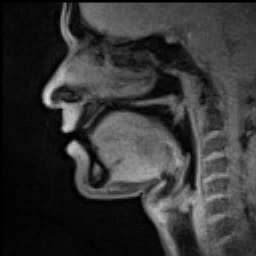
Speech is a human vocal communication using language. Each language uses phonetic combinations of vowel and consonant sounds that form the sound of its words,and using those words in their semantic character as words in the lexicon of a language according to the syntactic constraints that govern lexical words' function in a sentence. In speaking,speakers perform many different intentional speech acts,e.g.,informing,declaring,asking,persuading,directing,and can use enunciation,intonation,degrees of loudness,tempo,and other non-representational or paralinguistic aspects of vocalization to convey meaning. In their speech,speakers also unintentionally communicate many aspects of their social position such as sex,age,place of origin,physical states,psychological states,physico-psychological states,education or experience,and the like.
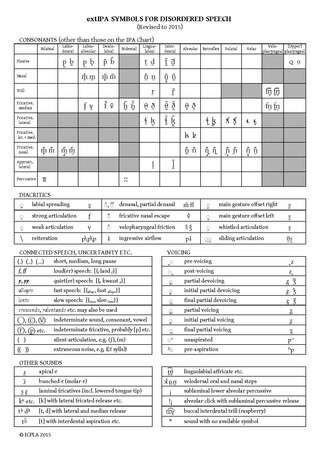
The Extensions to the International Phonetic Alphabet for Disordered Speech,commonly abbreviated extIPA,are a set of letters and diacritics devised by the International Clinical Phonetics and Linguistics Association to augment the International Phonetic Alphabet for the phonetic transcription of disordered speech. Some of the symbols are used for transcribing features of normal speech in IPA transcription,and are accepted as such by the International Phonetic Association.

Speech-language pathology is a field of healthcare expertise practiced globally. Speech-language pathology (SLP) specializes in the evaluation,diagnosis,treatment,and prevention of communication disorders,cognitive-communication disorders,voice disorders,pragmatic disorders,social communication difficulties and swallowing disorder across the lifespan. It is an independent profession considered an "allied health profession" or allied health profession by professional bodies like the American Speech-Language-Hearing Association (ASHA) and Speech Pathology Australia. Allied health professions include audiology,optometry,occupational therapy,rehabilitation psychology,physical therapy and others.
Clinical linguistics is a sub-discipline of applied linguistics involved in the description,analysis,and treatment of language disabilities,especially the application of linguistic theory to the field of Speech-Language Pathology. The study of the linguistic aspect of communication disorders is of relevance to a broader understanding of language and linguistic theory.
Electropalatography (EPG) is a technique used to monitor contacts between the tongue and hard palate,particularly during articulation and speech.

Martin J. Ball FRCSLT FRSA FLSW is Honorary Professor in Linguistics at Bangor University in Wales. Until August 2017 he was Professor of Speech-Language Pathology at Linköping University in Sweden. He holds dual UK-US citizenship. As of June 2019 he lives in Cork,Ireland.
A speech sound disorder (SSD) is a speech disorder in which some sounds (phonemes) are not produced or used correctly. The term "protracted phonological development" is sometimes preferred when describing children's speech,to emphasize the continuing development while acknowledging the delay.
Debbie Sell,OBE,FRCSLT is a leading British speech and language therapist.

A velopharyngeal fricative,also known as a posterior nasal fricative,is a sound produced by some children with speech disorders,including some with a cleft palate,as a substitute for sibilants,which cannot be produced with a cleft palate. It results from "the approximation but inadequate closure of the upper border of the velum and the posterior pharyngeal wall." To produce a velopharyngeal fricative,the soft palate approaches the pharyngeal wall and narrows the velopharyngeal port,such that the restricted port creates fricative turbulence in air forced through it into the nasal cavity. The articulation may be aided by a posterior positioning of the tongue and may involve velar flutter.

Peter John Roach is a British retired phonetician. He taught at the Universities of Leeds and Reading,and is best known for his work on the pronunciation of British English.
Jane Setter is a British phonetician. She teaches at the University of Reading,where she is Professor of Phonetics. She is best known for work on the pronunciation of British and Hong Kong English,and on speech prosody in atypical populations.
Ultrasound tongue imaging (UTI) has been used for speech production and linguistics research since it came into regular clinical use in the 1960s and 1970s. It is a non-invasive technique allowing researchers to view the shape,position and movements of the tongue (from root to apex) in real time during speech.
John Henry Esling,is a Canadian linguist specializing in phonetics. He is a Professor Emeritus of Linguistics at the University of Victoria,where he taught from 1981 to 2014. Esling was president of the International Phonetic Association from 2011 to 2015 and a co-editor of the 1999 Handbook of the International Phonetic Association.

The voiceless upper-pharyngeal plosive or stop is a rare consonant.
References
- 1 2 "Professor Sara Howard". University of Sheffield. Retrieved 12 October 2018.
- ↑ "Connected speech and word juncture in typical and atypical speech development". ESRC. Retrieved 12 October 2018.
- ↑ "RCSLT Honours Roll Call". Royal College of Speech and Language Therapists. Retrieved 12 October 2018.
- ↑ "About the ICPLA". ICPLA. Retrieved 12 October 2018.
| International | |
|---|---|
| National | |
| Other | |
