
Mechelen is a city and municipality in the province of Antwerp in the Flemish Region of Belgium. The municipality comprises the city of Mechelen proper, some quarters at its outskirts, the hamlets of Nekkerspoel (adjacent) and Battel, as well as the villages of Walem, Heffen, Leest, Hombeek, and Muizen. The river Dyle (Dijle) flows through the city, hence it is often referred to as the Dijlestad.
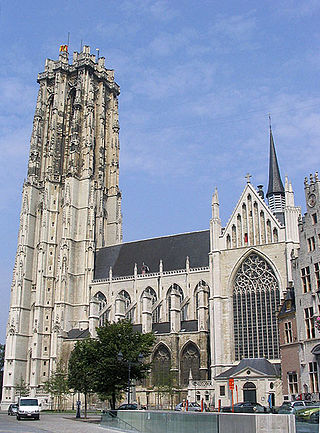
St. Rumbold's Cathedral is the Roman Catholic metropolitan archiepiscopal cathedral in Mechelen, Belgium, dedicated to Saint Rumbold, Christian missionary and martyr who founded an abbey nearby. His remains are rumoured to be buried inside the cathedral. State-of-the-art examination of the relics honoured as Saint Rumbold's and kept in a shrine in the retro-choir, showed a life span of about 40 years and a death date between 580 and 655, while tradition had claimed 775 AD.

Lier is a municipality located in the Belgian province of Antwerp, arguably on the outskirts of Antwerp. It is composed of the city of Lier proper and the village of Koningshooikt. The city centre is surrounded by the river Nete, around which it grew. In 2018, Lier had a total population of 35,712. The total area is 49.70 km2 making a population density (PD) of 720 per km2. Lier is known for its beers, its patron saint St. Gummarus and Lierse vlaaikes cake. It is also home to the world headquarters of Van Hool, a global bus and coach manufacturer. Lier's two principal football clubs are K. Lyra-Lierse and Lierse Kempenzonen.
Keldermans is a family of artists, originating from Mechelen. The members of the family were mostly architects working in the Brabantine Gothic style. As the most important architects of their time in the Netherlands, they defined the Brabantine Gothic style, and their works can still be seen today in cities like Mechelen, Brussels, Antwerp, Ghent, Lier, Middelburg and Gouda. Anthonis II and Rombout II were court architects for Charles V. Laurens II, last in the line, was influenced by Renaissance architecture and marked the end of the Gothic period in this region. The Keldermans family became known for the design and construction of the large tower of St Rumbold's Cathedral in Mechelen. Jan II qualifies most as the designer, the architect and the most important master builder. However, he would not see the start of the works himself and the first stone was therefore laid under the supervision of his son Andries. Other members of the Keldermans family who successively directed the works are Anthonis I, Anthonis II, Rombout II and Laurens II.

The Royal Carillon School "Jef Denyn" is a music school in Mechelen, Belgium, that specializes in the carillon. It is the first and largest carillon school in the world. The Belgian government defines it as an "International Higher Institute for the Carillon Arts under the High Protection of Her Majesty Queen Fabiola". The school has trained many of the foremost carillonneurs of the twentieth and twenty-first centuries and houses a rich archive and library.
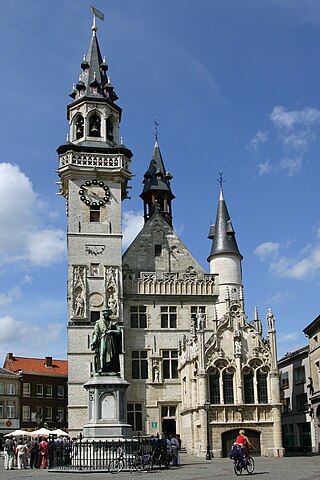
The Schepenhuis of Aalst, East Flanders, Belgium, is a former city hall, one of the oldest in the Low Countries. Dating originally from 1225, it was partially rebuilt twice as a result of fire damage, first after a 1380 war and again after a fireworks accident in 1879.
Wouter Vrancken is a Belgian football manager and a former defensive midfielder. He is the head coach of Genk.
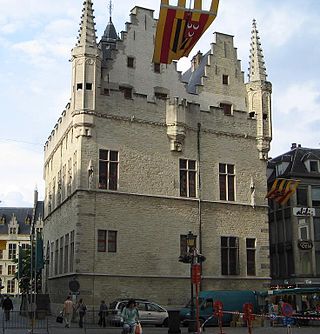
From the 15th century onwards, the Great Council of the Netherlands at Mechelen was the highest court in the Burgundian Netherlands. It was responsible for the Dutch-, French- and German-speaking areas. In Luxembourgish the phrase "mir ginn op Mechelen" still means playing one's last trump card. The Grote Raad first sat in the Schepenhuis in Mechelen then, from 1616, in the (old) palace of Margaretha of Austria on Keizerstraat.

The Hof van Savoye or Palace of Margaret of Austria is an early 16th-century building in Mechelen, Belgium. It was one of the first Renaissance buildings in Northern Europe.
Brabantine Gothic, occasionally called Brabantian Gothic, is a significant variant of Gothic architecture that is typical for the Low Countries. It surfaced in the first half of the 14th century at St. Rumbold's Cathedral in the city of Mechelen.
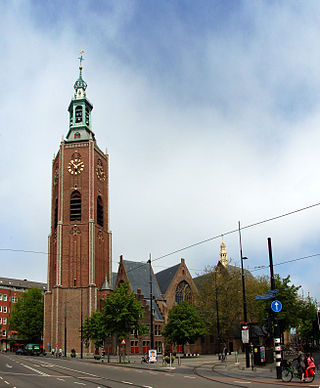
The Great Church or St. James' Church is a landmark Protestant church in The Hague, Netherlands. The building is located on the Torenstraat, named for its high tower. Together with the Binnenhof, it is one of the oldest buildings in The Hague. Members of the House of Orange-Nassau have been baptised and married there. The latest are King Willem-Alexander of the Netherlands and his daughter and heir apparent Catharina-Amalia, Princess of Orange.
Jean d'Oisy (1310–1377) was the architect of several ecclesiastical buildings in Brabantine Gothic style. He was one of the earliest introducers of northern French Gothic style into the Low Countries and a teacher of the reputed Brabantian architect Jacob van Thienen.
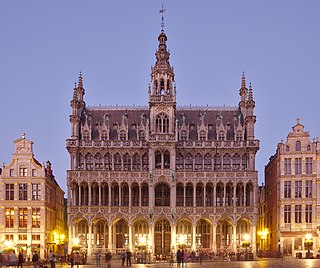
The Brussels City Museum is a municipal museum on the Grand-Place/Grote Markt of Brussels, Belgium. Conceived in 1860 and inaugurated in 1887, it is dedicated to the history and folklore of the City of Brussels from its foundation into modern times, which it presents through paintings, sculptures, tapestries, engravings, photos and models, including a notable scale-representation of the town during the Middle Ages.
Jan van Lokeren was a Flemish sculptor and woodcarver mostly active in Mechelen.
Jan van Mansdale, also Jan I Keldermans was a Brussels sculptor. He is considered the ancestor of the Keldermans family from Mechelen, which produced many master builders and sculptors.

Ghent City Hall is a four-sided complex in Ghent, East Flanders, Belgium, surrounded by the Botermarkt, the Hoogpoort, the Stadhuissteeg and the Poeljemarkt. The main wings are the late-Gothic alderman's house of De Keure and the alderman's house of Gedele in the Renaissance style. The building has 51 halls.
Frans Van Dijk was a Belgian architect. He was an important representative of eclecticism in architecture.

The Grote Markt is the central square of Aalst, East Flanders, Belgium. The Aldermen's House, the Town Hall, the Beurs van Amsterdam, Herberg Graaf van Egmont and the Belfry/Schepenhuis are located there.


