Related Research Articles
A lucid dream is a type of dream in which the dreamer becomes aware that they are dreaming while dreaming. During a lucid dream, the dreamer may gain some amount of control over the dream characters, narrative, or environment. Lucid dreaming has been studied and reported for many years. Prominent figures from ancient to modern times have been fascinated by lucid dreams and have sought ways to better understand their causes and purpose.

Sleep is a state of reduced mental and physical activity in which consciousness is altered and sensory activity is inhibited to a certain extent. During sleep, there is a decrease in muscle activity, and interactions with the surrounding environment. While sleep differs from wakefulness in terms of the ability to react to stimuli, it still involves active brain patterns, making it more reactive than a coma or disorders of consciousness.
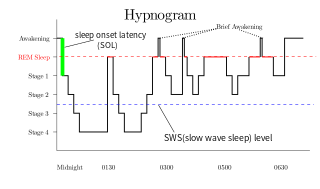
Rapid eye movement sleep is a unique phase of sleep in humans, mammals and birds, characterized by random rapid movement of the eyes, accompanied by low muscle tone throughout the body, and the propensity of the sleeper to dream vividly.
Physiological psychology is a subdivision of behavioral neuroscience that studies the neural mechanisms of perception and behavior through direct manipulation of the brains of nonhuman animal subjects in controlled experiments. This field of psychology takes an empirical and practical approach when studying the brain and human behavior. Most scientists in this field believe that the mind is a phenomenon that stems from the nervous system. By studying and gaining knowledge about the mechanisms of the nervous system, physiological psychologists can uncover many truths about human behavior. Unlike other subdivisions within biological psychology, the main focus of psychological research is the development of theories that describe brain-behavior relationships.

The sleep cycle is an oscillation between the slow-wave and REM (paradoxical) phases of sleep. It is sometimes called the ultradian sleep cycle, sleep–dream cycle, or REM-NREM cycle, to distinguish it from the circadian alternation between sleep and wakefulness. In humans, this cycle takes 70 to 110 minutes.

Oneirology is the scientific study of dreams. Current research seeks correlations between dreaming and current knowledge about the functions of the brain, as well as understanding of how the brain works during dreaming as pertains to memory formation and mental disorders. The study of oneirology can be distinguished from dream interpretation in that the aim is to quantitatively study the process of dreams instead of analyzing the meaning behind them.

The reticular formation is a set of interconnected nuclei that are located throughout the brainstem. It is not anatomically well defined, because it includes neurons located in different parts of the brain. The neurons of the reticular formation make up a complex set of networks in the core of the brainstem that extend from the upper part of the midbrain to the lower part of the medulla oblongata. The reticular formation includes ascending pathways to the cortex in the ascending reticular activating system (ARAS) and descending pathways to the spinal cord via the reticulospinal tracts.
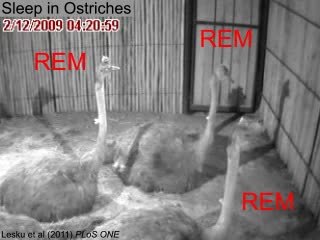
Slow-wave sleep (SWS), often referred to as deep sleep, consists of stage three of non-rapid eye movement sleep. It usually lasts between 70 and 90 minutes and takes place during the first hours of the night. Initially, SWS consisted of both Stage 3, which has 20–50 percent delta wave activity, and Stage 4, which has more than 50 percent delta wave activity.

Unihemispheric slow-wave sleep (USWS) is sleep where one half of the brain rests while the other half remains alert. This is in contrast to normal sleep where both eyes are shut and both halves of the brain show unconsciousness. In USWS, also known as asymmetric slow-wave sleep, one half of the brain is in deep sleep, a form of non-rapid eye movement sleep and the eye corresponding to this half is closed while the other eye remains open. When examined by low-voltage electroencephalography (EEG), the characteristic slow-wave sleep tracings are seen from one side while the other side shows a characteristic tracing of wakefulness. The phenomenon has been observed in a number of terrestrial, aquatic and avian species.
Parasomnias are a category of sleep disorders that involve abnormal movements, behaviors, emotions, perceptions, and dreams that occur while falling asleep, sleeping, between sleep stages, or during arousal from sleep. Parasomnias are dissociated sleep states which are partial arousals during the transitions between wakefulness, NREM sleep, and REM sleep, and their combinations.
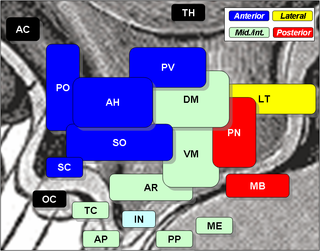
The lateral hypothalamus (LH), also called the lateral hypothalamic area (LHA), contains the primary orexinergic nucleus within the hypothalamus that widely projects throughout the nervous system; this system of neurons mediates an array of cognitive and physical processes, such as promoting feeding behavior and arousal, reducing pain perception, and regulating body temperature, digestive functions, and blood pressure, among many others. Clinically significant disorders that involve dysfunctions of the orexinergic projection system include narcolepsy, motility disorders or functional gastrointestinal disorders involving visceral hypersensitivity, and eating disorders.

Norepinephrine (NE), also called noradrenaline (NA) or noradrenalin, is an organic chemical in the catecholamine family that functions in the brain and body as both a hormone and neurotransmitter. The name "noradrenaline" is more commonly used in the United Kingdom, whereas "norepinephrine" is usually preferred in the United States. "Norepinephrine" is also the international nonproprietary name given to the drug. Regardless of which name is used for the substance itself, parts of the body that produce or are affected by it are referred to as noradrenergic.

Sleep in animals refers to a behavioral and physiological state characterized by altered consciousness, reduced responsiveness to external stimuli, and homeostatic regulation observed in various animals. Sleep has been observed in mammals, birds, reptiles, amphibians, and some fish, and, in some form, in insects and even in simpler animals such as nematodes. The internal circadian clock promotes sleep at night for diurnal organisms and in the day for nocturnal organisms. Sleep patterns vary widely among species. It appears to be a requirement for all mammals and most other animals.

A sleep study is a test that records the activity of the body during sleep. There are five main types of sleep studies that use different methods to test for different sleep characteristics and disorders. These include simple sleep studies, polysomnography, multiple sleep latency tests (MSLTs), maintenance of wakefulness tests (MWTs), and home sleep tests (HSTs). In medicine, sleep studies have been useful in identifying and ruling out various sleep disorders. Sleep studies have also been valuable to psychology, in which they have provided insight into brain activity and the other physiological factors of both sleep disorders and normal sleep. This has allowed further research to be done on the relationship between sleep and behavioral and psychological factors.

Narcolepsy is a chronic neurological disorder that involves a decreased ability to regulate sleep–wake cycles. Symptoms often include periods of excessive daytime sleepiness and brief involuntary sleep episodes. About 70% of those affected also experience episodes of sudden loss of muscle strength, known as cataplexy. Narcolepsy paired with cataplexy is evidenced to be an autoimmune disorder. These experiences of cataplexy can be brought on by strong emotions. Less commonly, there may be vivid hallucinations or an inability to move while falling asleep or waking up. People with narcolepsy tend to sleep about the same number of hours per day as people without, but the quality of sleep tends to be lessened.
Scientific studies have found that different brain areas show altered activity in humans with major depressive disorder (MDD), and this has encouraged advocates of various theories that seek to identify a biochemical origin of the disease, as opposed to theories that emphasize psychological or situational causes. Factors spanning these causative groups include nutritional deficiencies in magnesium, vitamin D, and tryptophan with situational origin but biological impact. Several theories concerning the biologically based cause of depression have been suggested over the years, including theories revolving around monoamine neurotransmitters, neuroplasticity, neurogenesis, inflammation and the circadian rhythm. Physical illnesses, including hypothyroidism and mitochondrial disease, can also trigger depressive symptoms.
It has been estimated that over 20% of adults suffer from some form of sleep deprivation. Insomnia and sleep deprivation are common symptoms of depression, and can be an indication of other mental disorders. The consequences of not getting enough sleep could have dire results; not only to the health, cognition, energy level and the mood of the individual, but also to those around them as sleep deprivation increases the risk of human-error related accidents, especially with vigilance-based tasks involving technology.

The neuroscience of sleep is the study of the neuroscientific and physiological basis of the nature of sleep and its functions. Traditionally, sleep has been studied as part of psychology and medicine. The study of sleep from a neuroscience perspective grew to prominence with advances in technology and the proliferation of neuroscience research from the second half of the twentieth century.

Emotions play a key role in overall mental health, and sleep plays a crucial role in maintaining the optimal homeostasis of emotional functioning. Deficient sleep, both in the form of sleep deprivation and restriction, adversely impacts emotion generation, emotion regulation, and emotional expression.
Caetextia is a term and concept first coined by psychologists Joe Griffin and Ivan Tyrrell to describe a chronic disorder that manifests as a context blindness in people on the autism spectrum. It was specifically used to designate the most dominant manifestation of autistic behaviour in higher-functioning individuals. Griffin and Tyrell also suggested that caetextia "is a more accurate and descriptive term for this inability to see how one variable influences another, particularly at the higher end of the spectrum, than the label of 'Asperger's syndrome'".
References
- ↑ "VADIM ROTENBERG. ARTICLES IN ENGLISH". rjews.net. Archived from the original on 2002-07-15.
http://www.vsrotenberg.rjews.com/articles.html
- Rotenberg V.S., Arshavsky V.V. Search activity and its impact on experimental and clinical pathology. Activitas Nervosa Superior (Praha), 1979, 21: 105–115.
- Rotenberg V.S., Arshavsky V.V. REM sleep, stress and search activity. Waking and Sleeping, 1979, 3: 235–244.
- Rotenberg V.S. Search activity in the context of psychosomatic disturbances, of brain monoamines and REM sleep function. Pavlovian J. Biolog. Sci. 1984, 19: 1–15.
- Rotenberg V.S. REM sleep and dreams as mechanism of search activity recovery. In: Moffitt A., Kramer M., Hoffmann R., editors. Functions of dreaming, New York: State University of New York Press, 1993: 261–292.
- Rotenberg V.S. Sleep after immobilization stress and sleep deprivation: Common features and theoretical integration. Critical Reviews in Neurobiology, 2000, 14: 225–231.
- Rotenberg V.S. An integrative psychophysiological approach to brain hemisphere functions in schizophrenia. Neuroscience and Biobehavioral Reviews, 1994, 18; 487–495.
- Rotenberg V.S., Kutsay S., Venger A. Behavioural attitudes and the level of distress in the process of adaptation to the new society. Stress and Health, 2001, 17: 187–193.
- Rotenberg V.S. Anorexia nervosa: Old contradictions and a new theoretical approach. International Journal of Psychiatry in Clinical Practice, 2000, 4: 89–92.
- Rotenberg V.S. REM sleep function and brain monoamine regulation: An application of the Search Activity Concept. In M. Lader, D.P.Cardinali, S.R. Pandi-Perumal, editors, Sleep and Sleep Disorders, Springer, New York, 2006: 27–35.
- Rotenberg V.S. Sleep and Memory: The influence of different sleep stages on memory. Neuroscience Biobehavior. Rev. 1992, 16: 497–502.
- Rotenberg V.S. The psychophysiology of REM sleep in relation to mechanisms of psychiatric disorders. In: A.Z. Golbin, H. M. Kravitz, L.G.Keith, editors. Sleep Psychiatry, Taylor & Francis, London & New York, 2004, 35–64.
- Rotenberg V.S. Search activity concept: Relationship between behavior, health and brain functions. Activitas Nervosa Superior, 2009, 51: 12–44. https://www.presentica.com/doc/11232907/search-activity-concept-relationship-between-pdf-document