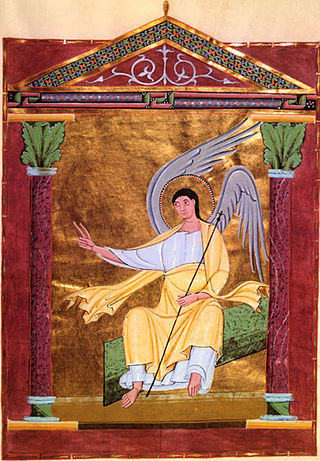
Last updated Full page miniature depicting the dream of Joseph
The Seeon Evangeliary or Evangeliary of Henry II (German: Evangelistar aus Seeon, Seeoner Evangelistar or Evangelistar Heinrichs II) is an evangeliary created at Seeon Abbey between 1002 and 1014. Today it is kept in the Bamberg State Library under the record number Msc. Bibl. 95)
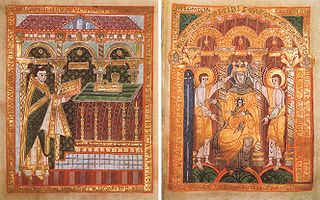
In the two page dedication miniature (fol. 7v–8r), King Henry brings a book with a bejeweled cover to donate to the theotokosMary. She stands in for Bamberg Cathedral. As in the Seeon Pontifical, in the rites celebrating the Kermesse the name of Mary is highlighted through the use of capital letters along with the patrons of the cathedral: Saint Peter and George. The two pages are identical in composition, in the manner of a diptych. Arches supported by columns form a well structured frame, enclosed by purple background flecked with gold. Figures of equal size seem to float with the archway on a gold ground, which is a stylistic feature typical of Ottonian illumination. Only the nimbus of Mary indicates her primacy over Henry. The two figures are labelled in capital letters: HEINRICVS REX PIVS ("devout King Henry") and S[an]C[t]A MARIA ΘEOTOCOS (Holy Mary, mother of God), using the Greek letter theta to represent the th of theotokos.
The silk cover is unusual: cloth was frequently part of sumptuous book bindings, but was rarely used on its own. In this case a flexible sheet of parchment was covered with samite in two shades of red. The individual fields of the pattern are alternately decorated with pairs of birds and busts. The binding was most probably made towards the end of the tenth century in an imperial Byzantine workshop in Constantinople.
Gude Suckale Redlefsen dates the evangeliary before 1012 because the manuscript was certainly intended for the high altar of the east choir of Bamberg cathedral, which was consecrated to Mary on the 6 May 1012, along with the main cathedral altar. The reference to Henry as "rex" (king) indicates that the book was produced before Henry's coronation as Holy Roman Emperor in 1014.
In the register of the Bamberg cathedral treasury of 1736 the Evangeliary is named among seven "Antiquities" which were distinguished for their extraordinarily rich bindings but were nevertheless kept in the cathedral library rather than the cathedral treasury.
Gude Suckale-Redlefsen. Prachtvolle Bücher. in Josef Kirmeier, Bernd Schneidmüller, Stefan Weinfurter, Evamaria Brockhoff (ed.): Kaiser Heinrich II. 1002–1024. Catalogue of the Bayerische Landesausstellung 2002, Bamberg, 9 July to 20 October 2002 (= Veröffentlichungen zur bayerischen Geschichte und Kultur. Vol. 44). Haus der Bayerischen Geschichte, Augsburg 2002, ISBN978-3-927233-82-9, pp.273–274.
Gude Suckale-Redlefsen. Die Handschriften des 8. bis 11. Jahrhunderts der Staatsbibliothek Bamberg (= Katalog der illuminierten Handschriften der Staatsbibliothek Bamberg. Vol. 1). Harrassowitz, Wiesbaden 2004, ISBN978-3-447-05117-0, pp.108–111 (Digitised version).
Werner Taegert. Schatz für die Ewigkeit – Buchstiftungen Kaiser Heinrichs II. für seinen Dom. in Norbert Jung, Wolfgang F. Reddig: Dem Himmel entgegen. 1000 Jahre Kaiserdom Bamberg 1012–2012. Katalog der Sonderausstellung (= Veröffentlichungen des Diözesanmuseums Bamberg. Bd. 22). Michael Imhof Verlag, Petersberg 2012, ISBN978-3-86568-754-8, pp.100–101 (with further bibliography).
Bamberg is a town in Upper Franconia district in Bavaria, Germany, on the river Regnitz close to its confluence with the river Main. Bamberg had 79,000 inhabitants in 2022. The town dates back to the 9th century, when its name was derived from the nearby Babenberch castle. Cited as one of Germany's most beautiful towns, with medieval streets and buildings, the old town of Bamberg with around 2,400 timber houses has been a UNESCO World Heritage Site since 1993.
Pope Benedict VIII was bishop of Rome and ruler of the Papal States from 18 May 1012 until his death. He was born Theophylact to the noble family of the counts of Tusculum. Unusually for a medieval pope, he had strong authority both in Rome and abroad.
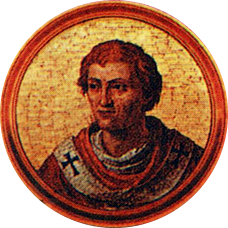
Pope Clement II was head of the Catholic Church and ruler of the Papal States from 25 December 1046 until his death in 1047. He was the first in a series of reform-minded popes from Germany. Suidger was the bishop of Bamberg. In 1046, he accompanied King Henry III of Germany, when at the request of laity and clergy of Rome, Henry went to Italy and summoned the Council of Sutri, which deposed Benedict IX and Sylvester III, and accepted the resignation of Gregory VI. Henry suggested Suidger as the next pope, and he was then elected, taking the name of Clement II. Clement then proceeded to crown Henry as emperor. Clement's brief tenure as pope saw the enactment of more stringent prohibitions against simony.
The Pericopes of Henry II is a luxurious medieval illuminated manuscript made for Henry II, the last Ottonian Holy Roman Emperor, made c. 1002–1012 AD. The manuscript, which is lavishly illuminated, is a product of the Liuthar circle of illuminators, who were working in the Benedictine Abbey of Reichenau, which housed a scriptorium and artists' workshop that has a claim to having been the largest and artistically most influential in Europe during the late 10th and early 11th centuries. An unrivalled series of liturgical manuscripts was produced at Reichenau under the highest patronage of Ottonian society.
Cunigunde of Luxembourg, OSB, also called Cunegundes, Cunegunda, and Cunegonda and, in Latin, Cunegundis or Kinigundis, was Empress of the Holy Roman Empire by marriage to Holy Roman Emperor Henry II. She ruled as interim regent after the death of her spouse in 1024. She is a saint and the patroness of Luxembourg; her feast day is 3 March.
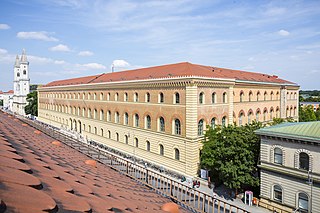
The Bavarian State Library in Munich is the central "Landesbibliothek", i. e. the state library of the Free State of Bavaria, the biggest universal and research library in Germany and one of Europe's most important universal libraries. With its collections currently comprising around 10.89 million books, it ranks among the leading research libraries worldwide. The Bayerische Staatsbibliothek furthermore is Europe's second-largest journals library. Furthermore, its historical holdings encompass one of the most important manuscript collections of the world, the largest collection of incunabula worldwide, as well as numerous further important special collections. Its collection of historical prints before 1850 totals almost one million units.
Ottonian art is a style in pre-romanesque German art, covering also some works from the Low Countries, northern Italy and eastern France. It was named by the art historian Hubert Janitschek after the Ottonian dynasty which ruled Germany and Northern Italy between 919 and 1024 under the kings Henry I, Otto I, Otto II, Otto III and Henry II. With Ottonian architecture, it is a key component of the Ottonian Renaissance. However, the style neither began nor ended to neatly coincide with the rule of the dynasty. It emerged some decades into their rule and persisted past the Ottonian emperors into the reigns of the early Salian dynasty, which lacks an artistic "style label" of its own. In the traditional scheme of art history, Ottonian art follows Carolingian art and precedes Romanesque art, though the transitions at both ends of the period are gradual rather than sudden. Like the former and unlike the latter, it was very largely a style restricted to a few of the small cities of the period, and important monasteries, as well as the court circles of the emperor and his leading vassals.
Seeon Abbey is a former Benedictine monastery in the municipality of Seeon-Seebruck in the rural district of Traunstein in Bavaria, Germany.
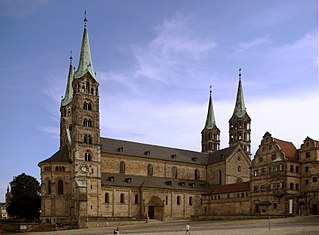
Bamberg Cathedral is a church in Bamberg, Germany, completed in the 13th century. The cathedral is under the administration of the Archdiocese of Bamberg and is the seat of the its archbishop. Since 1993, the cathedral has been part of the UNESCO World Heritage Site "Town of Bamberg".
The Evangeliary or Book of the Gospels is a liturgical book containing only those portions of the four gospels which are read during Mass or in other public offices of the Church. The corresponding terms in Latin are Evangeliarium and Liber evangeliorum.
The Prince-Bishopric of Bamberg was an ecclesiastical State of the Holy Roman Empire. It goes back to the Roman Catholic Diocese of Bamberg established at the 1007 synod in Frankfurt, at the behest of King Henry II to further expand the spread of Christianity in the Franconian lands. The bishops obtained the status of Imperial immediacy about 1245 and ruled their estates as Prince-bishops until they were subsumed to the Electorate of Bavaria in the course of the German Mediatisation in 1802.
Maurice was an Egyptian military leader who headed the legendary Theban Legion of Rome in the 3rd century, and is one of the favourite and most widely venerated saints of that martyred group. He is the patron saint of several professions, locales, and kingdoms.
Quedlinburg Abbey was a house of secular canonesses (Frauenstift) in Quedlinburg in what is now Saxony-Anhalt, Germany. It was founded in 936 on the initiative of Saint Mathilda, the widow of the East Frankish King Henry the Fowler, as his memorial. For many centuries it and its abbesses enjoyed great prestige and influence. Quedlinburg Abbey was an Imperial Estate and one of the approximately forty self-ruling Imperial Abbeys of the Holy Roman Empire. It was disestablished in 1802/3. The church, known as Stiftskirche St Servatius, is now used by the Lutheran Evangelical Church in Germany.
Michaelsberg Abbey or Michelsberg Abbey, also St. Michael's Abbey, Bamberg is a former Benedictine monastery in Bamberg in Bavaria, Germany. After its dissolution in 1803 the buildings were used for the almshouse Vereinigtes Katharinen- und Elisabethen-Spital, which is still there as a retirement home. The former abbey church remains in use as the Michaelskirche.
Henry II, also known as Saint Henry, Obl. S. B., was Holy Roman Emperor from 1014. He died without an heir in 1024, and was the last ruler of the Ottonian line. As Duke of Bavaria, appointed in 995, Henry became King of the Romans following the sudden death of his second cousin, Emperor Otto III in 1002, was made King of Italy in 1004, and crowned emperor by Pope Benedict VIII in 1014.
Hartwig was the archbishop of Salzburg from 991 until his death. He was a younger son of the Bavarian count palatine Hartwig of the Aribonid family. The Gesta archiepiscoporum Salisburgensium calls him a "friend of divine praise".
The Aachen Gospels are a Carolingian illuminated manuscript which was created at the beginning of the ninth century by a member of the Ada School. The Evangeliary belongs to a manuscript group which is referred to as the Ada Group or Group of the Vienna Coronation Gospels. It is part of the church treasury of Charlemagne's Palatine Chapel, now Aachen Cathedral, and is today kept in the Aachen Cathedral Treasury. The Treasury Gospels and the more recent Ottonian Liuthar Gospels are the two most significant medieval manuscripts on display there.
The Rich Bernward Gospels are a richly decorated evangeliary in the Hildesheim Cathedral Museum. It was a donation of Bernward, Bishop of Hildesheim, to his foundation St. Michael's, specifically for the altar to Mary in the crypt below the west choir, which was consecrated in 1015 and which he had designated as his tomb.
The Sacramentary of Henry II, also called the Regensburg Sacramentary, is a manuscript of liturgical texts, which was created in Regensburg at the order of Emperor Henry II. It is among the most significant works of Ottonian illumination. The manuscript was gifted to Bamberg Cathedral by Henry II, was part of the Cathedral treasury until 1803 when it became part of the Bavarian State Library as a result of Secularisation. It remains there today, stored under the inventory number clm 4456. It is modelled on the Codex Aureus of St. Emmeram donated by Charles the Bald in 870.
The Emperor's Bible, also known as Codex Caesareus, Codex Caesareus Upsaliensis or the Goslar Gospels, is an 11th-century illuminated manuscript currently in Uppsala University Library, Sweden. Despite its name, it is not a Bible but a Gospel Book. The book was made in the scriptorium of Echternach Abbey, and is one of four preserved large Gospel Books made there during the 11th century. It was commissioned by Emperor Henry III and donated by him to Goslar Cathedral, where it remained until the Thirty Years' War. It was then lost for about 100 years. Its previous richly decorated cover was also lost at this time at the latest. The book later appeared again in the possession of Swedish diplomat and civil servant Gustaf Celsing the Elder. At the death of his son, it was acquired by Uppsala University.
This page is based on this Wikipedia article Text is available under the CC BY-SA 4.0 license; additional terms may apply. Images, videos and audio are available under their respective licenses.