Related Research Articles

The performing arts are arts such as music, dance, and drama which are performed for an audience. They are different from the visual arts, which involve the use of paint, canvas or various materials to create physical or static art objects. Performing arts include a range of disciplines which are performed in front of a live audience, including theatre, music, and dance.
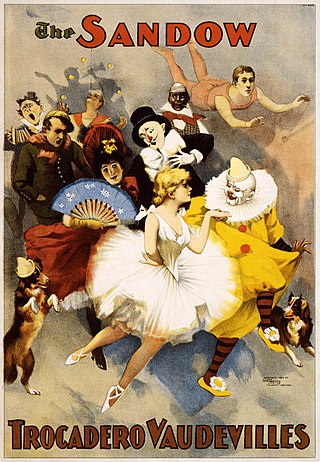
Vaudeville is a theatrical genre of variety entertainment which began in France at the end of the 19th century. A Vaudeville was originally a comedy without psychological or moral intentions, based on a comical situation: a dramatic composition or light poetry, interspersed with songs and dances. It became popular in the United States and Canada from the early 1880s until the early 1930s, while changing over time.
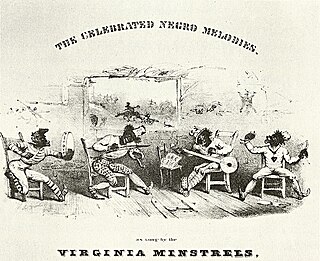
The minstrel show, also called minstrelsy, was an American form of theater developed in the early 19th century. The shows were performed by mostly white actors wearing blackface makeup for the purpose of comically portraying racial stereotypes of African Americans. There were also some African-American performers and black-only minstrel groups that formed and toured. Minstrel shows stereotyped blacks as dimwitted, lazy, buffoonish, cowardly, superstitious, and happy-go-lucky. Each show consisted of comic skits, variety acts, dancing, and music performances that depicted people specifically of African descent.

Noh is a major form of classical Japanese dance-drama that has been performed since the 14th century. It is the oldest major theater art that is still regularly performed today. Noh is often based on tales from traditional literature featuring a supernatural being transformed into a human hero who narrates the story. Noh integrates masks, costumes and various props in a dance-based performance, requiring highly trained actors and musicians. Emotions are primarily conveyed by stylized conventional gestures while the iconic masks represent specific roles such as ghosts, women, deities, and demons. Having a strong emphasis on tradition rather than innovation, Noh is highly codified and regulated by the iemoto system.
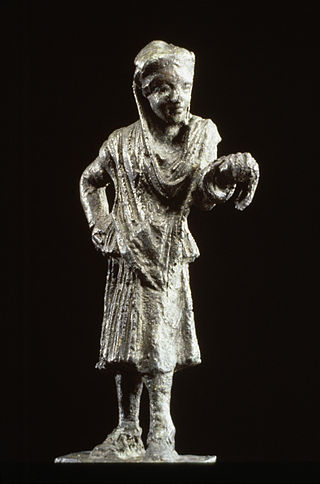
A theatrical culture flourished in ancient Greece from 700 BC. At its centre was the city-state of Athens, which became a significant cultural, political, and religious place during this period, and the theatre was institutionalised there as part of a festival called the Dionysia, which honoured the god Dionysus. Tragedy, comedy, and the satyr play were the three dramatic genres emerged there. Athens exported the festival to its numerous colonies. Modern Western theatre comes, in large measure, from the theatre of ancient Greece, from which it borrows technical terminology, classification into genres, and many of its themes, stock characters, and plot elements.

Peking opera, or Beijing opera, is the most dominant form of Chinese opera, which combines instrumental music, vocal performance, mime, martial arts, dance and acrobatics. It arose in Beijing in the mid-Qing dynasty (1644–1912) and became fully developed and recognized by the mid-19th century. The form was extremely popular in the Qing court and has come to be regarded as one of the cultural treasures of China. Major performance troupes are based in Beijing, Tianjin and Shanghai. The art form is also preserved in Taiwan, where it is also known as Guójù. It has also spread to other regions such as the United States and Japan.

Experimental theatre, inspired largely by Wagner's concept of Gesamtkunstwerk, began in Western theatre in the late 19th century with Alfred Jarry and his Ubu plays as a rejection of both the age in particular and, in general, the dominant ways of writing and producing plays. The term has shifted over time as the mainstream theatre world has adopted many forms that were once considered radical.

Street theatre is a form of theatrical performance and presentation in outdoor public spaces without a specific paying audience. These spaces can be anywhere, including shopping centres, car parks, recreational reserves, college or university campus and street corners. They are especially seen in outdoor spaces where there are large numbers of people. The actors who perform street theatre range from buskers to organised theatre companies or groups that want to experiment with performance spaces, or to promote their mainstream work. It was a source of providing information to people when there were no sources of providing information like television, radio etc. Nowadays, street play is used to convey a message to the crowd watching it. Street play is considered to be the rawest form of acting, because one does not have a microphone or loud speakers.

Yiddish theatre consists of plays written and performed primarily by Jews in Yiddish, the language of the Ashkenazi Jewish community. The range of Yiddish theatre is broad: operetta, musical comedy, and satiric or nostalgic revues; melodrama; naturalist drama; expressionist and modernist plays. At its height, its geographical scope was comparably broad: from the late 19th century until just before World War II, professional Yiddish theatre could be found throughout the heavily Jewish areas of Eastern and East Central Europe, but also in Berlin, London, Paris, Buenos Aires and New York City.
Jacques Lecoq was a French stage actor and acting movement coach. He was best known for his teaching methods in physical theatre, movement, and mime which he taught at the school he founded in Paris known as École internationale de théâtre Jacques Lecoq. He taught there from 1956 until his death from a cerebral hemorrhage in 1999.
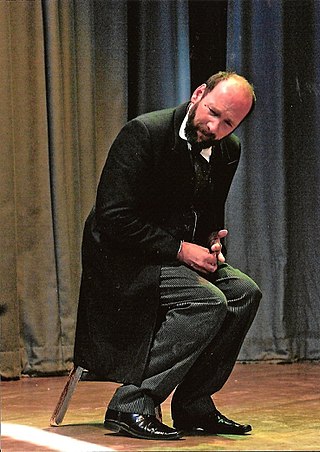
A solo performance, sometimes referred to as a one-man show, one-woman show, or one-person show, features a single person telling a story for an audience, typically for the purpose of entertainment. This type of performance comes in many varieties, including autobiographical creations, comedy acts, novel adaptations, vaudeville, poetry, music and dance. In 1996, Rob Becker's Defending the Caveman became the longest-running one-person play in the history of Broadway theatre.

Winifred Emms, best known by her stage name Hetty King, was an English entertainer who performed in the music halls as a male impersonator over some 70 years.
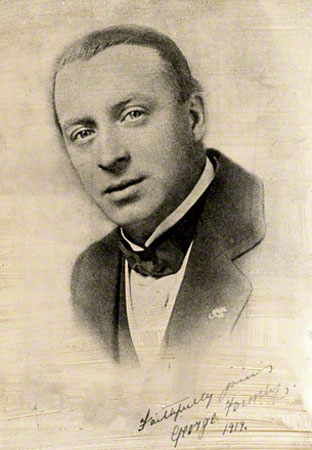
George Formby was an English comedian and singer in musical theatre, known as one of the greatest music hall performers of the early 20th century. His comedy played upon Lancashire stereotypes, and he was popular around Britain. His nickname, "The Wigan Nightingale", was coined because of the way he would use his bronchial cough as a comedic device in his act.

George Walker was an American vaudevillian, actor, and producer. In 1893, in San Francisco, Walker at the age of 20 met Bert Williams, who was a year younger. The two young men became performing partners. Walker and Williams appeared in The Gold Bug (1895), Clorindy (1898), The Policy Player (1899), Sons of Ham (1900), In Dahomey (1903), Abyssinia (1906), and Bandanna Land (1907). Walker married dancer Ada Overton, who later also was a choreographer.
The term guest appearance generally denotes the appearance of a guest in an artistic or pop-culture setting.

Cross-gender acting, also called cross-gender casting or cross-casting, is when actors or actresses portray a character of the opposite sex. It is distinct from both transgender and cross-dressing character roles.
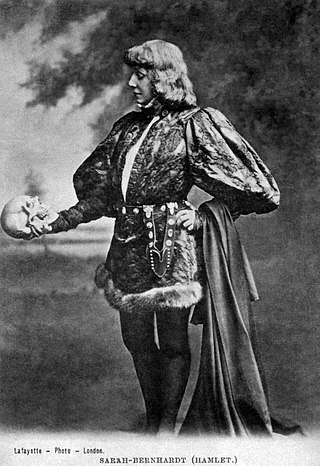
Theatre or theater is a collaborative form of performing art that uses live performers, usually actors or actresses, to present experiences of a real or imagined event before a live audience in a specific place, often a stage. The performers may communicate this experience to the audience through combinations of gesture, speech, song, music, and dance. It is the oldest form of drama, though live theatre has now been joined by modern recorded forms. Elements of art, such as painted scenery and stagecraft such as lighting are used to enhance the physicality, presence and immediacy of the experience. Places, normally buildings, where performances regularly take place are also called "theatres", as derived from the Ancient Greek θέατρον, itself from θεάομαι.

An actor or actress is a person who portrays a character in a production. The actor performs "in the flesh" in the traditional medium of the theatre or in modern media such as film, radio, and television. The analogous Greek term is ὑποκριτής (hupokritḗs), literally "one who answers". The actor's interpretation of a role—the art of acting—pertains to the role played, whether based on a real person or fictional character. This can also be considered an "actor's role", which was called this due to scrolls being used in the theaters. Interpretation occurs even when the actor is "playing themselves", as in some forms of experimental performance art.
Tent shows have been an important part of American history since the mid-to-late nineteenth century. In 1927, Don Carle Gillette gave "statistical evidence that the tented drama constituted 'a more extensive business than Broadway and all the rest of the legitimate theatre industry put together.'" The shows first began "in regions which couldn’t support full-time playhouses." Men such as Fayette Lodowick, one of the earliest tent show entrepreneurs, would travel around river towns all over the United States making money on traveling tent shows. These shows "were utilized for a variety of amusements including medicine shows, moving picture shows, vaudeville shows, circuses, musicals, concert companies, and any number of one-night stand dramatic troupes."

Brighton Open Air Theatre, also known as B•O•A•T, is a British theatre built in Dyke Road Park, Brighton, which opened on 9 May 2015. It has been paid for not by corporate funding or public grants, but by private donations. The theatre is the legacy of the Brighton showman and construction manager, Adrian Bunting, who died of pancreatic cancer, aged 47, in May 2013.
References
- ↑ Vorenberg Bonnie L. (1999), "Senior Theatre Connections", Portland OR, USA, ArtAge Publications
- 1 2 3 "Aging Well Magazine - Curtain Call — Senior Theater's Dramatic Growth". www.todaysgeriatricmedicine.com. Retrieved 2025-01-13.
 | This theatre-related article is a stub. You can help Wikipedia by expanding it. |