In software testing, test automation is the use of software separate from the software being tested to control the execution of tests and the comparison of actual outcomes with predicted outcomes. Test automation can automate some repetitive but necessary tasks in a formalized testing process already in place, or perform additional testing that would be difficult to do manually. Test automation is critical for continuous delivery and continuous testing.
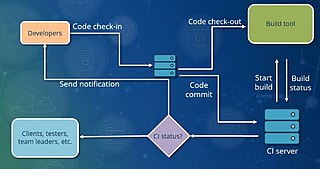
In software engineering, continuous integration (CI) is the practice of merging all developers' working copies to a shared mainline several times a day. Nowadays it is typically implemented in such a way that it triggers an automated build with testing. Grady Booch first proposed the term CI in his 1991 method, although he did not advocate integrating several times a day. Extreme programming (XP) adopted the concept of CI and did advocate integrating more than once per day – perhaps as many as tens of times per day.
Release engineering, frequently abbreviated as RE or as the clipped compound Releng, is a sub-discipline in software engineering concerned with the compilation, assembly, and delivery of source code into finished products or other software components. Associated with the software release life cycle, it was said by Boris Debic of Google Inc. that release engineering is to software engineering as manufacturing is to an industrial process:
Release engineering is the difference between manufacturing software in small teams or startups and manufacturing software in an industrial way that is repeatable, gives predictable results, and scales well. These industrial style practices not only contribute to the growth of a company but also are key factors in enabling growth.

In a computer system or network, a runbook is a compilation of routine procedures and operations that the system administrator or operator carries out. System administrators in IT departments and NOCs use runbooks as a reference.
A federal enterprise architecture framework (FEAF) is the U.S. reference enterprise architecture of a federal government. It provides a common approach for the integration of strategic, business and technology management as part of organization design and performance improvement.
Build automation is the process of automating the creation of a software build and the associated processes including: compiling computer source code into binary code, packaging binary code, and running automated tests.
OpenSAF is an open-source service-orchestration system for automating computer application deployment, scaling, and management. OpenSAF is consistent with, and expands upon, Service Availability Forum (SAF) and SCOPE Alliance standards.
Data-driven testing (DDT), also known as table-driven testing or parameterized testing, is a software testing methodology that is used in the testing of computer software to describe testing done using a table of conditions directly as test inputs and verifiable outputs as well as the process where test environment settings and control are not hard-coded. In the simplest form the tester supplies the inputs from a row in the table and expects the outputs which occur in the same row. The table typically contains values which correspond to boundary or partition input spaces. In the control methodology, test configuration is "read" from a database.
There is considerable variety among software testing writers and consultants about what constitutes responsible software testing. Proponents of a context-driven approach consider much of the writing about software testing to be doctrine, while others believe this contradicts the IEEE 829 documentation standard.
Business process management (BPM) is the discipline in which people use various methods to discover, model, analyze, measure, improve, optimize, and automate business processes. Any combination of methods used to manage a company's business processes is BPM. Processes can be structured and repeatable or unstructured and variable. Though not required, enabling technologies are often used with BPM.
Release management is the process of managing, planning, scheduling and controlling a software build through different stages and environments; it includes testing and deploying software releases.
DevOps is a methodology in the software development and IT industry. Used as a set of practices and tools, DevOps integrates and automates the work of software development (Dev) and IT operations (Ops) as a means for improving and shortening the systems development life cycle.
Lean integration is a management system that emphasizes creating value for customers, continuous improvement, and eliminating waste as a sustainable data integration and system integration practice. Lean integration has parallels with other lean disciplines such as lean manufacturing, lean IT, and lean software development. It is a specialized collection of tools and techniques that address the unique challenges associated with seamlessly combining information and processes from systems that were independently developed, are based on incompatible data models, and remain independently managed, to achieve a cohesive holistic operation.
Risk IT Framework, published in 2009 by ISACA, provides an end-to-end, comprehensive view of all risks related to the use of information technology (IT) and a similarly thorough treatment of risk management, from the tone and culture at the top to operational issues. It is the result of a work group composed of industry experts and academics from different nations, from organizations such as Ernst & Young, IBM, PricewaterhouseCoopers, Risk Management Insight, Swiss Life, and KPMG.
Continuous testing is the process of executing automated tests as part of the software delivery pipeline to obtain immediate feedback on the business risks associated with a software release candidate. Continuous testing was originally proposed as a way of reducing waiting time for feedback to developers by introducing development environment-triggered tests as well as more traditional developer/tester-triggered tests.
Continuous delivery (CD) is a software engineering approach in which teams produce software in short cycles, ensuring that the software can be reliably released at any time and, following a pipeline through a "production-like environment", without doing so manually. It aims at building, testing, and releasing software with greater speed and frequency. The approach helps reduce the cost, time, and risk of delivering changes by allowing for more incremental updates to applications in production. A straightforward and repeatable deployment process is important for continuous delivery.
Healthcare CRM, also known as Healthcare Relationship Management, is a broadly used term for a Customer relationship management system, or CRM, used in healthcare.
Marketing automation refers to software platforms and technologies designed for marketing departments and organizations to more effectively market on multiple channels online and automate repetitive tasks.
Infrastructure as code (IaC) is the process of managing and provisioning computer data centers through machine-readable definition files, rather than physical hardware configuration or interactive configuration tools. The IT infrastructure managed by this process comprises both physical equipment, such as bare-metal servers, as well as virtual machines, and associated configuration resources. The definitions may be in a version control system. The code in the definition files may use either scripts or declarative definitions, rather than maintaining the code through manual processes, but IaC more often employs declarative approaches.
Autonomous pharmacy is an approach to medication management that seeks to create a more automated and data-driven process for medication inventory and dispensing. The main concept behind autonomous pharmacy is to use technology in place of manual medication processes in order to help healthcare providers reduce medication errors, decrease costs and save staff time. Autonomous pharmacy may use a combination of hardware, software and technology-enabled services to allow pharmacists to more effectively manage medication dispersal.
