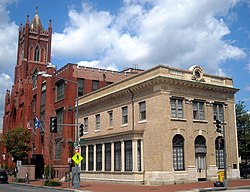
48 Wall Street, formerly the Bank of New York & Trust Company Building, is a 32-story, 512-foot-tall (156 m) skyscraper on the corner of Wall Street and William Street in the Financial District of Lower Manhattan in New York City. Built in 1927–1929 in the Neo-Georgian and Colonial Revival styles, it was designed by Benjamin Wistar Morris.

The Sugar Hill Historic District is a historic district in Detroit, Michigan. It contains 14 structures located along three streets: East Forest, Garfield, and East Canfield, between Woodward Avenue on the west and John R. on the east. The district was listed on the National Register of Historic Places in 2003.
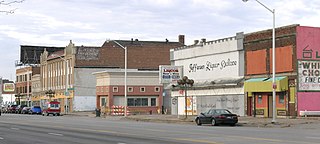
The Jefferson–Chalmers Historic Business District is a neighborhood located on East Jefferson Avenue between Eastlawn Street and Alter Road in Detroit, Michigan. The district is the only continuously intact commercial district remaining along East Jefferson Avenue, and was listed on the National Register of Historic Places in 2004.

Davenport Bank and Trust Company was the leading bank of the Quad Cities metropolitan area for much of the 20th century and for the surrounding region of eastern Iowa and western Illinois. It was once Iowa's largest commercial bank, and the headquarters building has dominated the city's skyline since it was constructed in 1927 at the corner of Third and Main Streets in downtown Davenport, Iowa. It was acquired by Norwest Bank of Minneapolis in 1993 and now operates as part of Wells Fargo following a 1998 merger of the two financial institutions. The historic building was listed on the National Register of Historic Places in 1983 under the name of its predecessor financial institution American Commercial and Savings Bank. In 2016 the National Register approved a boundary increase with the Davenport Bank and Trust name. It was included as a contributing property in the Davenport Downtown Commercial Historic District in 2020. It remains the tallest building in the Quad Cities, and is today known as Davenport Bank Apartments as it has been redeveloped into a mixed-use facility housing commercial, office, and residential space.

The First National Bank Building is a historic building located in downtown Davenport, Iowa, United States. It was individually listed on the National Register of Historic Places in 1983. In 2020 it was included as a contributing property in the Davenport Downtown Commercial Historic District. The building is now known as the US Bank Building, its main tenant.

The Mount Vernon Triangle Historic District is a historic district in the Mount Vernon Triangle neighborhood of Washington, D.C., consisting of 22 contributing residential, commercial, and industrial buildings, and one known archaeological site. The area was once a working class neighborhood for mostly German immigrants and home to semi-industrial enterprises such as a dairy and an automobile repair shop. The Northern Liberty Market that once stood on the corner of 5th Street and K Street NW played a large role in spurring development in the surrounding area as did the streetcars on Massachusetts Avenue and New York Avenue.
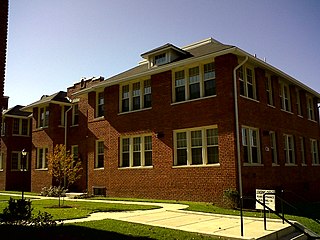
Petworth Gardens, also known as the Webster Garden Apartments, are historic structures located in the Petworth neighborhood in the Northwest Quadrant of Washington, D.C. They were listed on the National Register of Historic Places in 2008.

Olympia Apartments is an historic structure located in the Columbia Heights neighborhood in Washington, D.C.'s Northwest Quadrant. Albert B. Morgan designed this apartment building and it was completed in 1898.

The Cathedral Mansions Apartment Buildings are historic structures located at 2900, 3000, and 3100 Connecticut Avenue NW in the Woodley Park neighborhood of Washington, D.C. Constructed from 1922 to 1924, architect Eugene Waggaman designed the Connecticut Avenue apartment buildings in the Classical Revival style for developer Harry Wardman. Architect Mihran Mesrobian's initials appear on a drawing for one of the buildings.

The Second National Bank is a historic structure located in Downtown Washington, D.C. It was listed on the National Register of Historic Places in 1994.

Commercial National Bank is an historic structure located in Downtown Washington, D.C. It was listed on the National Register of Historic Places in 1991.

O Street Market, also known as Northern Market, is a historic structure located at 1400 7th Street NW in the Shaw neighborhood of Washington, D.C. Built in 1881, it is one of three 19th-century public market buildings still standing in the city, along with Eastern Market and Georgetown Market. The market was listed on the District of Columbia Inventory of Historic Sites in 1968 and the National Register of Historic Places in 1995. The most distinctive architectural element of the Gothic Revival building is its corner tower on 7th and O Streets.

The Riggs–Tompkins Building is an historic structure located in the Columbia Heights neighborhood of Washington, D.C. George N. Ray designed the building that was completed in 1922. It has been listed on the District of Columbia Inventory of Historic Sites since 1985 and it was listed on the National Register of Historic Places in 1987.
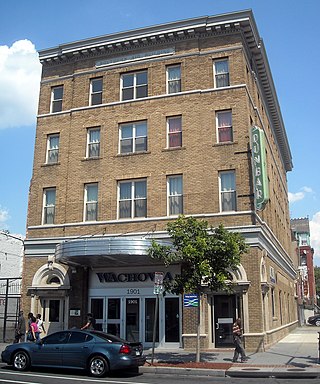
The Southern Aid Society Building–Dunbar Theater is an historic structure located in the Shaw neighborhood of Washington, D.C. The building was designed by architect Isaiah T. Hatton. Reginald W. Geare designed the theater portion of the building. It was completed in 1921. It has been listed on the District of Columbia Inventory of Historic Sites since 1984 and it was listed on the National Register of Historic Places in 1986. It is a contributing property in the Greater U Street Historic District.

The McLachlen Building is a historic structure located in Downtown Washington, D.C. It has been listed on the District of Columbia Inventory of Historic Sites since 1985, and it was listed on the National Register of Historic Places in 1986.
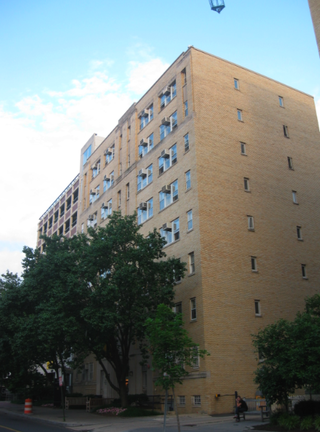
Munson Hall is a residence hall on the campus of George Washington University, located at 2212 I St., Northwest, Washington, D.C. in the Foggy Bottom neighborhood.

This is a list of the National Register of Historic Places listings in Downtown and Midtown Detroit, Michigan. It is intended to be a complete list of the properties and districts on the National Register of Historic Places in Downtown and Midtown neighborhoods in Detroit, Michigan, United States. Latitude and longitude coordinates are provided for many National Register properties and districts; these locations may be seen together in online maps.

The Union Arcade is an apartment building located in downtown Davenport, Iowa, United States. The building was individually listed on the National Register of Historic Places in 1983 by its original name Union Savings Bank and Trust. Originally, the building was built to house a bank and other professional offices. Although it was not the city's largest bank, and it was not in existence all that long, the building is still associated with Davenport's financial prosperity between 1900 and 1930. From 2014 to 2015 the building was renovated into apartments and it is now known as Union Arcade Apartments. In 2020 it was included as a contributing property in the Davenport Downtown Commercial Historic District.

The First National Bank of Davenport, also known as Brenton Bank and The Brenton, is a historic building located in central Davenport, Iowa, United States. It was added to the National Register of Historic Places in 2018. It is significant for its associations with the history of community planning and development, and as an important example of modernistic design.

The Downtown Paris Historic District, in Paris, Kentucky, in Bourbon County, Kentucky, is a historic district which was listed on the National Register of Historic Places in 1989.