Related Research Articles
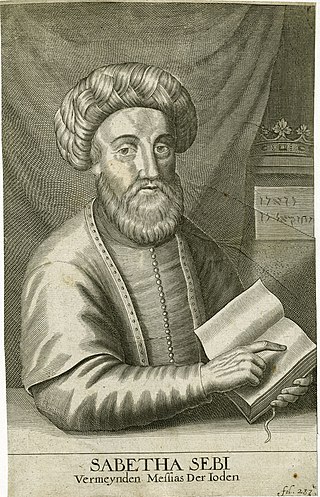
Sabbatai Zevi was an Ottoman Jewish mystic, false messiah and ordained rabbi from Smyrna. He was likely of Ashkenazi origin. Active throughout the Ottoman Empire, Zevi claimed to be the long-awaited Jewish Messiah and founded the Sabbatean movement.
Sforno is the name of a prominent Jewish Italian family, many members of which distinguished themselves as rabbis and scholars. The most prominent of these were the following:

Isaiah or Yeshayahu ben Avraham Ha-Levi Horowitz, , also known as the Shelah HaKaddosh after the title of his best-known work, was a prominent rabbi and mystic.
David ha-Levi Segal, also known as the Turei Zahav after the title of his significant halakhic commentary on the Shulchan Aruch, was one of the greatest Polish rabbinical authorities.
Nathan ben Jehiel of Rome was a Jewish Italian lexicographer. He authored the Arukh, a notable dictionary of Talmudic and Midrashic words, and consequently he himself is often referred to as "the Arukh".
Benjamin ben Abraham Anaw was a Roman Jewish liturgical poet, Talmudist, and commentator of the thirteenth century, and older brother of Zedekiah ben Abraham Anaw.
Josef ben Isaac ibn Ezra was a Sephardic rabbi of the sixteenth and seventeenth centuries, descended from the Ibn Ezra family. Brought up in Salonica, he studied under Rabbi Samuel de Medina and became head of the Talmudic school there; among his pupils were Aaron Hazzan, Meir Melammed, and Shabbethai Jonah. Late in life he was a refugee in Constantinople, and then the rabbi of Sofia, where he died.
The Dönme were a group of Sabbatean crypto-Jews in the Ottoman Empire who converted outwardly to Islam, but retained their Jewish faith and Kabbalistic beliefs in secret. The movement was centered mainly in Thessaloniki. It originated during and soon after the era of Sabbatai Zevi, a 17th-century Sephardic Jewish Rabbi and Kabbalist who claimed to be the Jewish Messiah and eventually feigned conversion to Islam under threat of death from the Sultan Mehmed IV. After Zevi's forced conversion to Islam, a number of Sabbatean Jews purportedly converted to Islam and became the Dönme. Some Sabbateans lived on into 21st-century Turkey as descendants of the Dönme.

Shabtai Horowitz was a rabbi and talmudist, probably born in Ostroh, Volhynia. He was the son of the kabbalist Isaiah Horowitz, and at an early age married the daughter of the wealthy and scholarly Moses Charif of Lublin. With his father he seems to have gone to Prague, where he occupied a position as preacher; from Prague he went as rabbi to Fürth, whence he was called to Frankfurt am Main about 1632, and finally to Vienna about 1650.
Aaron Samuel ben Israel Kaidanover was a Polish-Lithuanian rabbi. Among his teachers were Jacob Hoeschel and his son Joshua Hoeschel.
Joseph ben Solomon Fiametta was an Italian rabbi at Ancona.

Raniero Panzieri was an Italian politician, writer and Marxist theoretician, considered as the founder of operaismo.
Aaron ben Joseph Sason was an Ottoman Talmudic author; born toward the middle of the sixteenth century, probably at Salonica, where he received his rabbinical education under the supervision of Mordecai Matalon, an eminent scholar. During the last decades of the sixteenth century Aaron ben Joseph engaged in teaching, and some of his pupils ranked among the eminent rabbis of Turkey. With these, as well as with his colleagues, he maintained a lively correspondence on Talmudic questions, the summary of which was published at Venice in 1625 under the title "Torat Emet". In the introduction to this work he mentions his commentaries on "Yad ha-Ḥazaḳah" of Maimonides and on the "Ṭur" of Jacob ben Asher, as well as his treatises on various halakic subjects, which do not appear to have been published, and which are perhaps altogether lost. It seems probable that the work "Sefat Emet", which, according to the testimony of Shabbethai, Bass, contains scholia to the Talmud and to the Tosafot, was written by Aaron ben Joseph and not by his grandson, Aaron ben Isaac Sason. This probability is supported to some extent by the title, "Sefat Emet," which corresponds with the title of his collection of responsa, as well as by the above cited statement in his introduction to "Torat Emet," that he had written scholia to the Talmud.
Shabtai is a Jewish masculine name.
Panzieri is a surname. Notable people with the surname include:
Jeremiah ben Isaac Mattersdorf was a Polish Jewish rabbi and author, who served as the Chief Rabbi of Mattersburg, Austria and Abaújszánto, Hungary.

Ḥayyim ben Shabbethai, commonly known by the acronym Maharhash was a Sephardic rabbi and Talmudist, who is considered to be one of the great sages of Greek Jewry, serving as the Chief Rabbi of Thessaloniki, Greece.
Aaron Mosessohn was a German rabbi.
Moses Shabbethai Beer was an Italian rabbi. He was born in Pesaro, and he officiated as rabbi in Rome from December 1825. He was admitted to interviews with Popes Leo XII and Gregory XVI in 1827 and 1831, respectively, in order that he might plead on behalf of his community. This was the first time in the history of the Roman Jews that one of their representatives was permitted to appear in person before the pontiff.
Ḥayyim Vidal Shabbethai ben Shabbethai Angel was Salonican rabbi and preacher. He wrote Sippur ha-Ḥayyim, containing several funeral orations and miscellaneous homilies on the Pentateuch.
References
 This article incorporates text from a publication now in the public domain : Singer, Isidore; et al., eds. (1901–1906). "Panzieri or Pansieri". The Jewish Encyclopedia . New York: Funk & Wagnalls.