The Maratha caste is composed of 96 clans, originally formed in the earlier centuries from the amalgamation of families from the peasant (Kunbi), shepherd (Dhangar), blacksmith (Lohar), pastoral (Gavli), carpenter (Sutar), Bhandari, Thakar and Koli castes in Maharashtra. Many of them took to military service in the 16th century for the Deccan sultanates or the Mughals. Later in the 17th and 18th centuries, they served in the armies of the Maratha Kingdom, founded by Shivaji, a Maratha Kunbi by caste. Many Marathas were granted hereditary fiefs by the Sultanates, and Mughals for their service.

The Konkan is a stretch of land by the western coast of India, bound by the river Daman Ganga at Damaon in the north, to Anjediva Island next to Karwar town in the south; with the Arabian Sea to the west and the Deccan plateau to the east. The hinterland east of the coast has numerous river valleys, riverine islands and the hilly slopes known as the Western Ghats; that lead up into the tablelands of the Deccan. The region has been recognised by name, since at least the time of Strabo in the third century CE. It had a thriving mercantile port with Arab tradesmen from the 10th century. The best-known islands of Konkan are Ilhas de Goa, the site of the Goa state's capital at Panjim; also, the Seven Islands of Bombay, on which lies Mumbai, the capital of Maharashtra and the headquarters of Konkan Division.

Sant Tukaram Maharaj, also known as Tuka, Tukobaraya, Tukoba, was a Hindu, Marathi Saint of Varkari sampradaya" in Dehu village, Maharashtra in the 17th century. He was a bhakt of the god Vithoba of Pandharpur. He is best known for his devotional poetry called Abhanga, which are popular in Maharashtra, many of his poems deal with social reform.
Marathi literature is the body of literature of Marathi, an Indo-Aryan language spoken mainly in the Indian state of Maharashtra and written in the Devanagari and Modi script.
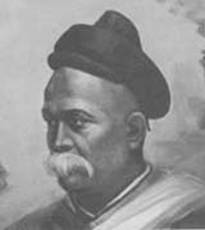
Rao Bahadur Mahadev Govind Ranade, popularly referred to as Nyayamurti Ranade, was an Indian scholar, social reformer, judge and author. He was one of the founding members of the Indian National Congress party and held several designations such as Member of the Bombay Legislative Council and Member of the Finance Committee at the Centre. He was also a judge of the Bombay High Court, Maharashtra.

The Chitpavan Brahmin or the Kokanastha Brahmin is a Hindu Maharashtrian Brahmin community inhabiting Konkan, the coastal region of the state of Maharashtra. Initially working as messengers and spies in the late seventeenth century, the community came into prominence during the 18th century when the heirs of Peshwa from the Bhat family of Balaji Vishwanath became the de facto rulers of the Maratha empire. Until the 18th century, the Chitpavans were held in low esteem by the Deshastha, the older established Brahmin community of Karnataka-Maharashtra region.
Chandraseniya Kayastha Prabhu (CKP) or historically and commonly known as Chandraseniya Prabhu or just Prabhu is a caste mainly found in Gujarat and Maharashtra. Historically, they made equally good warriors, statesmen as well as writers. They held the posts such as Deshpande and Gadkari according to the historian, B.R. Sunthankar, produced prominent warriors in Maharashtrian history.
Tryambak Shankar Shejwalkar was an Indian historian and essayist.
Govind Shripad Talwalkar, also known honorifically as Govindrao Talwalkar) was an Indian journalist, the editor of Maharashtra Times, historian, scholar, intellectual with liberal views, social reformer and author of 32 books. He received the Lokmanya Tilak Award from the Government of Maharashtra, India and also the B. D. Goenka Award, Durga Ratan Award, Agarkar Award & Bhalerao Award for excellence in journalism and Ramshastri award for social justice. He received Maharashtra Government Award for his book - Navroji te Nehru; and N.C. Kelkar Award and Sahitya Paishad Award for his four volume book - Soviet Samrajyacha Uday ani Asta; and Damani Award for his book - Badalta Europe.

Shaniwar Peth is a historic ward in the centre of the Indian city of Pune. Shaniwar means Saturday in Marathi and other Indian languages.
Ashok Ramchandra Kelkar (1929–2014) was a linguist and critical Marathi writer from Maharashtra, India. He was honoured with the Padma Shri in 2002 and Sahitya Akademi Award for Marathi in 2010.
Marathi Brahmins are communities native to the Indian state of Maharashtra. They are classified into mainly three sub-divisions based on their places of origin, "Desh", "Karad" and "Konkan". The Brahmin subcastes that come under Maharashtra Brahmins include Deshastha, Chitpavan (Konkanastha), Saraswat, Karhade, and Devrukhe.
Shubhada Sharad Gogate, born 2 September 1943 as Pushpa Ranade, is a Marathi author from Maharashtra, India.
James Thomas Molesworth was a military officer in the services of the British East India Company, and one of the most prominent lexicographers of the Marathi language.

Ramchandra Dattatrey Ranade (1886–1957) was an Indian scholar-philosopher-saint of Karnataka and Maharashtra.

Thomas Candy was an English educator with a lifelong association to India, who made lasting contributions to the lexicography, orthography, and stylistics of the Marathi language.

Chandrashekhar Govind Agashe was an Indian industrialist and lawyer, best remembered as the founder of the Brihan Maharashtra Sugar Syndicate Ltd. He served as the managing agent of the company from its inception in 1934 till his death in 1956. He served as the President of the Bhor State Council from 1934 to 1948, having previously been the council's Vice President from 1933 to 1934, its Secretary from 1932 to 1933, and the Chief Justiciar of the Indian princely state itself from 1920 to 1932.

Vasudeo Sitaram Bendrey was historian, author, editor, translator and publisher in Marathi language. He is known as Bhishmacharya of Marathi History. He dedicated his work for research in Maharashtra history and wrote, edited and translated over 60 books on different history topics.
Jagdish "Panditrao" Chandrashekhar Agashe was an Indian industrialist, best remembered for succeeding his father Chandrashekhar Agashe as the joint managing director of the Brihan Maharashtra Sugar Syndicate Ltd. from 1970 to 1978. The Panditrao Agashe School in Pune is named in his honour.
The Honyaji Bhagoji Kengle was Koli freedom activist from Maharashtra who sought freedom from British colonial rule in India. Kengle also fought against Sahukars, or Moneylenders who were capturing the lands of poor native Indians and British supporting elements. The Bombay government announced the reward of INR 1000 for Honya Kengle dead or alive and 200 - 600 INR for other revolutionaries. He was labelled as an Outlaw by British government. He led the Koli rebellion from 1872 to 1876.
