Related Research Articles

Karbala or Kerbala is a city in central Iraq, located about 100 km (62 mi) southwest of Baghdad, and a few miles east of Lake Milh, also known as Razzaza Lake. Karbala is the capital of Karbala Governorate, and has an estimated population of 711,530 people (2018).
In Shi'a Islam the guidance of clergy and keeping such a structure holds great importance. There are several branches of Shi'ism, of which Twelver Shi'ism is by far the largest, and each of the branches has different clergy structures. Individual clerics are referred to as mullā or ākhūnd, but since those terms have developed "a somewhat pejorative connotation" since at least the 1980s, the term rūḥānī has been "promoted" as an alternative, "especially by the clerical class itself".
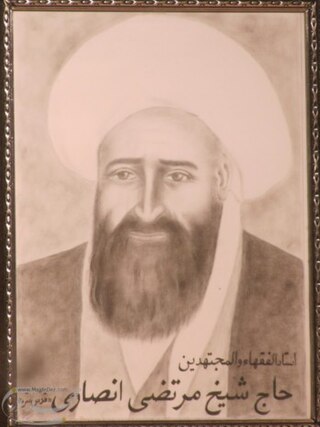
Grand Ayatollah Sheikh Murtadha al-Ansari al-Tostari (1781–1864),, also transliterated as Mortaza Ansari Shushtari, was a Shia jurist who "was generally acknowledged as the most eminent jurist of the time."
Kitab al-Makasib or Makasib is a two-volume Twelver Shi'ah legal manual of Islamic commercial law written on Fiqh by Morteza Ansari. It remains a key textbook in the modern Hawza and has been the subject of numerous commentaries. Makasib and the notable work of Akhund Khorasani, Kefayah al-osul, are taught in advanced classes at the seminaries. This book is one of the resources for the examination of the Assembly of Experts.

Ayatollah Sayyid Muhammad-Ridha al-Husayni al-Shirazi was an Iraqi-Iranian Shia scholar, and the eldest son of Muhammad al-Shirazi.

Sheikh Jafar ibn Hussein ibn Ali Shooshtari was a prominent Shia scholar from the city of Shooshtar.

Grand Ayatollah Sayyid Mohammad Hadi Milani was an Iranian-Iraqi marja'.

Grand Ayatollah Sheikh Muhammad-Hasan al-Najafi, also known as Sahib al-Jawahir, was a prominent Shiite religious authority and author. He was most known for his books of Jawahir al-Kalam Fi Sharh Shara'i' al-Islam, a 42-volume work on fiqh.

Ayatollah Shaykh Abdallah Mazandarani was a Shia Marja' and a leader of the constitutional movement against the Qajar dynasty. He was a pupil of Mirzaye Rashti. He worked alongside Akhund Khurasani and Mirza Ḥusayn Khalīlī Tihranī to support the first democratic revolution of Asia, Iran's Constitutional Revolution, and co-signed all major statements of the main source of emulation, Akhund Khurasani.
The Oudh Bequest is a waqf which led to the gradual transfer of more than six million rupees from the Indian kingdom of Oudh (Awadh) to the Shia holy cities of Najaf and Karbala between 1850 and 1903. The bequest first reached the cities in 1850. It was distributed by two mujtahids, one from each city. The British later gradually took over the bequest and its distribution; according to scholars, they intended to use it as a "power lever" to influence Iranian ulama and Shia. The attempts by the British to disburse the Oudh Bequest was one of the principle causes of the rise of the Society of Islamic Revival in 1918.
Ibn al-Sheikh , or Sheikh Mohammad Haeri Mazandarani, was an important spiritual figure in the Persian Constitutional Revolution. He served on the Supreme Court.

Grand Ayatollah Mujaddid Mirza Abu Muhammad Mu'iz al-DinMuhammad-Hassan al-Husayni al-Shirazi, better simply known as Mirza Shirazi, was an Iraqi-Iranian Shia marja'.

Ayatollah al-Shaheed Sayyid Abū al-Fatḥ ʿIzz ad-Dīn Naṣrallāh ِal-Fāʾizī al-Mūsawī al-Ḥāʾirī, also known as Sayyid Nasrallah al-Haeri, was a senior Iraqi Shia jurist, teacher, poet, author and annalist.
The family of Al Faiz, also transliterated in a number of other ways, including AlFa'iz, Al Fa'ez, AlFaez, or Al Fayez, is the oldest Alid family of Karbala, which they have occupied, on some occasions ruled, and held custodianship of its holy sites, since 861.

Grand Ayatollah Mulla Muhammad Ashrafi was a leading Iranian Shia Marja' in Mazandaran; Iran from roughly 1839 to his death in 1898. His Father Mulla Muhammad Mehdi was one of the Ulama of Behshahr. He was his first teacher and thought him primary cleric subjects and tried to nurture him with shia knowledge and Ahl Al-Bait friendship and love.

Grand Ayatollah Sayyid Abd al-A'la al-Musawi al-Sabziwari was an Iranian-Iraqi Shia marja'. He is regarded as one of the most influential grand religious authorities and he was a contemporary of Abu al-Qasim al-Khoei.
Ayatollah Sayyid Muhammad-Kadhim al-Musawi al-Qazwini was an Iraqi Shia scholar, poet and orator of Iranian descent. He was born in Karbala, Iraq and died in Qom, Iran.
The family of al-Shahristani, also transliterated in a number of other ways, including al-Shehristani or al-Shahrestani, are an Iraqi-Iranian clerical Shia family that settled in Karbala from the village of Shahristan, near Isfahan, in the late 18th century.
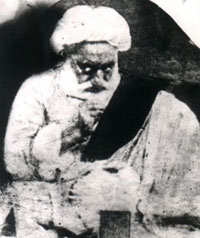
Grand Ayatollah Sheikh Muhammad-Taqi Golshan Shirazi Ha'eri, also known as al-Mirza al-Thani, was a senior Iranian-Iraqi jurist and political leader. He led the Iraqi revolt of 1920.
Ayatollah Sheikh Muhammad-Baqir al-Irawani is an Iraqi Shia scholar, religious authority, and poet.
References
- ↑ Society, Politics and Economics in Mazandaran, Iran 1848-1914
- ↑ "Knowledge Heritage of Sheikh Sharif Al-Ulama Al-Mazandarani". Faculty of Education - University of Kufa. November 7, 2021.
- ↑ "Mengenal Ulama Besar Syiah: Sharif al-Ulama Mazandarani". alhassanain.org.
- ↑ Continuity and Change in the Ulama Population of Najaf and Karbala, 1791-1904: A Socio-Demographic Study
- ↑ قرآن, IQNA | خبرگزاری بین المللی (April 2, 1401). "یادی از "شریف العلماء مازندرانی"، مرجع و محقق بزرگ شیعه". fa.
{{cite web}}: CS1 maint: multiple names: authors list (link) CS1 maint: numeric names: authors list (link) - ↑ Exir Al-Ebadat Fi Asrar Al-Shahadat (Book)
- ↑ The Messiah of Shiraz: Studies in Early and Middle Babism
- ↑ Shi'i Scholars of Nineteenth-Century Iraq: The 'Ulama' of Najaf and Karbala'
- ↑ "The Life and Times of Shaykh Murtada Ansari || Imam Reza (A.S.) Network". www.imamreza.net.