
A farm is an area of land that is devoted primarily to agricultural processes with the primary objective of producing food and other crops; it is the basic facility in food production. The name is used for specialized units such as arable farms, vegetable farms, fruit farms, dairy, pig and poultry farms, and land used for the production of natural fiber, biofuel, and other commodities. It includes ranches, feedlots, orchards, plantations and estates, smallholdings, and hobby farms, and includes the farmhouse and agricultural buildings as well as the land. In modern times, the term has been extended so as to include such industrial operations as wind farms and fish farms, both of which can operate on land or at sea.

Free range denotes a method of farming husbandry where the animals, for at least part of the day, can roam freely outdoors, rather than being confined in an enclosure for 24 hours each day. On many farms, the outdoors ranging area is fenced, thereby technically making this an enclosure, however, free range systems usually offer the opportunity for the extensive locomotion and sunlight that is otherwise prevented by indoor housing systems. Free range may apply to meat, eggs or dairy farming.

Kwara State is a state in Western Nigeria, bordered to the east by Kogi State, to the north by Niger State, and to the south by Ekiti, Osun, and Oyo states, while its western border makes up part of the international border with Benin. Its capital is the city of Ilorin and the state has 16 local government areas.

Abubakar Bukola SarakiMBBS is a Nigerian politician who served as the 13th president of the Nigerian Senate from 2015 to 2019. He was elected the President of Nigeria’s 8th Senate on 9 June 2015 under the All Progressives Congress (APC).

Agriculture is one of the dominant parts of Senegal's economy, even though Senegal lies within the drought-prone Sahel region. As only about 5% of the land is irrigated, Senegal continues to rely on rain-fed agriculture. Agriculture occupies about 75% of the workforce. Despite a relatively wide variety of agricultural production, the majority of farmers produce for subsistence needs. Millet, rice, corn, and sorghum are the primary food crops grown in Senegal. Production is subject to drought and threats of pests such as locusts, birds, fruit flies, and white flies. Moreover, the effects of climate change in Senegal are expected to severely harm the agricultural economy due to extreme weather such as drought, as well as increased temperatures.

Industrial agriculture is a form of modern farming that refers to the industrialized production of crops and animals and animal products like eggs or milk. The methods of industrial agriculture include innovation in agricultural machinery and farming methods, genetic technology, techniques for achieving economies of scale in production, the creation of new markets for consumption, the application of patent protection to genetic information, and global trade. These methods are widespread in developed nations and increasingly prevalent worldwide. Most of the meat, dairy, eggs, fruits and vegetables available in supermarkets are produced in this way.

Intensive animal farming, industrial livestock production, and macro-farms, also known as factory farming, is a type of intensive agriculture, specifically an approach to animal husbandry designed to maximize production while minimizing costs. To achieve this, agribusinesses keep livestock such as cattle, poultry, and fish at high stocking densities, at large scale, and using modern machinery, biotechnology, and global trade. The main products of this industry are meat, milk and eggs for human consumption.

Many farmers in India depend on animal husbandry for their livelihood. In addition to supplying milk, meat, eggs, wool, their castings (dung) and hides, animals, mainly bullocks, are the major source of power for both farmers and dairies. Thus, animal husbandry plays an important role in the rural economy. The gross value of output from this sector was 8,123 billion Rupees in FY 2015–16.
Uganda's favorable soil conditions and climate have contributed to the country's agricultural success. Most areas of Uganda have usually received plenty of rain. In some years, small areas of the southeast and southwest have averaged more than 150 millimeters per month. In the north, there is often a short dry season in December and January. Temperatures vary only a few degrees above or below 20 °C but are moderated by differences in altitude.

In New Zealand, agriculture is the largest sector of the tradable economy. The country exported NZ$46.4 billion worth of agricultural products in the 12 months to June 2019, 79.6% of the country's total exported goods. The agriculture, forestry and fisheries sector directly contributed $12.653 billion of the national GDP in the 12 months to September 2020, and employed 143,000 people, 5.9% of New Zealand's workforce, as of the 2018 census.

Agriculture in Saudi Arabia is focused on the export of dates, dairy products, eggs, fish, poultry, fruits, vegetables, and flowers to markets around the world after achieving self-sufficiency in the production of such products. The government of Saudi Arabia is heavily involved in the agriculture industry and subsidizing corporate farming and the Ministry of Environment, Water and Agriculture is primarily responsible for agricultural policy. In the private sector, farmers receive long-term interest-free government loans and low-cost water, fuel, electricity, and duty-free imports of raw materials and machinery.
Gbemisola Ruqayyah Saraki is a Nigerian politician who served as the Minister of State for Mines and Steel Development of Nigeria since 6 July 2022 till 29th May 2023. She served earlier as the Minister of State for Transportation from 2019 till she was moved by the President to the Ministry of Mines and Steel Development in 2022.
Sha'aba Lafiagi was elected governor of Kwara State in January 1992 on the Social Democratic Party (SDP) platform, and was removed from office by the administration of General Sani Abacha in November 1993.
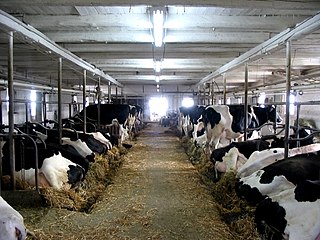
Dairy farming is one of the largest agricultural sectors in Canada. Dairy has a significant presence in all of the provinces and is one of the top two agricultural commodities in seven out of ten provinces.

Abdulfatah Ahmed is a Nigerian banker and politician. He is the former Governor of Kwara State.
Canada's supply management, abbreviated SM, is a national agricultural policy framework used across the country, which controls the supply of dairy, poultry and eggs through production and import controls and pricing mechanisms. The supply management system was authorized by the 1972 Farm Products Agencies Act, which established the two national agencies that oversee the system. The Agriculture and Agri-Food Canada federal department is responsible for both the Canadian Dairy Commission and its analogue for eggs, chicken and turkey products, the Farm Products Council of Canada. Five national supply management organizations, the SM-5 Organizations — Egg Farmers of Canada (EFC), Turkey Farmers of Canada (TFC), Chicken Farmers of Canada (CFC), the Canadian Hatching Egg Producers (CHEP) and the Ottawa-based Canadian Dairy Commission (CDC), a Crown corporation — in collaboration with provincial and national governing agencies, organizations and committees, administer the supply management system.
The Ilorin Sallah stampede was a crowd crush that occurred at Ilorin, the capital of Kwara State, North-central Nigeria on Eid al-Fitr at the end of Ramadan in 2013. The crush resulted in the death of 20 people and left several others severely injured. Four people died the first day, and 16 more over the next few days. The incident occurred on 16 October 2013 at Senator Bukola Saraki's house. Saraki is the two-term governor of Kwara State and the incumbent President of the Senate of Nigeria.
Ibrahim Yahaya Oloriegbe is a Nigerian medical doctor, politician and philanthropist. Oloriegbe graduated with MBBS degree from Ahmadu Bello University, Zaria, Nigeria in 1985. He attended training programmes in Change Management, Advocacy, Facilitation Skills, Project Management, Health policy and systems analysis, Legislation, Leadership and an Executive Programme on Coaching and Consulting for Change at the Oxford University U.K
Ó Tó Gẹ́ is the slogan for the political revolution that took place in Nigeria's Kwara State in 2019. The slogan was first used by 79-year-old Lazeez Ayinla Kolawole, a member of the All Progressives Congress.

Charles Oladele Akande Ibitoye, was the thirty third traditional ruler (king) or Olomu of Omu-Aran from 1993 until his death in the year 2017. He was born into the Ruling House of Ijawusi of Ikoja Compound. He took the regnal name Adogbajale-bi-ileke II. Omu-Aran, which is the Head Post of Igbomina land, a town in the Nigerian state of Kwara. It originated from Ile-Ife and is the local government headquarters of the Irepodun local government. He was appointed on the 1st February 1993, crowned on 19 February 1993 and was presented a first class Staff of Office on the 8 May 1993 by Mohammed Sha'aba Lafiagi, Executive Governor of Kwara State, in a ceremony attended by dignitaries from across the globe.


