Related Research Articles

A troll is a being in Nordic folklore, including Norse mythology. In Old Norse sources, beings described as trolls dwell in isolated areas of rocks, mountains, or caves, live together in small family units, and are rarely helpful to human beings.

In English folklore, The Puck, also known as Goodfellows, are demons or fairies which can be domestic sprites or nature sprites.
A trow is a malignant or mischievous fairy or spirit in the folkloric traditions of the Orkney and Shetland islands. Trows may be regarded as monstrous giants at times, or quite the opposite, short-statured fairies dressed in grey.

A pixie is a mythical creature of British folklore. Pixies are speculated to be particularly concentrated in the high moorland areas around Devon and Cornwall, suggesting some Celtic origin for the belief and name. However, the word 'pixie' also appears in Dorset, Somerset and to a lesser extent in Sussex, Wiltshire and Hampshire.

The púca, pucapwca, pookah, phouka, puck is a creature of Celtic, English, and Channel Islands folklore. Considered to be bringers both of good and bad fortune, they could help or hinder rural and marine communities. Púcaí can have dark or white fur or hair. The creatures were said to be shape-changers that could take the appearance of horses, goats, cats, dogs, and hares. They may also take a human form, which includes various animal features, such as ears or a tail.

A fairy ring, also known as fairy circle, elf circle, elf ring or pixie ring, is a naturally occurring ring or arc of mushrooms. They are found mainly in forested areas, but also appear in grasslands or rangelands. Fairy rings are detectable by sporocarps in rings or arcs, as well as by a necrotic zone, or a ring of dark green grass. Fungus mycelium is present in the ring or arc underneath. The rings may grow to over 10 metres (33 ft) in diameter, and they become stable over time as the fungus grows and seeks food underground.
Nordic folklore is the folklore of Denmark, Norway, Sweden, Iceland and the Faroe Islands. It has common roots with, and has been under mutual influence with, folklore in England, Germany, the Low Countries, the Baltic countries, Finland and Sápmi. Folklore is a concept encompassing expressive traditions of a particular culture or group. The peoples of Scandinavia are heterogenous, as are the oral genres and material culture that has been common in their lands. However, there are some commonalities across Scandinavian folkloric traditions, among them a common ground in elements from Norse mythology as well as Christian conceptions of the world.
Fin is the subject of a legend involving the construction of a church. To get the work done, an agreement was made between a holy man and a troll or giant with dire consequences for the loser. The Danish version features a troll from Kalundborg, Zealand, Denmark. In the Swedish legend, the subject is a giant from Lund with the name Jätten Finn.
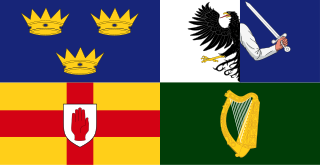
Irish folklore refers to the folktales, balladry, music, dance and mythology of Ireland. It is the study and appreciation of how people lived.

Þrymskviða is one of the best known poems from the Poetic Edda. The Norse myth had enduring popularity in Scandinavia and continued to be told and sung in several forms until the 19th century.
In Sami shamanism, Horagalles, also written Hora Galles and Thora Galles and often equated with Tiermes or Aijeke, is the thunder god. He is depicted as a wooden figure with a nail in the head and with a hammer, or occasionally on shaman drums, two hammers.
The Troll's Daughter is a Danish folktale from Svend Grundtvig's collection (1876), whose English translation was published by Andrew Lang in The Pink Fairy Book (1897).

A Folk Tale is a ballet in three acts, created in 1854 for the Royal Danish Ballet by the Danish ballet master and choreographer August Bournonville to the music of Johan Peter Emilius Hartmann and Niels W. Gade. The first performance took place on 20 March 1854. Set in the Middle Ages, the ballet tells the story of a changeling living among the trolls and elves. Bournonville declared the ballet "The most complete and best of all my choreographic works."
The Elder Mother is an elder-guarding being in English and Scandinavian folklore known by a variety of names, such as the Danish Hyldemoer ("Elder-Mother") and the Lincolnshire names Old Lady and Old Girl.
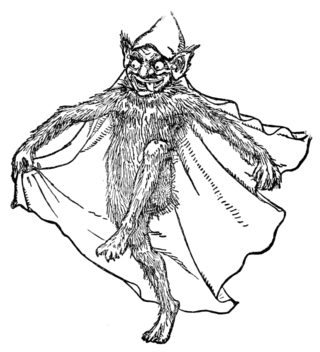
A goblin is a small, grotesque, monstrous creature that appears in the folklore of multiple European cultures. First attested in stories from the Middle Ages, they are ascribed conflicting abilities, temperaments, and appearances depending on the story and country of origin, ranging from mischievous household spirits to malicious, bestial thieves. They often have magical abilities similar to a fairy or demon, such as the ability to shapeshift.

Just Mathias Thiele was a Danish scholar and librarian. A central personage during the Danish Golden Age, he contributed to Danish cultural life in a number of capacities. He collected and published Danish folk tales with inspiration from the Brothers Grimm and founded the Royal Print Collection, today part of the Danish National Gallery. After the death of Bertel Thorvaldsen, he saved his archives and other papers and based on them he wrote his first biography.

Danish folklore consists of folk tales, legends, songs, music, dancing, popular beliefs, myths and traditions communicated by the inhabitants of towns and villages across the country, often passed on from generation to generation by word of mouth. As in neighbouring countries, interest in folklore grew with an emerging feeling of national consciousness in 19th century Denmark. Researchers travelled across the country collecting innumerable folktales, songs and sayings while observing traditional dress in the various regions. Folklore today is part of the national heritage, represented in particular by national and local traditions, songs, folk dances and literature.
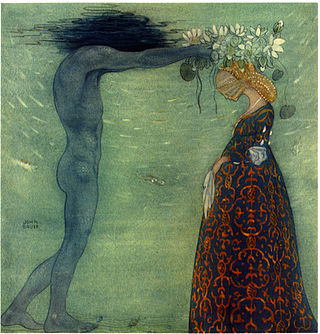
"Agnete og Havmanden" (Danish) or "Agneta och havsmannen" (Swedish) is a ballad. It is also found in Norway and as a prose folktale published by Just Mathias Thiele in his 1818 Danske Folkesagn, though Thomas Bredsdorff has argued that this prose version is of literary rather than folkloric origin. The ballad too is generally thought to be relatively late in its composition, perhaps from the eighteenth century.
Bergbúa þáttr is a short medieval Icelandic tale (þáttr). It tells of Þórðr and his companion who get lost on their way to church one winter and take refuge in a cave. Once inside, after they have settled down for the evening, they hear noises from the back of the cave. Later they see two huge eyes and hear a voice which recites a poem of twelve stanzas, now known as Hallmundarkviða. The speaker of these verses refers to himself as a giant, and repeats the poem three time across the course of the night. The giant instructs the humans to remember the poem or suffer a forfeit. Þórðr memorises the poem but his companion does not and subsequently dies the following year.

The Dog in the Sea, also known as The Dog and the Sailor is a northern European fairy tale classified as ATU 540, "The Dog in the Sea".
References
- 1 2 Just Mathias Thiele, "Kirstens Bierg", Danmarks folkesagn, 3 vols., Volume 2: Sagn om Naturgienstande, Copenhagen: C. A. Reitzel, 1843, OCLC 468296419, p. 222 (in Danish).
- 1 2 Thomas Keightley, "Kirsten's-Hill", The Fairy Mythology, 2 vols., Volume 1, London: William Harrison Ainsworth, 1828, OCLC 312214182, pp. 198–99.
- ↑ Edwin Sidney Hartland, The Science of Fairy Tales: An Inquiry into Fairy Mythology, London: Walter Scott, 1891, OCLC 1250026499, pp. 310–11.
- ↑ Thiele, Prøver af Danske Folkesagn, Copenhagen: Thiele Brothers, 1817, OCLC 503751108, p. 22 (in Danish).