
A biome is a distinct geographical region with specific climate, vegetation, and animal life. It consists of a biological community that has formed in response to its physical environment and regional climate. Biomes may span more than one continent. A biome encompasses multiple ecosystems within its boundaries. It can also comprise a variety of habitats.

In physical geography, tundra is a type of biome where tree growth is hindered by frigid temperatures and short growing seasons. The term comes from the Finnish word tunturia, meaning "treeless plain". There are three regions and associated types of tundra: Arctic tundra, alpine tundra, and Antarctic tundra.
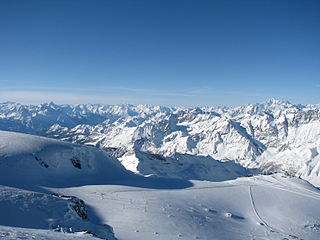
The Alpine region of Switzerland, conventionally referred to as the Swiss Alps, represents a major natural feature of the country and is, along with the Swiss Plateau and the Swiss portion of the Jura Mountains, one of its three main physiographic regions. The Swiss Alps extend over both the Western Alps and the Eastern Alps, encompassing an area sometimes called Central Alps. While the northern ranges from the Bernese Alps to the Appenzell Alps are entirely in Switzerland, the southern ranges from the Mont Blanc massif to the Bernina massif are shared with other countries such as France, Italy, Austria and Liechtenstein.

The tropics are the regions of Earth surrounding the Equator. They are defined in latitude by the Tropic of Cancer in the Northern Hemisphere at 23°26′10.2″ (or 23.43616°) N and the Tropic of Capricorn in the Southern Hemisphere at 23°26′10.2″ (or 23.43616°) S. The tropics are also referred to as the tropical zone and the torrid zone.

Alpine tundra is a type of natural region or biome that does not contain trees because it is at high elevation, with an associated harsh climate. As the latitude of a location approaches the poles, the threshold elevation for alpine tundra gets lower until it reaches sea level, and alpine tundra merges with polar tundra.

A meadow is an open habitat or field, vegetated by grasses, herbs, and other non-woody plants. Trees or shrubs may sparsely populate meadows, as long as these areas maintain an open character. Meadows can occur naturally under favourable conditions, but are often artificially created from cleared shrub or woodland for the production of hay, fodder, or livestock. Meadow habitats, as a group, are characterized as "semi-natural grasslands", meaning that they are largely composed of species native to the region, with only limited human intervention.

The tree line is the edge of a habitat at which trees are capable of growing and beyond which they are not. It is found at high elevations and high latitudes. Beyond the tree line, trees cannot tolerate the environmental conditions. The tree line is sometimes distinguished from a lower timberline, which is the line below which trees form a forest with a closed canopy.

Alpine plants are plants that grow in an alpine climate, which occurs at high elevation and above the tree line. There are many different plant species and taxa that grow as a plant community in these alpine tundra. These include perennial grasses, sedges, forbs, cushion plants, mosses, and lichens. Alpine plants are adapted to the harsh conditions of the alpine environment, which include low temperatures, dryness, ultraviolet radiation, wind, drought, poor nutritional soil, and a short growing season.

During the Last Glacial Maximum, the mammoth steppe, also known as steppe-tundra, was once the Earth's most extensive biome. It stretched east-to-west, from the Iberian Peninsula in the west of Europe, across Eurasia to North America, through Beringia and Canada; from north-to-south, the steppe reached from the arctic islands southward to China. The mammoth steppe was cold and dry, and relatively featureless, though topography and geography varied considerably throughout. Some areas featured rivers which, through erosion, naturally created gorges, gulleys, or small glens. The continual glacial recession and advancement over millennia contributed more to the formation of larger valleys and different geographical features. Overall, however, the steppe is known to be flat and expansive grassland. The vegetation was dominated by palatable, high-productivity grasses, herbs and willow shrubs.

The Abisko Scientific Research Station (ANS) is a field research station managed by the Swedish Polar Research Secretariat. Situated on the south shore of Lake Torneträsk, it lies at the edge of the Abisko National Park. The station conducts ecological, geological, geomorphological and meteorological research in subarctic environments and each year about 500 scientists visit from all over the world. The varied geological, topographical and climatic conditions of the area allow it to be inhabited by a range of flora and fauna. These features, which have caused the area to be given National Park status, also make it an important place for scientific research, particularly of alpine and subalpine ecosystems.

Snowpack forms from layers of snow that accumulate in geographic regions and high elevations where the climate includes cold weather for extended periods during the year. Snowpacks are an important water resource that feed streams and rivers as they melt. Therefore, snowpacks are both the drinking water source for many communities and a potential source of flooding. Snowpacks also contribute mass to glaciers in their accumulation zone.

About 1,702 species of plants live on the Arctic tundra, including flowering plants, short shrubs, herbs, grasses, and mosses. These plants are adapted to short, cold growing seasons. They have the ability to withstand extremely cold temperatures in the winter, and grow and reproduce in summer conditions that are quite limiting.

The Holdridge life zones system is a global bioclimatic scheme for the classification of land areas. It was first published by Leslie Holdridge in 1947, and updated in 1967. It is a relatively simple system based on few empirical data, giving objective criteria. A basic assumption of the system is that both soil and the climax vegetation can be mapped once the climate is known.

The International Tundra Experiment (ITEX) is a long-term international collaboration of researchers examining the responses of arctic and alpine plants and ecosystems to climate change. Researchers measure plant responses to standardized, small-scale passive warming, snow manipulations, and nutrient additions. Researchers use small open-top chambers (OTCs) to passively increase mean air temperature by 1-2 °C. The ITEX approach has been validated by tundra responses at the plot level. The network has published meta-analyses on plant phenology, growth, and reproduction, composition and abundance, and carbon flux. The ITEX network consists of more than 50 sites in polar and alpine locations around the world.

Montane ecosystems are found on the slopes of mountains. The alpine climate in these regions strongly affects the ecosystem because temperatures fall as elevation increases, causing the ecosystem to stratify. This stratification is a crucial factor in shaping plant community, biodiversity, metabolic processes and ecosystem dynamics for montane ecosystems. Dense montane forests are common at moderate elevations, due to moderate temperatures and high rainfall. At higher elevations, the climate is harsher, with lower temperatures and higher winds, preventing the growth of trees and causing the plant community to transition to montane grasslands and shrublands or alpine tundra. Due to the unique climate conditions of montane ecosystems, they contain increased numbers of endemic species. Montane ecosystems also exhibit variation in ecosystem services, which include carbon storage and water supply.
The Swiss Federal Institute for Forest, Snow and Landscape Research is a Swiss research institution, part of the Swiss Federal Institutes of Technology Domain.
Vegetation classification is the process of classifying and mapping the vegetation over an area of the earth's surface. Vegetation classification is often performed by state based agencies as part of land use, resource and environmental management. Many different methods of vegetation classification have been used. In general, there has been a shift from structural classification used by forestry for the mapping of timber resources, to floristic community mapping for biodiversity management. Whereas older forestry-based schemes considered factors such as height, species and density of the woody canopy, floristic community mapping shifts the emphasis onto ecological factors such as climate, soil type and floristic associations. Classification mapping is usually now done using geographic information systems (GIS) software.

Changing climate conditions are amplified in polar regions and northern high-latitude areas are projected to warm at twice the rate of the global average. These modifications result in ecosystem interactions and feedbacks that can augment or mitigate climatic changes. These interactions may have been important through the large climate fluctuations since the glacial period. Therefore it is useful to review the past dynamics of vegetation and climate to place recent observed changes in the Arctic into context. This article focuses on northern Alaska where there has been much research on this theme.

Michael Lehning is a German and Swiss environmental and atmospheric scientist. He is a professor of environmental engineering at EPFL, the head of EPFL's Laboratory of Cryospheric Sciences, and head of the group Snow Processes at the Swiss Federal Institute for Forest, Snow and Landscape Research (WSL).

The Tundra of North America is a Level I ecoregion of North America designated by the Commission for Environmental Cooperation (CEC) in its North American Environmental Atlas.

