Related Research Articles

The Australian Army is the principal land warfare force of Australia, a part of the Australian Defence Force (ADF) along with the Royal Australian Navy and the Royal Australian Air Force. The Army is commanded by the Chief of Army (CA), who is subordinate to the Chief of the Defence Force (CDF) who commands the ADF. The CA is also directly responsible to the Minister for Defence, with the Department of Defence administering the ADF and the Army.

Anzac Day is a national day of remembrance in Australia and New Zealand that broadly commemorates all Australians and New Zealanders "who served and died in all wars, conflicts, and peacekeeping operations" and "the contribution and suffering of all those who have served". Observed on 25 April each year, Anzac Day was originally devised to honour the members of the Australian and New Zealand Army Corps (ANZAC) who served in the Gallipoli campaign, their first engagement in the First World War (1914–1918).
Lae is the capital of Morobe Province and is the second-largest city in Papua New Guinea. It is located near the delta of the Markham River and at the start of the Highlands Highway, which is the main land transport corridor between the Highlands Region and the coast. Lae is the largest cargo port of the country and is the industrial hub of Papua New Guinea. The city is known as the Garden City and home of the University of Technology.

Morobe Province is a province on the northern coast of Papua New Guinea. The provincial capital and largest city is Lae. The province covers 33,705 km2, with a population of 674,810, and since the division of Southern Highlands Province in May 2012 it is the most populous province. It includes the Huon Peninsula, the Markham River, and delta, and coastal territories along the Huon Gulf. The province has nine administrative districts. At least 101 languages are spoken, including Kâte and Yabem language. English and Tok Pisin are common languages in the urban areas, and in some areas pidgin forms of German are mixed with the native language.

The New Guinea campaign of the Pacific War lasted from January 1942 until the end of the war in August 1945. During the initial phase in early 1942, the Empire of Japan invaded the Territory of New Guinea on 23 January and Territory of Papua on 21 July and overran western New Guinea beginning on 29 March. During the second phase, lasting from late 1942 until the Japanese surrender, the Allies—consisting primarily of Australian forces—cleared the Japanese first from Papua, then New Guinea, and finally from the Dutch colony.
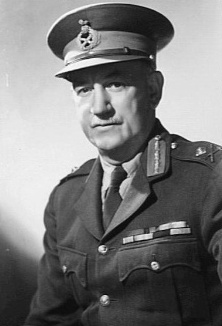
Major General James Harold Cannan, was an Australian Army brigadier general in the First World War and the Quartermaster General during the Second World War.

The 5th Division was an infantry division of the Australian Army which served during the First and Second World Wars. The division was formed in February 1916 as part of the expansion of the Australian Imperial Force infantry brigades. In addition to the existing 8th Brigade were added the new 14th and 15th Brigades, which had been raised from the battalions of the 1st and 2nd Brigades respectively. From Egypt the division was sent to France and then Belgium, where they served in the trenches along the Western Front until the end of the war in November 1918. After the war ended, the division was demobilised in 1919.

The South West Pacific theatre, during World War II, was a major theatre of the war between the Allies and the Axis. It included the Philippines, the Dutch East Indies, Borneo, Australia and its mandate Territory of New Guinea and the western part of the Solomon Islands. This area was defined by the Allied powers' South West Pacific Area (SWPA) command.

The Royal Western Australia Regiment is a reserve infantry regiment of the Australian Army consisting of two battalions, the 11th/28th Battalion and the 16th Battalion. The regiment was raised in July 1960 as part of the reorganisation of the Australian Army Reserve through the amalgamation of the three existing infantry regiments in Western Australia:

The Australian Women's Army Service (AWAS) was a non-medical women's service established in Australia during the Second World War. Raised on 13 August 1941 to "release men from certain military duties for employment in fighting units" the service grew to over 20,000-strong and provided personnel to fill various roles including administration, driving, catering, signals and intelligence. Following the end of the Second World War, the service was demobilised and ceased to exist by 1947. It later provided a cadre of experienced personnel to the Women's Royal Australian Army Corps when it was established in 1951.

The Salamaua–Lae campaign was a series of actions in the New Guinea campaign of World War II. Australian and United States forces sought to capture two major Japanese bases, one in the town of Lae, and another one at Salamaua. The campaign to take the Salamaua and Lae area began after the successful defence of Wau in late January, which was followed up by an Australian advance towards Mubo as the Japanese troops that had attacked Wau withdrew to positions around Mubo. A series of actions followed over the course of several months as the Australian 3rd Division advanced north-east towards Salamaua. After an amphibious landing at Nassau Bay, the Australians were reinforced by a US regimental combat team, which subsequently advanced north up the coast.

Major General Rupert Major Downes, was an Australian soldier, surgeon and historian.
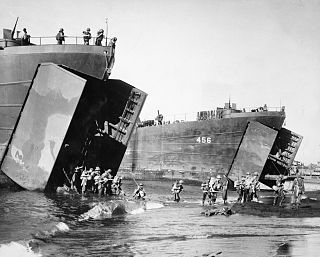
The Landing at Lae was an amphibious landing to the east of Lae and then the subsequent advance on the town during the Salamaua–Lae campaign of World War II. Part of Operation Postern, which was undertaken to capture the Japanese base at Lae, the landing was undertaken between 4 and 6 September 1943 by Australian troops from the 9th Division, supported by US naval forces from the VII Amphibious Force. The first major amphibious operation undertaken by the Australian Army since the failed Gallipoli Campaign, the Australians invested a significant amount of effort into planning the operation.
Nadzab Village is in the Markham Valley, Morobe Province, Papua New Guinea on the Highlands Highway. Administratively, it is located in Gabsongkeg ward of Wampar Rural LLG. The Nadzab Airport is located East of Nadzab Village and was the site of the only Allied paratrooper assault in New Guinea on 5 September 1943.

The 2/4th Field Regiment was an Australian Army artillery regiment formed on 2 May 1940, as part of the 7th Division during World War II. The regiment was involved in campaigns in North Africa, Syria–Lebanon, Salamaua–Lae, the Finisterre Ranges and Borneo. After training in Victoria, the regiment deployed to North Africa in late 1940. After being deployed in the defence of Mersa Matruh in Egypt in early 1941, the regiment took part in the fighting against the Vichy French in Syria and Lebanon, before undertaking garrison duties there. It returned to Australia in early 1942 following Japan's entry into the war, and in September 1943, a small group of artillerymen from the 2/4th parachuted with two short 25 Pounder guns in the airborne landing at Nadzab airstrip in New Guinea in support of the U.S. Army's 503rd Parachute Infantry Regiment. Later, the regiment took part in the 7th Division's advance through the Finisterre Range before returning to Australia in early 1944. Its final involvement in the war came around Balikpapan in 1945. After the war, the regiment was disbanded on 7 February 1946.

Major General Kenneth William Eather, was a senior Australian Army officer who served during the Second World War. Eather led a battalion in the Battle of Bardia, a brigade on the Kokoda Track campaign and a division in the New Britain campaign. He was the last Australian officer to be promoted to the rank of major general during the Second World War, and when he died in 1993 he was Australia's last surviving general of that war.
The ANZAC Squadron, also called the Allied Naval Squadron, was an Allied naval warship task force which was tasked with defending northeast Australia and surrounding area in early 1942 during the Pacific Campaign of World War II. The squadron, consisting of cruisers and destroyers from the navies of Australia, New Zealand, and the United States was formed on February 12, 1942, under the command of Royal Navy Rear Admiral John Gregory Crace. The squadron was the primary fleet element operating in the ANZAC Area under the overall command of United States Navy Vice Admiral Herbert Fairfax Leary.
The Lae War Cemetery, established in 1944, is located adjacent to the Botanical Gardens in the centre of the city of Lae, the capital of Morobe Province, in Papua New Guinea. The cemetery is managed by the Commonwealth War Graves Commission.

Major General Edward James Milford was an Australian Army officer who fought in the First and the Second World Wars.
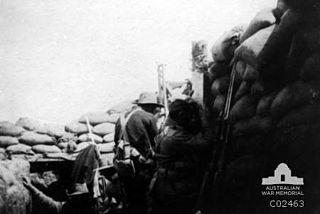
The 22nd Battalion was an infantry battalion of the Australian Army. It was raised in 1915 as part of the Australian Imperial Force for service during World War I and formed part of the 6th Brigade, attached to the 2nd Division. It fought during the Gallipoli campaign and on the Western Front before being disbanded in 1919. In 1921, it was re-raised as a part-time unit and was merged with the 29th Battalion in 1930 to form the "29th/22nd Infantry Battalion". Split in August 1939 and known as the "22nd Battalion ", the battalion saw action against the Japanese during World War II in the Huon Peninsula and New Britain campaigns. The battalion was disbanded in June 1946. It was re-established as part of the Royal Victoria Regiment in the mid-1960s as a remote area battalion within the Citizens Military Force, and later became a part of the 8th/7th Battalion, Royal Victoria Regiment.
References
- ↑ ""Sons of the Anzacs"". The Mercury . Hobart, Tasmania. 10 February 1945. p. 9. Retrieved 12 February 2012– via National Library of Australia.
- ↑ Sons of the Anzacs at National Film and Sound Archive

