Lift or LIFT may refer to:

A slurry wall is a civil engineering technique used to build reinforced concrete walls in areas of soft earth close to open water, or with a high groundwater table. This technique is typically used to build diaphragm (water-blocking) walls surrounding tunnels and open cuts, and to lay foundations.

A progressing cavity pump is a type of positive displacement pump and is also known as a progressive cavity pump, progg cavity pump, eccentric screw pump or cavity pump. It transfers fluid by means of the progress, through the pump, of a sequence of small, fixed shape, discrete cavities, as its rotor is turned. This leads to the volumetric flow rate being proportional to the rotation rate (bidirectionally) and to low levels of shearing being applied to the pumped fluid.

Casing is a large diameter pipe that is assembled and inserted into a recently drilled section of a borehole. Similar to the bones of a spine protecting the spinal cord, casing is set inside the drilled borehole to protect and support the wellstream. The lower portion is typically held in place with cement. Deeper strings usually are not cemented all the way to the surface, so the weight of the pipe must be partially supported by a casing hanger in the wellhead.
Capacity or capacities may refer to:
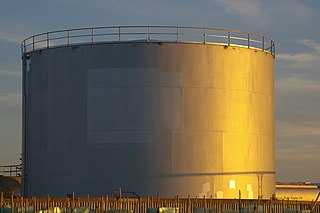
Storage tanks are containers that hold liquids, compressed gases or mediums used for the short- or long-term storage of heat or cold. The term can be used for reservoirs, and for manufactured containers. The usage of the word tank for reservoirs is uncommon in American English but is moderately common in British English. In other countries, the term tends to refer only to artificial containers.
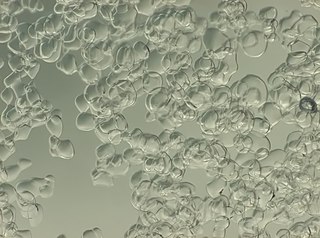
Slurry ice is a phase changing refrigerant made up of millions of ice "micro-crystals" formed and suspended within a solution of water and a freezing point depressant. Some compounds used in the field are salt, ethylene glycol, propylene glycol, alcohols like isobutyl and ethanol, and sugars like sucrose and glucose. Slurry ice has greater heat absorption compared to single phase refrigerants like brine, because the melting enthalpy of the ice is also used.
In civil engineering, concrete leveling is a procedure that attempts to correct an uneven concrete surface by altering the foundation that the surface sits upon. It is a cheaper alternative to having replacement concrete poured and is commonly performed at small businesses and private homes as well as at factories, warehouses, airports and on roads, highways and other infrastructure.

A raw mill is the equipment used to grind raw materials into "rawmix" during the manufacture of cement. Rawmix is then fed to a cement kiln, which transforms it into clinker, which is then ground to make cement in the cement mill. The raw milling stage of the process effectively defines the chemistry of the finished cement, and has a large effect upon the efficiency of the whole manufacturing process.

Well completion is the process of making a well ready for production after drilling operations. This principally involves preparing the bottom of the hole to the required specifications, running in the production tubing and its associated down hole tools as well as perforating and stimulating as required. Sometimes, the process of running in and cementing the casing is also included. After a well has been drilled, should the drilling fluids be removed, the well would eventually close in upon itself. Casing ensures that this will not happen while also protecting the wellstream from outside incumbents, like water or sand.
A mud pump, is a reciprocating piston/plunger pump designed to circulate drilling fluid under high pressure down the drill string and back up the annulus. A mud pump is an important part of the equipment used for oil well drilling.
Squeeze job, or squeeze cementing is a term often used in the oilfield to describe the process of injecting cement slurry into a zone, generally for pressure-isolation purposes.
Oil Well Cementing Equipment are essential for the Oil/Gas exploration or production wells and are must used oilfield equipments while drilling a well.

Pumpable icetechnology (PIT) uses thin liquids, with the cooling capacity of ice. Pumpable ice is typically a slurry of ice crystals or particles ranging from 5 micrometers to 1 cm in diameter and transported in brine, seawater, food liquid, or gas bubbles of air, ozone, or carbon dioxide.
Hydraulics is a topic in engineering dealing with the mechanical properties of liquids.
Well cementing is the process of introducing cement to the annular space between the well-bore and casing or to the annular space between two successive casing strings. Personnel who conduct this job are called "Cementers".

Red mud, now more frequently termed bauxite residue, is an industrial waste generated during the processing of bauxite into alumina using the Bayer process. It is composed of various oxide compounds, including the iron oxides which give its red colour. Over 95% of the alumina produced globally is through the Bayer process; for every tonne of alumina produced, approximately 1 to 1.5 tonnes of red mud are also produced. Annual production of alumina in 2020 was over 133 million tonnes resulting in the generation of over 175 million tonnes of red mud.
This page is based on this
Wikipedia article Text is available under the
CC BY-SA 4.0 license; additional terms may apply.
Images, videos and audio are available under their respective licenses.

