Tippmann is an American manufacturer of paintball markers and paintball equipment, including military simulation (MilSim) kits. A related company, Tippmann Industrial Products manufactures manual and pneumatic heavy-duty sewing machines primarily used for leather, other leather-related equipment, and some industrial products. Originally a family-owned business run from Fort Wayne, Indiana, in 2004 Dennis Tippmann Sr. sold a majority ownership stake to Summit Partners, a private equity firm. Tippmann designed one of the first automatic markers, the use of refillable air systems in place of 12 gram cartridges, the "Cyclone Feed" system, the "Flatline" barrel, and the Tippmann C-3, the first propane-powered marker.
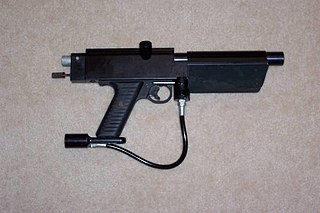
The Autococker is a closed-bolt semiautomatic paintball marker manufactured by Worr Game Products (WGP). It was one of the first paintball markers to be designed specifically for the sport, and has long been known throughout the paintball community for its popularity and customizability as well as its complexity. It is commonly believed that the closed-bolt design of the marker makes it inherently more accurate than its open-bolt counterparts, though this is disputed.
The Sturmgewehr 57 is a selective fire battle rifle designed by Schweizerische Industrie Gesellschaft of Switzerland. It uses a roller-delayed blowback system similar to the H&K G3 and CETME rifles. The AM 55 entered service in the Swiss Army with the designation F. ass. 57 7.5mm or 7.5mm Stgw. 57, with export variations constituting the SG 510 family of small arms.

A paintball marker, also known as a paintball gun, paint gun, or simply marker, is an air gun used in the shooting sport of paintball, and the main piece of paintball equipment. Paintball markers use compressed gas, such as carbon dioxide (CO2) or compressed air (HPA), to propel dye-filled gel capsules called paintballs through the barrel and quickly strike a target. The term "marker" is derived from its original use as a tool for forestry personnel to mark trees and ranchers to mark wandering cattle.
A ball detent is a simple mechanical arrangement used to hold a moving part in a temporarily fixed position relative to another part. Usually the moving parts slide with respect to each other, or one part rotates within the other.
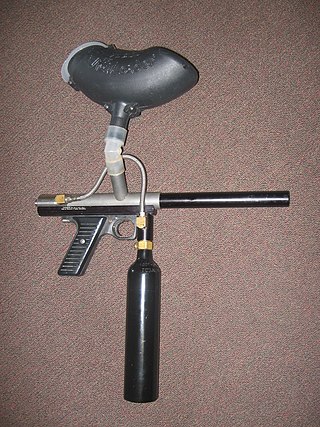
The Automag is a paintball marker designed by Tom Kaye and produced by Airgun Designs, Inc. It bears the distinction of being the first semi-automatic marker ever to win a paintball tournament. Team Swarm used Automags in their victory at the 1990 International Masters.
The Shocker is a series of electropneumatic paintball markers manufactured by Smart Parts. The original Shocker was built by PneuVentures and distributed by Smart Parts in the US in 1995. It is now discontinued, but was the first electropneumatic paintball marker on the market at the time. Several revisions of the marker have since been produced.
The Spyder Rodeo is a paintball marker designed and manufactured by Kingman Group.
The CCI Phantom is a Nelson-based pump action paintball marker developed and produced by Mike Casady. Production began in 1987 after about six months of prototype work. The name for the marker was derived from the much more stealth-oriented and drawn-out style of play that was typical when the game was first developing. The Phantom was designed to be powered by a single 12-gram CO2 Powerlet, but larger tanks may also be used by removing the powerlet adapter or using a dummy powerlet. When first introduced the marker featured a fixed barrel assembly referred to as a "unibody" combined with a modified Crosman air pistol frame and brass bead sight. However, since roughly 1989 the body and barrel of the marker have been two distinct parts and no longer feature the bead style sight. The marker is also capable of supporting bulk gravity fed hoppers by using a different breach type. The Phantom is one of only a handful of readily available markers acceptable for use in the various forms of stock class paintball. However, because the Phantom is capable of auto-triggering and features barrel porting it is considered to be a modified stock class marker.
The ICD Promaster is an electropneumatic paintball marker manufactured by Indian Creek Designs and first released in 2005. The Promaster was designed to replace the aging Bushmaster 2000 model, which had been Indian Creek Design's flagship marker between 2000 and 2004.
The PGP is a paintball pistol originally manufactured by Sheridan. It is a "Stock Class" paintball marker, meaning that it utilizes 12 gram CO2 powerlets, and has a horizontal feed tube that holds 10 rounds.
The Walther Model 1936 Olympia II is a single action semi-automatic handgun manufactured by Walther. The first version was the M1925, formally known as the Automatic Walther Sport Pistol cal. 22 LR, and was introduced in 1925. It was followed by the M1932, the Olympia Pistole I, and used to good effect in the 1932 Olympic Games. The final development Walther made was the M1936 Olympia II that won five Gold Medals at the 1936 Berlin Olympics and effectively ended the Olympic reign of the Colt Woodsman Target model. The pistol continued to be manufactured up until 1944, but no major changes were made during the war. In 1952 the pistol was reintroduced under license by Hämmerli-Walther. In 1957 Smith & Wesson introduced the Model 41, based on the Olympia-Pistole. The Norinco TT Olympia is a Chinese copy of the Walther M1936 Hunter made sometime after 1980. Most variants were chambered for the .22 Long Rifle but the Schnellfeuer version used the .22 short, produced to equip the German team for the Berlin Olympic Games of 1936 for the rapid fire events. The Olympia pistol is a fixed barrel, internal hammer, open-topped slide design and had a large contoured wooden grip which extended well below the bottom of the butt frame causing the necessity of the magazine bottom plate to be fitted with a wooden block extension. Once World War II started, the need for weapons quickly shifted from competition and sport to the military, thus Olympia production slowed.
The Barrett M90 is a bolt-action, bullpup rifle chambered in .50 BMG. It was designed and manufactured by Barrett Firearms Company. In 1995, Barrett stopped production of the M90, and replaced it with the M95.
The Intimidator is an electropneumatic paintball marker that was manufactured by former professional paintball player Bob Long and his company, Bob Long Technologies.
The Barrett Model 98B is a bolt-action sniper rifle chambered in .338 Lapua Magnum and manufactured by Barrett Firearms Manufacturing. The Model 98B was officially announced in October 2008, and became available for sale in early 2009, with an MSRP of $4,495.00.
The Fabarm FP6 is a pump-action combat shotgun that was manufactured by the Italian firearms company Fabbrica Bresciana Armi S.p.A. (FABARM) and sold by Heckler & Koch. It was intended for civilian and law enforcement use.
RAP4 is a manufacturer of paintball markers, paintball equipment, tactical gear and training tools.
The Savage 110 BA is a bolt-action sniper/tactical rifle manufactured by Savage Arms. The rifle is designated with an "LE" code; "Law Enforcement". All 110 BA series rifles are configured with AccuTrigger, matte-blued barreled action, fluted heavy free-floating barrel, muzzle brake, oversized bolt handle, external box magazine, magpul adjustable stock, adjustable pistol grip, and three swivel studs for sling and bipod mounting.

The Kingman Training: Eraser / Chaser are .43 caliber. (11mm) paintball pistols utilizing a Reversal Striker Valve (RSV) system. The KT marker gives a simulated weight and feel, comparable to a real hand pistol.

The UTAS UTS-15 is a 12 gauge pump-action shotgun with two 7-round magazine tubes that can feed in an alternating or selecting pattern. The UTS-15 has a 28.3" overall length with an 18.5" barrel, chambered for 2½", 2¾", and 3" magnum ammunition. Constructed primarily of fiber reinforced injection molded polymer, the UTS-15 weighs 6.9 lbs. Additionally, there is a top mounted picatinny rail for the mounting of a wide variety of both iron and optical sights, coupled with Beretta style barrel threading for choke tubes.


