Statement
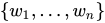
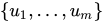
Let and be finite subsets of a vector space . If is a set of linearly independent vectors, and spans , then:


1. ;

2. There is a set with such that spans .
The Steinitz exchange lemma is a theorem in linear algebra concerning bases, dimensionality of a vector space, stating that for any set smaller than a spanning set, there is a set of vectors in the spanning set but missing from the smaller set that can be added to the smaller set to make that set spanning as well.
It can be used, for example, to show that any two bases for a finite-dimensional vector space have the same number of elements. The result is named after the German mathematician Ernst Steinitz. The result is often called the Steinitz–Mac Lane exchange lemma, also recognizing the generalization [1] by Saunders Mac Lane of Steinitz's lemma to matroids. [2]
Let and be finite subsets of a vector space . If is a set of linearly independent vectors, and spans , then:
1. ;
2. There is a set with such that spans .
Suppose and . We wish to show that , and that after rearranging the if necessary, the set spans . We proceed by induction on .
For the base case, suppose is zero. In this case, the claim holds because there are no vectors , and the set spans by hypothesis.
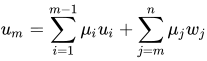
For the inductive step, assume the proposition is true for . By the inductive hypothesis we may reorder the so that spans . Since , there exist coefficients such that
At least one of the for must be non-zero, since otherwise this equality would contradict the linear independence of ; this also shows that indeed By reordering if necessary, we may assume that is nonzero. Therefore, we have
In other words, is in the span of . Since this span contains each of the vectors , by the inductive hypothesis it contains .
The Steinitz exchange lemma is a basic result in computational mathematics, especially in linear algebra and in combinatorial algorithms. [3]