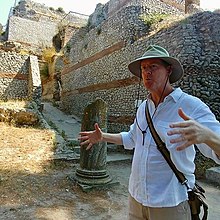
Miami University is a public research university in Oxford, Ohio, United States. The university was founded in 1809, making it the second-oldest university in Ohio and the 10th oldest public university in the United States. Miami was one of the original eight Public Ivy schools, a group of publicly funded universities considered as providing a quality of education comparable to those of the Ivy League. The school's system comprises the main campus in Oxford, as well as regional campuses in nearby Hamilton, Middletown, and West Chester. Miami also maintains an international boarding campus, the Dolibois European Center in Differdange, Luxembourg. It is classified among "R2: Doctoral Universities – High research activity".

The Villa of the Papyri was an ancient Roman villa in Herculaneum, in what is now Ercolano, southern Italy. It is named after its unique library of papyri scrolls, discovered in 1750. The Villa was considered to be one of the most luxurious houses in all of Herculaneum and in the Roman world. Its luxury is shown by its exquisite architecture and by the large number of outstanding works of art discovered, including frescoes, bronzes and marble sculpture which constitute the largest collection of Greek and Roman sculptures ever discovered in a single context.

Mary Ellen Miller is an American art historian and academician specializing in Mesoamerica and the Maya.

The J. Paul Getty Museum, commonly referred to as the Getty, is an art museum in Los Angeles, California housed on two campuses: the Getty Center and Getty Villa. It is operated by the J. Paul Getty Trust, the world's wealthiest art institution.

The J. Paul Getty Trust is the world's wealthiest art institution, with an estimated endowment of US$7.7 billion in 2020. Based in Los Angeles, California, it operates the J. Paul Getty Museum, which has two locations—the Getty Center in the Brentwood neighborhood of Los Angeles and the Getty Villa in the Pacific Palisades neighborhood of Los Angeles. Its other programs are the Getty Foundation, the Getty Research Institute, and the Getty Conservation Institute.

The Getty Villa is an educational center and art museum located at the easterly end of the Malibu coast in the Pacific Palisades neighborhood of Los Angeles, California, United States. One of two campuses of the J. Paul Getty Museum, the Getty Villa is dedicated to the study of the arts and cultures of ancient Greece, Rome, and Etruria. The collection has 44,000 Greek, Roman, and Etruscan antiquities dating from 6,500 BC to 400 AD, including the Lansdowne Heracles and the Victorious Youth. The UCLA/Getty Master's Program in Archaeological and Ethnographic Conservation is housed on this campus.

The Villa Poppaea is an ancient luxurious Roman seaside villa located in Torre Annunziata between Naples and Sorrento, in Southern Italy. It is also called the Villa Oplontis or Oplontis Villa A as it was situated in the ancient Roman town of Oplontis.

The Villa of the Mysteries is a well-preserved suburban ancient Roman villa on the outskirts of Pompeii, southern Italy. It is famous for the series of exquisite frescos in Room 5, which are usually interpreted as showing the initiation of a bride into a Greco-Roman mystery cult. These are now among the best known of the relatively rare survivals of Ancient Roman painting from the 1st century BC.
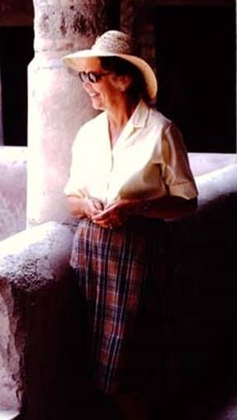
Wilhelmina Mary Feemster Jashemski was an American scholar of the ancient site of Pompeii, where her archaeological investigations focused on the evidence of gardens and horticulture in the ancient city. She is remembered for her contributions to archaeobotany at Pompeiian sites, as she developed methods for preserving the remains of roots from antiquity, known as root casting.

Villa Boscoreale is a name given to any of several Roman villas discovered in the district of Boscoreale, Italy. They were all buried and preserved by the eruption of Mount Vesuvius in 79 AD, along with Pompeii and Herculaneum. The only one visible in situ today is the Villa Regina, the others being reburied soon after their discovery. Although these villas can be classified as "rustic" rather than of otium due to their agricultural sections and sometimes lack of the most luxurious amenities, they were often embellished with extremely luxurious decorations such as frescoes, testifying to the wealth of the owners. Among the most important finds are the exquisite frescoes from the Villa of Publius Fannius Synistor and the sumptuous Boscoreale Treasure of the Villa della Pisanella, which is now displayed in several major museums.

Herron Gymnasium was a gymnasium and classroom building on the Miami University campus in Oxford, Ohio. Later known as Van Voorhis Hall, it was listed in the National Register of Historic Places in November 1979. Originally conceived in 1893, it was constructed in 1897 and named for John W. Herron, a Miami alumnus and Cincinnati judge. It was Miami University's first gymnasium, and would serve as the main recreational center until the construction of Withrow Court in 1932, which led Herron to become a women's gym. Except for an interlude during World War II when it served as a Navy barracks, it served as a women's gym until the construction of "New Herron" in 1962. In the late 20th century its use diminished to AFROTC and men's intramural sports, and the gymnasium was demolished in 1986 and replaced with a parking lot.

Barry Allen Munitz has been a senior administrator at the University of Illinois and the University of Houston, a business executive at Maxxam, Inc., chancellor of the California State University system, and chief executive officer of the world's wealthiest art institution, the J. Paul Getty Trust. He is on the Board of Selectors of Jefferson Awards for Public Service.

Herculaneum was an ancient Roman town, located in the modern-day comune of Ercolano, Campania, Italy. Herculaneum was buried under volcanic ash and pumice in the eruption of Mount Vesuvius in 79 AD.
Roger Clifford Carrington (1906–1971) was an English classical scholar, archaeologist and teacher. He was headmaster of St. Olave's and St. Saviour's Grammar School for Boys from 1937 to 1970.

The Joukowsky Institute for Archaeology and the Ancient World is an interdisciplinary center at Brown University focused on research and teaching of archaeology, with an emphasis on the archaeology and art of the ancient Mediterranean, Egypt, and the Near East. Brown's undergraduate and graduate programs in archeology are organized through the institute.

Barbara Tsakirgis was an American classical archaeologist with specialization in Greek and Roman archaeology, particularly of ancient Greek houses and households. She worked in the archaeological excavation sites in Sicily and Athens for her doctoral thesis from Princeton University on the subject of Hellenistic houses at Morgantina. Her thesis was published as The Domestic Architecture of Morgantina in the Hellenistic and Roman Periods (1984). She taught at the Vanderbilt University's Department of Classical Studies and was an associate professor from 1992 to 2019.

José Antonio Bowen is an American author and academic. He served as the 11th president of Goucher College from 2014 to 2019.
Lea Margaret Stirling is a Canadian classical scholar and professor in the Department of Classics at the University of Manitoba. Her research focuses on Roman archaeology and Roman art with particular emphases on Roman sculpture, Late Antique art, and cemetery archaeology, and Roman North Africa.

Kelly Olson is a Canadian Classicist. She is Professor and Acting Chair in the Department of Classical Studies at the University of Western Ontario.
Avinoam Shalem is the Riggio Professor of the History of the Arts of Islam at Columbia University. He served as director of the American Academy in Rome from 2020 to 2021.