
The Metropolitan Museum of Art, colloquially referred to as the Met, is an art museum in New York City. It is the largest art museum in the Americas and fourth-largest in the world.

Naïve art is usually defined as visual art that is created by a person who lacks the formal education and training that a professional artist undergoes. When this aesthetic is emulated by a trained artist, the result is sometimes called primitivism, pseudo-naïve art, or faux naïve art.
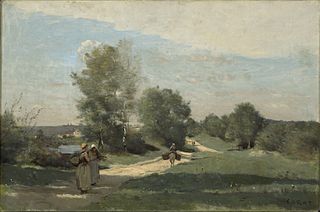
The Barbizon school of painters were part of an art movement toward Realism in art, which arose in the context of the dominant Romantic Movement of the time. The Barbizon school was active roughly from 1830 through 1870. It takes its name from the village of Barbizon, France, on the edge of the Forest of Fontainebleau, where many of the artists gathered. Most of their works were landscape painting, but several of them also painted landscapes with farmworkers, and genre scenes of village life. Some of the most prominent features of this school are its tonal qualities, color, loose brushwork, and softness of form.

Henri Julien Félix Rousseau was a French post-impressionist painter in the Naïve or Primitive manner. He was also known as Le Douanier, a humorous description of his occupation as a toll and tax collector. He started painting seriously in his early forties; by age 49, he retired from his job to work on his art full-time.
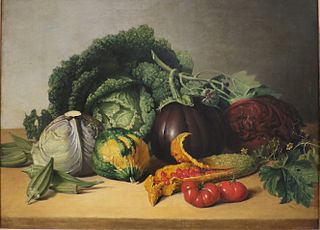
Still Life: Balsam Apple and Vegetables is an early 19th century oil painting by American painter James Peale. Done in oil on canvas, the painting depicts a number of vegetables set on a table. The work is currently on display at the Metropolitan Museum of Art. It is considered Peale's finest still life.

Still Life with Checked Tablecloth is an early 20th century painting by Spanish Cubist artist Juan Gris. Done in oil and graphite on canvas, the painting depicts a table set with grapes, a bottle of red wine, beer, a newspaper and guitar. In addition, the composite image formed from these various objects can be seen as Gris' take on a bull's head. The work is in the collection of the Metropolitan Museum of Art.

Still Life with a Guitar is an oil on canvas painting by Spanish cubist Juan Gris, from 1913. The work is in the collection of the Metropolitan Museum of Art, in New York, Gallery 905.

Violin and Playing Cards on a Table is an oil on canvas painting by Spanish cubist Juan Gris, from 1913. The work is a still life, a typical motif for the cubists. It is in the collection of the Metropolitan Museum of Art, in New York.

In a Courtyard, Tangier is a late 19th-century painting by French artist Philippe Pavy. Done in oil on wood, the work depicts a young woman resting in a Tangerian courtyard. The painting was one of a series of paintings Pavy produced after he traveled in North Africa in the 1880s. It is currently in the collection of the Metropolitan Museum of Art.

The Afternoon Meal is a mid-eighteenth-century still life painting by Spanish painter Luis Egidio Meléndez (1716–1780).
The Repast of the Lion is an early 20th century painting by French post-impressionist Henri Rousseau. Done in oil on canvas, the work depicts a feeding lion in a jungle setting. The painting expands upon some of Rousseau's late 19th century work, and the foliage depicted in the painting was inspired by the artist's studying of Paris' botanical gardens. The work is currently on display at the Metropolitan Museum of Art.

Boating is an 1874 painting by French artist Édouard Manet in the collection of the Metropolitan Museum of Art, New York.

Lady at the Tea Table is a late 19th-century painting by American artist Mary Cassatt. The work, done in oil on canvas, is in the collection of the Metropolitan Museum of Art.

Cypresses is a late 19th-century painting by Dutch artist Vincent van Gogh painted around June 1889. Done in oil on canvas, the painting depicts a pair of cypress trees in the French countryside. The work is currently on display in the Metropolitan Museum of Art.

Philippe Rousseau was a French painter known primarily for his still life paintings.

Morning, An Overcast Day, Rouen is a late 19th-century painting by Danish-French artist Camille Pissarro. Done in oil on canvas, the work depicts the industrial cityscape of Rouen, France. The centerpiece of the painting is Boieldieu Bridge, a steel arch bridge which Pissarro painted from his room in a nearby hotel. The painting is in the collection of the Metropolitan Museum of Art.

The Banks of the Bièvre near Bicêtre is an oil-on-canvas painting executed c. 1908–09 by French artist Henri Rousseau. It depicts the working-class community of Bicêtre on the outskirts of southern Paris. The painting is in the collection of the Metropolitan Museum of Art.

Boy Blowing Bubbles is an 1867 oil-on-canvas painting by Édouard Manet, who gave it its present title. It depicts Léon Koelin-Leenhoff, the illegitimate son of Manet's future wife, Suzanne Leenhoff. The painting shows him aged 15 blowing soap bubbles, a traditional symbol of the brevity of life. It is now in the Calouste Gulbenkian Museum in Lisbon, whose founder acquired it via André Weil in New York in November 1943.
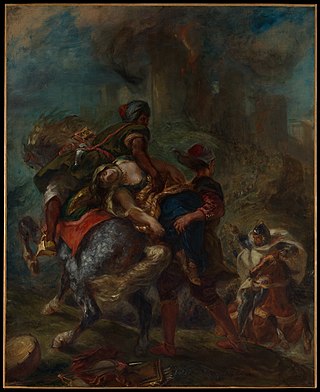
The Abduction of Rebecca is a mid-19th century painting by French artist Eugène Delacroix. Done in oil on canvas, the work depicts the a scene from Sir Walter Scott's novel Ivanhoe in which the heroine Rebecca is abducted. Delacroix produced the painting during the height of the French Romanticist Movement, and presented the work at the Paris Salon of 1846. The 1846 version of Abduction is currently in the collection of the Metropolitan Museum of Art, which describes the work as "one of Delacroix’s greatest paintings". In 1858 Delacroix created an almost identical work for the Paris Salon of 1859; the second version of Abduction is in the collection of the Louvre.

Grace Hoops is a genre painting by the American artist Winslow Homer. It depicts two young women outdoors playing the game of graces. Scenes of childhood innocence constituted one of Homer's recurring subjects throughout the 1870s. The work is now in the collection of the McMullen Museum of Art at Boston College, having been donated as part of the Carolyn A. and Peter S. Lynch collection.

