This article is being considered for deletion in accordance with Wikipedia's deletion policy. Please share your thoughts on the matter at this article's entry on the Articles for deletion page. Feel free to improve the article, but the article must not be blanked, and this notice must not be removed, until the discussion is closed. For more information, particularly on merging or moving the article during the discussion, read the guide to deletion. |
 | This article may rely excessively on sources too closely associated with the subject, potentially preventing the article from being verifiable and neutral.(April 2018) (Learn how and when to remove this template message) |
 | |
| Abbreviation | CEPAS |
|---|---|
| Established | 1965 |
| Type | Social service center |
| Purpose | Promotion of just political and socio-economic development |
| Location |
|
Region served | Democratic Republic of the Congo |
Official language | French |
Director | Alain Nzadi-a-Nzadi |
Research & animation | John P. Nyembo |
Editor | Pierre Akele Adau |
Development | Patrick Mavinga |
Main organ | Revue |
Parent organization | Central African Province of Jesuits |
| Affiliations | Jesuit, Catholic |
Budget | US$180,000/year |
Staff | 14 |
| Website | (in French) Official website |
Studies Centre for Social Action (Centre d'Etudes pour l'Action Sociale), CEPAS, has since 1965, soon after independence, promoted equitable development in the Democratic Republic of Congo through its socio-economic and political studies. It is a development centre run by the Central African Province of the Society of Jesus in the Catholic Church. [1]

The Society of Jesus is a scholarly religious congregation of the Catholic Church which originated in sixteenth-century Spain. The members are called Jesuits. The society is engaged in evangelization and apostolic ministry in 112 nations. Jesuits work in education, intellectual research, and cultural pursuits. Jesuits also give retreats, minister in hospitals and parishes, sponsor direct social ministries, and promote ecumenical dialogue.
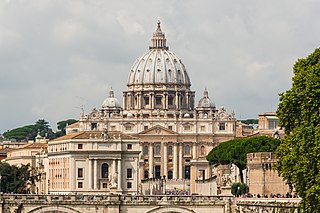
The Catholic Church, also known as the Roman Catholic Church, is the largest Christian church, with approximately 1.3 billion baptised Catholics worldwide as of 2016. As the world's "oldest continuously functioning international institution", it has played a prominent role in the history and development of Western civilisation. The church is headed by the Bishop of Rome, known as the Pope. Its central administration, the Holy See, is in the Vatican City, an enclave within the city of Rome in Italy.
Currently the priority themes addressed by CEPAS include decentralization, accountability of public authorities, civic education, natural resource governance, peace and reconciliation, gender balance, and poverty reduction.[ citation needed ]
Support for CEPAS comes from Misereor (Germany), Carême (Switzerland), Alboan and Entreculturas (Spain). CEPAS collaborates with World Vision, OSISA and SARW (South Africa), the Carter Center (USA), Rodhecic, Episcopal Commission for Natural Resources, the DRC Ministry of Finance and Central Bank, and CADICEC. [2]
Entreculturas is a non-governmental organization for development cooperation, the international social outreach of the Spanish Province of Jesuits, founded in Madrid in 1985. It focuses mainly on educating the poor in Latin America and Africa, while responding to humanitarian crises and also educating to global awareness in Spain.

The Carter Center is a nongovernmental, not-for-profit organization founded in 1982 by former U.S. President Jimmy Carter. He and his wife Rosalynn Carter partnered with Emory University just after his defeat in the 1980 U.S. Presidential elections. The center is located in a shared building adjacent to the Jimmy Carter Library and Museum on 37 acres (150,000 m2) of parkland, on the site of the razed neighborhood of Copenhill, two miles (3 km) from downtown Atlanta, Georgia. The library and museum are owned and operated by the United States National Archives and Records Administration, while the Center is governed by a Board of Trustees, consisting of business leaders, educators, former government officials, and philanthropists.
