
Look up subsonic in Wiktionary, the free dictionary.
Subsonic may refer to:
Subsonic may refer to:


Aerodynamics, from Ancient Greek: ἀήρ aero (air) + Ancient Greek: δυναμική (dynamics), is the study of the motion of air, particularly when affected by a solid object, such as an airplane wing. It involves topics covered in the field of fluid dynamics and its subfield of gas dynamics. The term aerodynamics is often used synonymously with gas dynamics, the difference being that "gas dynamics" applies to the study of the motion of all gases, and is not limited to air. The formal study of aerodynamics began in the modern sense in the eighteenth century, although observations of fundamental concepts such as aerodynamic drag were recorded much earlier. Most of the early efforts in aerodynamics were directed toward achieving heavier-than-air flight, which was first demonstrated by Otto Lilienthal in 1891. Since then, the use of aerodynamics through mathematical analysis, empirical approximations, wind tunnel experimentation, and computer simulations has formed a rational basis for the development of heavier-than-air flight and a number of other technologies. Recent work in aerodynamics has focused on issues related to compressible flow, turbulence, and boundary layers and has become increasingly computational in nature.

The Aérospatiale/BAC Concorde is a Franco-British supersonic airliner jointly developed and manufactured by Sud Aviation and the British Aircraft Corporation (BAC). Studies started in 1954, and France and the UK signed a treaty establishing the development project on 29 November 1962, as the programme cost was estimated at £70 million . Construction of the six prototypes began in February 1965, and the first flight took off from Toulouse on 2 March 1969. The market was predicted for 350 aircraft, and the manufacturers received up to 100 option orders from many major airlines. On 9 October 1975, it received its French Certificate of Airworthiness, and from the UK CAA on 5 December.
Mach number is a dimensionless quantity in fluid dynamics representing the ratio of flow velocity past a boundary to the local speed of sound. It is named for the Moravian physicist and philosopher Ernst Mach.

A ramjet, or athodyd, is a form of airbreathing jet engine that uses the forward motion of the engine to produce thrust. Since it produces no thrust when stationary ramjet-powered vehicles require an assisted take-off like a rocket assist to accelerate it to a speed where it begins to produce thrust. Ramjets work most efficiently at supersonic speeds around Mach 3 and can operate up to speeds of Mach 6.

Supersonic speed is the speed of an object that exceeds the speed of sound (Mach 1). For objects traveling in dry air of a temperature of 20 °C (68 °F) at sea level, this speed is approximately 343.2 m/s. Speeds greater than five times the speed of sound (Mach 5) are often referred to as hypersonic. Flights during which only some parts of the air surrounding an object, such as the ends of rotor blades, reach supersonic speeds are called transonic. This occurs typically somewhere between Mach 0.8 and Mach 1.2.

A jet aircraft is an aircraft propelled by jet engines.
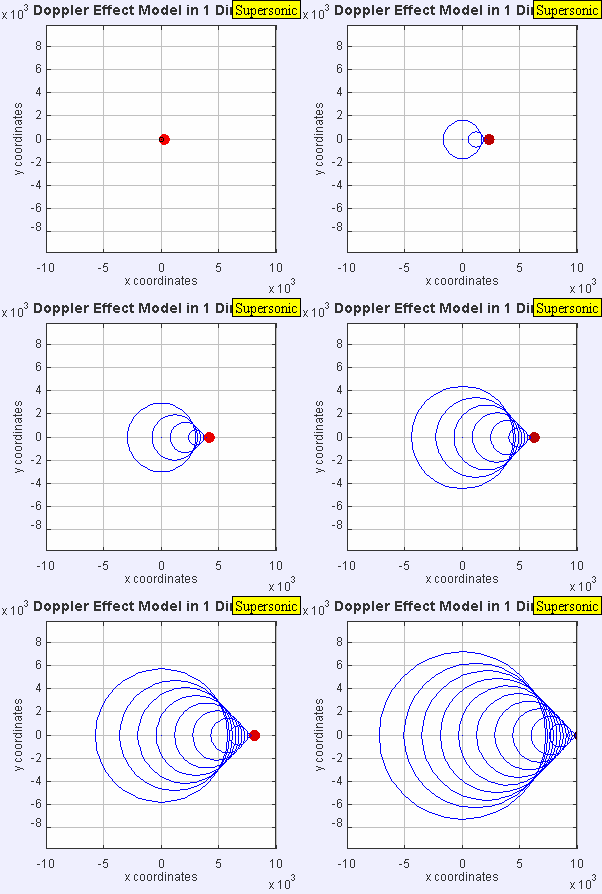
A sonic boom is a sound associated with shock waves created when an object travels through the air faster than the speed of sound. Sonic booms generate enormous amounts of sound energy, sounding similar to an explosion or a thunderclap to the human ear. A decibel is the primary unit measurement of sound. "A thunderclap is incredibly loud, producing levels between 100 and 120 dBA - the equivalent of standing near a jet during take-off."

A supersonic transport (SST) or a supersonic airliner is a civilian supersonic aircraft designed to transport passengers at speeds greater than the speed of sound. To date, the only SSTs to see regular service have been Concorde and the Tupolev Tu-144. The last passenger flight of the Tu-144 was in June 1978 and it was last flown in 1999 by NASA. Concorde's last commercial flight was in October 2003, with a November 26, 2003 ferry flight being its last airborne operation. Following the permanent cessation of flying by Concorde, there are no remaining SSTs in commercial service. Several companies have each proposed a supersonic business jet, which may bring supersonic transport back again.

A scramjet is a variant of a ramjet airbreathing jet engine in which combustion takes place in supersonic airflow. As in ramjets, a scramjet relies on high vehicle speed to compress the incoming air forcefully before combustion, but whereas a ramjet decelerates the air to subsonic velocities before combustion using shock cones, a scramjet has no shock cone and slows the airflow using shockwaves produced by its ignition source in place of a shock cone. This allows the scramjet to operate efficiently at extremely high speeds.
Transonic flow is air flowing around an object at a speed that generates regions of both subsonic and supersonic airflow around that object. The exact range of speeds depends on the object's critical Mach number, but transonic flow is seen at flight speeds close to the speed of sound, typically between Mach 0.8 and 1.2.
Supercruise is sustained supersonic flight of a supersonic aircraft with a useful cargo, passenger, or weapons load without using afterburner. Many supersonic military aircraft are not capable of supercruise and can only maintain Mach 1+ flight in short bursts with afterburners. Aircraft such as the SR-71 Blackbird are designed to cruise at supersonic speed with afterburners enabled.
Indicated airspeed (IAS) is the airspeed read directly from the airspeed indicator (ASI) on an aircraft, driven by the pitot-static system. It uses the difference between total pressure and static pressure, provided by the system, to either mechanically or electronically measure dynamic pressure. The dynamic pressure includes terms for both density and airspeed. Since the airspeed indicator cannot know the density, it is by design calibrated to assume the sea level standard atmospheric density when calculating airspeed. Since the actual density will vary considerably from this assumed value as the aircraft changes altitude, IAS varies considerably from true airspeed (TAS), the relative velocity between the aircraft and the surrounding air mass. Calibrated airspeed (CAS) is the IAS corrected for instrument and position error.

Inlet cones are a component of some supersonic aircraft and missiles. They are primarily used on ramjets, such as the D-21 Tagboard and Lockheed X-7. Some turbojet aircraft including the Su-7, MiG-21, English Electric Lightning, and SR-71 also use an inlet cone.
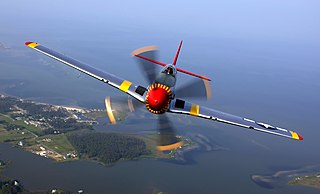
An airplane or aeroplane is a fixed-wing aircraft that is propelled forward by thrust from a jet engine, propeller, or rocket engine. Airplanes come in a variety of sizes, shapes, and wing configurations. The broad spectrum of uses for airplanes includes recreation, transportation of goods and people, military, and research. Worldwide, commercial aviation transports more than four billion passengers annually on airliners and transports more than 200 billion tonne-kilometers of cargo annually, which is less than 1% of the world's cargo movement. Most airplanes are flown by a pilot on board the aircraft, but some are designed to be remotely or computer-controlled such as drones.

In aerodynamics, the critical Mach number of an aircraft is the lowest Mach number at which the airflow over some point of the aircraft reaches the speed of sound, but does not exceed it. At the lower critical Mach number, airflow around the entire aircraft is subsonic. Supersonic aircraft such as Concorde and combat aircraft also have an upper critical Mach number at which the airflow around the entire aircraft is supersonic.

A supersonic aircraft is an aircraft capable of supersonic flight, which is an aircraft able to fly faster than the speed of sound. Supersonic aircraft were developed in the second half of the twentieth century. Supersonic aircraft have been used for research and military purposes, but only two supersonic aircraft, the Tupolev Tu-144 and the Concorde, ever entered service for civil use as airliners. Fighter jets are the most common example of supersonic aircraft.
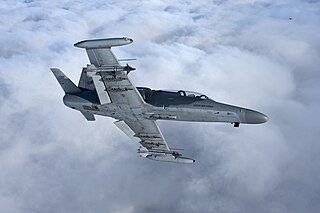
A subsonic aircraft is an aircraft with a maximum speed less than the speed of sound. The term technically describes an aircraft that flies below its critical Mach number, typically around Mach 0.8. All current civil aircraft, including airliners, helicopters, future passenger drones, personal air vehicles and airships, as well as many military types, are subsonic.

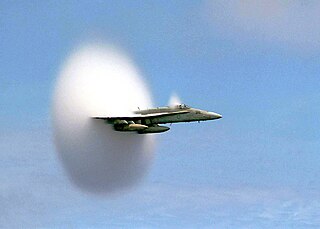
A vapor cone, also known as shock collar or shock egg, is a visible cloud of condensed water that can sometimes form around an object moving at high speed through moist air, for example, an aircraft flying at transonic speeds. When the localized air pressure around the object drops, so does the air temperature. If the temperature drops below the saturation temperature, a cloud forms.
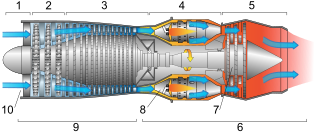
This article briefly describes the components and systems found in jet engines.
An airbreathing jet engine is a jet engine that ejects a propelling (reaction) jet of hot exhaust gases after first taking in atmospheric air, followed by compression, heating and expansion back to atmospheric pressure through a nozzle. Alternatively the reaction jet may include a cold jet of ducted bypass air which has been compressed by a fan before returning to atmospheric pressure through an additional nozzle. These engines are gas turbine engines. Engines using only ram for the compression process, and no turbomachinery, are the ramjet and pulsejet.