Sunan Walilanang is, according to the Babad Tanah Jawi ("History of the land of Java") manuscripts, one of the nine Wali Sanga ("Nine Saints") to whom Indonesian legend attributes the establishment of Islam as the dominant religion amongst the Javanese, Indonesia's largest ethnic group.

Indonesia, officially the Republic of Indonesia, is a country in Southeast Asia and Oceania between the Indian and Pacific oceans. It consists of over 17,000 islands, including Sumatra, Java, Sulawesi, and parts of Borneo and New Guinea. Indonesia is the world's largest archipelagic state and the 14th-largest country by area, at 1,904,569 square kilometres. With over 280 million people, Indonesia is the world's fourth-most-populous country and the most populous Muslim-majority country. Java, the world's most populous island, is home to more than half of the country's population.

The history of Indonesia has been shaped by its geographic position, natural resources, a series of human migrations and contacts, wars and conquests, as well as by trade, economics and politics. Indonesia is an archipelagic country of 17,000 to 18,000 islands stretching along the equator in Southeast Asia. The country's strategic sea-lane position fostered inter-island and international trade; trade has since fundamentally shaped Indonesian history. The area of Indonesia is populated by peoples of various migrations, creating a diversity of cultures, ethnicities, and languages. The archipelago's landforms and climate significantly influenced agriculture and trade, and the formation of states. The boundaries of the state of Indonesia match the 20th-century borders of the Dutch East Indies.

Sumatra is one of the Sunda Islands of western Indonesia. It is the largest island that is fully within Indonesian territory, as well as the sixth-largest island in the world at 482,286.55 km2 (182,812 mi.2), including adjacent islands such as the Simeulue, Nias, Mentawai, Enggano, Riau Islands, Bangka Belitung and Krakatoa archipelago.

Southeast Asia is the geographical southeastern region of Asia, consisting of the regions that are situated south of China, east of the Indian subcontinent, and northwest of the Australian mainland, which is part of Oceania. Southeast Asia is bordered to the north by East Asia, to the west by South Asia and the Bay of Bengal, to the east by Oceania and the Pacific Ocean, and to the south by Australia and the Indian Ocean. Apart from the British Indian Ocean Territory and two out of 26 atolls of the Maldives in South Asia, Maritime Southeast Asia is the only other subregion of Asia that lies partly within the Southern Hemisphere. Mainland Southeast Asia is entirely in the Northern Hemisphere. East Timor and the southern portion of Indonesia are the parts of Southeast Asia that lie south of the equator.
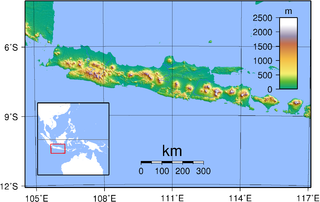
Java is one of the Greater Sunda Islands in Indonesia. It is bordered by the Indian Ocean to the south and the Java Sea to the north. With a population of 156.4 million people, Java is the world's most populous island, home to approximately 56% of the Indonesian population. Indonesia's capital city, Jakarta, is on Java's northwestern coast.

Tuanku Imam Bonjol, also known as Muhammad Syahab, Peto Syarif, and Malim Basa, was one of the most popular leaders of the Padri movement in Central Sumatra. He was declared a National Hero of Indonesia.

Aceh, officially the Province of Aceh, is the westernmost province of Indonesia. It is located on the northern end of Sumatra island, with Banda Aceh being its capital and largest city. It is bordered by the Indian Ocean to the west, Strait of Malacca to the northeast, as well bordering the province of North Sumatra to the east, its sole land border, and shares maritime borders with Malaysia and Thailand to the east, and Andaman and Nicobar Islands of India to the north. Granted a special autonomous status, Aceh is a religiously conservative territory and the only Indonesian province practicing Sharia law officially. There are ten indigenous ethnic groups in this region, the largest being the Acehnese people, accounting for approximately 70% of the region's population of about 5.5 million people in mid-2023. Its area is comparable to Croatia or Togo.

The National Awakening Party, frequently abbreviated to PKB, is an Islam-based political party in Indonesia.

Islam is the largest religion in Indonesia, with 87.06% of the Indonesian population identifying themselves as Muslims, based on civil registry data in 2023. In terms of denomination, the overwhelming majority are Sunni Muslims; the Pew Research Center estimates them as comprising ~99% of the country's Muslim population in 2011, with the remaining 1% being Shia who are concentrated around Jakarta and about 400,000 Ahmadi as well.

The Samudera Pasai Sultanate, also known as Samudera or Pasai or Samudera Darussalam or Pacem, was a Muslim kingdom on the north coast of Sumatra from the 13th to the 16th centuries.

Kejawèn or Javanism, also called Kebatinan, Agama Jawa, and Kepercayaan, is a Javanese cultural tradition, consisting of an amalgam of Animistic, Buddhist, Islamic and Hindu aspects. It is rooted in Javanese history and religiosity, syncretizing aspects of different religions and traditions.

Muhammadiyah ; officially Muhammadiyah Society is a major Islamic non-governmental organization in Indonesia. The organization was founded in 1912 by Ahmad Dahlan in the city of Yogyakarta as a reformist socioreligious movement, advocating ijtihad - individual interpretation of Qur'an and Sunnah, as opposed to Taqlid - conformity to the traditional interpretations propounded by the ulama. Since its establishment, Muhammadiyah has adopted a reformist platform mixing religious and secular education, primarily as a way to promote the upward mobility of Muslims toward a 'modern' community and to purify Indonesian Islam of local syncretic practices. It continues to support local culture and promote religious tolerance in Indonesia, while a few of its higher education institutions are attended mostly by non-Muslims, especially in East Nusa Tenggara and Papua provinces. The group also runs a large chain of charity hospitals, and operated 128 universities as of the late 1990s.

Several different religions are practised in Indonesia. Indonesia is officially a presidential republic and a unitary state without an established state religion. The first principle of Indonesia's philosophical foundation, Pancasila, requires its citizens to state the belief in "the one and almighty God". Although, as explained by the Constitutional Court, this first sila of Pancasila is an explicit recognition of divine substances and meant as a principle on how to live together in a religiously diverse society. Blasphemy is a punishable offence and the Indonesian government has a discriminatory attitude towards its numerous tribal religions, atheist and agnostic citizens. In addition, the Aceh province officially applies Sharia law and is notorious for its discriminatory practices towards religious and sexual minorities.

The history of the arrival of Islam in Indonesia is somewhat unclear. One theory states that Islam arrived directly from Arabia as early as the 9th century, during the time of the Umayyad and Abbasid caliphates. Another theory credits Sufi travelers for bringing Islam in the 12th or 13th century, either from Gujarat in India or from Persia. Before the archipelago's conversion to Islam, the predominant religions in Indonesia were Hinduism and Buddhism.

Ahmad Syafi'i Maarif, popularly known as Buya Syafi'i, was an Indonesian Islamic scholar and intellectual. He was chairman of Muhammadiyah between 1998 and 2005. Educated in the United States, he was known for his moderate and progressive interpretation of Islam and his opposition to the direct influence of Islam in politics.

Azyumardi Azra was an Indonesian public intellectual, Muslim scholar and Rector of Syarif Hidayatullah State Islamic University Jakarta. He graduated from Department of History, Columbia University in 1992. He was known as a prolific books writer; member of advisory board of a number of international organizations such as UN Democracy Fund (UNDEF), International Institute for Democracy and Electoral Assistance. After serving as Rector at Syarif Hidayatullah State Islamic University Jakarta, he was the Director of Graduate School.
Sejarah Banten is a Javanese chronicle containing stories of conversion to Islam in Indonesia. The manuscripts of the chronicle date from the late 19th century, although two are known to be copies written from the originals in the 1730s and 1740s.

Tajug is a pyramidal or pyramid square ornament which is usually used for sacred buildings in Southeast Asia including Indonesia, such as mosque or cupola graveyard. It is considered derived from Indian and Chinese architecture, which has history since pre-Islamic era, although there's also an element of an influence from Indian mosques. The term tajug is also used to refer to mosques or surau in some regions of Indonesia.
Campus Dakwah Institute is a collective term for a student organization in Indonesia aimed as a union for Muslim campus students as well as medium for proselytization of Islam (dawah). Most universities in Indonesia have their own LDK. In each campus, LDK can be different in its organization, in which different names are often employed, including Unit Kegiatan Mahasiswa Islam, Kerohanian Islam, Forum Studi Islam, and Badan Kerohanian Islam.

Mosque architecture in Indonesia refers to the architectural traditions of mosques built in the archipelago of Indonesia. Initial forms of the mosque, for example, were predominantly built in the vernacular Indonesian architectural style mixed with Hindu, Buddhist or Chinese architectural elements, and notably didn't equip orthodox form of Islamic architectural elements such as dome and minaret. Vernacular architectural style varies depending on the island and region.
 | This Indonesian biographical article is a stub. You can help Wikipedia by expanding it. |
