Related Research Articles
Electronic music is a genre of music that employs electronic musical instruments, digital instruments, or circuitry-based music technology in its creation. It includes both music made using electronic and electromechanical means. Pure electronic instruments depended entirely on circuitry-based sound generation, for instance using devices such as an electronic oscillator, theremin, or synthesizer. Electromechanical instruments can have mechanical parts such as strings, hammers, and electric elements including magnetic pickups, power amplifiers and loudspeakers. Such electromechanical devices include the telharmonium, Hammond organ, electric piano and the electric guitar.

Ryuichi Sakamoto was a Japanese composer, pianist, record producer, and actor who pursued a diverse range of styles as a solo artist and as a member of Yellow Magic Orchestra (YMO). With his bandmates Haruomi Hosono and Yukihiro Takahashi, Sakamoto influenced and pioneered a number of electronic music genres.

Chiptune is a style of synthesized electronic music made using the programmable sound generator (PSG) sound chips or synthesizers in vintage arcade machines, computers and video game consoles. The term is commonly used to refer to tracker format music using extremely basic and small samples that an old computer or console could produce, as well as music that combines PSG sounds with modern musical styles. It has been described as "an interpretation of many genres" since any existing song can be arranged in a chiptune style defined more by choice of instrument and timbre than specific style elements.

Yellow Magic Orchestra was a Japanese electronic music band formed in Tokyo in 1978 by Haruomi Hosono, Yukihiro Takahashi and Ryuichi Sakamoto. The group is considered influential and innovative in the field of popular electronic music. They were pioneers in their use of synthesizers, samplers, sequencers, drum machines, computers, and digital recording technology, and effectively anticipated the "electropop boom" of the 1980s. They are credited with playing a key role in the development of several electronic genres, including synthpop, J-pop, electro, and techno, while exploring subversive sociopolitical themes throughout their career.

Uwe H. Schmidt, also known as Atom™, Atom Heart, or Señor Coconut, is a German composer, musician and producer of electronic music. He is often regarded as the father of electrolatino, electrogospel, and aciton music. In the nineties, Schmidt moved to Chile and developed part of his career there, adopting the alias Señor Coconut.

Haruomi Hosono, sometimes credited as Harry Hosono, is a Japanese musician, singer, songwriter and record producer. He is considered to be one of the most influential musicians in Japanese pop music history, credited with shaping the sound of Japanese pop for decades as well as pop music outside of Japan. He also inspired genres such as city pop and Shibuya-kei, and as leader of Yellow Magic Orchestra, contributed to the development and pioneering of numerous electronic genres.

The Roland MC-8 MicroComposer by the Roland Corporation was introduced in early 1977 at a list price of US$4,795. It was one of the earliest stand-alone microprocessor-driven CV/Gate music sequencers, following EMS Sequencer 256 in 1971 and New England Digital's ABLE computer (microprocessor) in 1975. Roland called the MC-8 a "computer music composer" and it was considered revolutionary at the time, introducing features such as a keypad to enter note information and 16 kilobytes of random access memory which allowed a maximum sequence length of 5200 notes, a huge step forward from the 8-16 step sequencers at the time. It also allowed the user to allocate multiple pitch CVs to a single Gate channel, creating polyphonic parts within the overall sequence. Due to the high price, only 200 units were sold worldwide, but it represented a huge leap forward in music technology.

Yukihiro Takahashi was a Japanese musician, singer, record producer, and actor, who was best known internationally as the drummer and lead vocalist of the Yellow Magic Orchestra, and as the former drummer of the Sadistic Mika Band. He was also a member of the group Metafive.
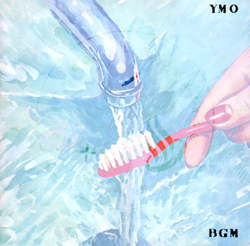
BGM is the fourth studio album by Yellow Magic Orchestra, released on March 21, 1981. The title stands for "Background music", though Japanese TV and press advertising alternately used "Beautiful Grotesque Music". This album was produced by Haruomi Hosono. Recording started on January 15, 1981, in an effort to release the album by March 21, 1981. The album was the first of any kind to feature the Roland TR-808, one of the earliest programmable drum machines; YMO had already been the first band to use the device, featuring it on-stage as early as 1980. In addition to the TR-808, this was also their first studio album recorded with the Roland MC-4 Microcomposer.

Yellow Magic Orchestra is the first official studio album by Japanese electronic music band Yellow Magic Orchestra, who were previously known as the Yellow Magic Band. Originally released by Alfa Records, in Japan in 1978, the album was released by A&M Records in Europe and the United States and Canada in early 1979, with the US version featuring new cover art but without the closing track of "Acrobat". Both versions would later be re-issued in 2003 as a double-disc format, with the American version as the first disc.
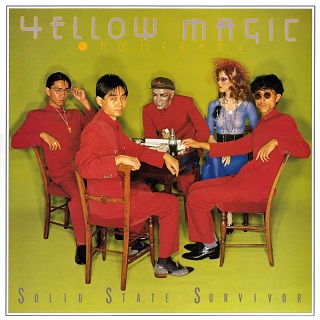
Solid State Survivor is the second album by Japanese electronic music band Yellow Magic Orchestra, released in 1979. Later, Solid State Survivor was released in 1982 in the UK on LP and cassette, also in 1992 in the United States on CD, but many of the songs from this album were compiled for release in the US as the US pressing of ×∞Multiplies (1980), including the tracks "Behind the Mask", "Rydeen", "Day Tripper", and "Technopolis". Solid State Survivor is only one of a handful of YMO albums in which the track titles do not have a Japanese equivalent.

Technodelic is the fifth studio album by Yellow Magic Orchestra, released in 1981. The album is notable for its experimental approach and heavy use of digital samplers which were not commonly used until the mid-to-late 1980s, resulting in a more minimalist and avant-garde sound compared to their previous work.

Satoshi Tomiie is a Japanese DJ and record producer.
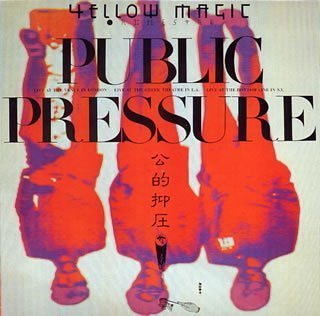
Public Pressure is Yellow Magic Orchestra's first live album, released on February 21, 1980. It was their second number-one album in Japan, setting a record of 250,000 copies sold within two weeks of release.
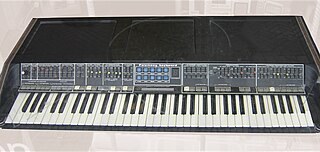
The Polymoog is a hybrid polyphonic analog synthesizer that was manufactured by Moog Music from 1975 to 1980. The Polymoog was based on divide-down oscillator technology similar to electronic organs and string synthesizers of the time.

Christopher John Mosdell is a British lyricist, poet, author, composer, vocalist and illustrator based in Tokyo, Japan, and New York City, United States.
Shinji Hosoe, also known as Megaten and Sampling Masters MEGA, is a Japanese video game composer and musician most famous for scoring Ridge Racer, Street Fighter EX and many Namco arcade games between 1987 and 1996. He also runs the music production and publishing company SuperSweep, alongside long time collaborator Ayako Saso.
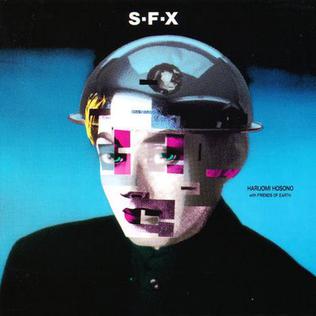
S-F-X is a 1984 album by Japanese electronic musician Haruomi Hosono. The album is his first solo album after Yellow Magic Orchestra. Credited also is "Friends of Earth", as Hosono would later form a band with this name. The album is the first album released by label Non Standard, a record label created between Hosono and Teichiku Records to release the technopop/hip-hop styled material he worked on.
This is the discography of Japanese electronic music band Yellow Magic Orchestra (YMO).

Fabriksampler V2 is a 2008 compilation album by acclaimed international musicians released on Pharmafabrik label, part of its Fabriksampler series. The album features 11 exclusive tracks made specially for this compilation, from Henrik Nordvargr Björkk (Sweden), Lull (UK), Wo0 (Serbia), Go Tsushima (Japan), Left Eye Dominant (Italy), Alexei Borisov (Russia), Tania Stene (Norway), PureH (Slovenia), Sunao Inami (Japan), Dodecahedragraph (Slovenia), The Cherry Blues Project (Argentina) and Final (UK). The compilation was issued as an audio CD and video DVD box.
References
| International | |
|---|---|
| Artists | |
