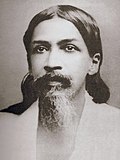
In Sri Aurobindo's philosophy, Supermind (or "Truth-Consciousness") is the dynamic manifestation of the Absolute, often described as the "Real-Idea" or the movement of Knowledge-Will that creates the universe.[1] It functions as the "intermediate link" between the indivisible unity of Spirit (Sachchidananda) above and the divided consciousness of Mind and the manifest world below.[2] Furthermore, it is considered the unique power capable of effecting the "integral transformation" of human nature into Divine nature, thereby establishing a divine life on earth.[3]
In Sri Aurobindo's philosophy, Supermind (also referred to as Mahas or the Truth-Consciousness) constitutes the fourth aspect of the "upper hemisphere" of existence, following Sat (Pure Existence), Chit (Consciousness-Force), and Ananda (Bliss).[4] Its primary function is to facilitate manifestation by differentiating the "One" into the "Many" while maintaining a consciousness of their underlying Unity; unlike the human Mind, which functions through division and separation, the Supermind operates through integral knowledge based on identity with the object of knowledge.[5] Sri Aurobindo emphasized that opening to this plane involves a long, difficult process of transformation, explicitly rejecting the expectation of an "instantaneous miracle" or the satisfaction of personal desires for sudden good fortune.[6]
Sri Aurobindo's Cosmological Structure
The Upper Hemisphere (Parārdha) (Realm of Unity, Knowledge, and Spirit)[7]
According to Sri Aurobindo, full yogic development consists of two parts: the standard yogic goal of ascent into a formless and timeless self, and the descent and establishment of the supramental consciousness into Earthly life.[17] Through integral yoga, one actualises the Supermind, for the supramental consciousness transforms the entire being and leads to the divinisation of the material world.[18]
This supramental transformation gives rise to a new individual, the Gnostic being, which is fully formed by the supramental power.[19] Division and ignorance are overcome, and replaced with a unity of consciousness.[20] The physical body will be transformed and divinised.[21] The gnostic being sees the spirit everywhere in the world, and in every other person.[22] This awareness eliminates the usual separation between man and life, and between people.[23] One sees that all existences are various forms of the divine reality.[24] Every individual existence in life plays a role in the unfolding of existence.[25] The Gnostic beings can work together to create a new common life; this new life is superior to the present way of being.[26] A nucleus or sufficient number of such individuals can create the foundation of a new social life and order.[27] This will lead to a greater unity, mutuality, and harmony.[28]
The Supramental Descent
On 29 February 1956, Mirra Alfassa (The Mother) announced that the manifestation of the Supramental upon earth was no longer a promise but a living fact.[29] This event served as the culmination of the work described by Sri Aurobindo, who stated that the "supramental change is a thing decreed and inevitable" and that the Mother’s specific role in their joint yoga was "to bring down the supramental".[30] Sri Aurobindo had previously clarified that this descent was not meant to be an arbitrary miracle, but a rapid evolutionary process pouring the Truth-Consciousness into the inferior planes to transform the earth-nature.[31]
Subsequently, on 1 January 1969, The Mother (at age 90) experienced the "arrival" of a new consciousness, which she identified on 8 January 1969 as the "superman consciousness" – "the intermediary between man and the supramental being".[32] This correlates with Sri Aurobindo's earlier vision that the whole earth-consciousness would not be supramentalised immediately; rather, there would first appear "a new race representing the supermind, as man represents the mind".[33] This transitional stage is necessary because the gulf between the human mind and the Supermind is too great to be crossed in a single bound; therefore, intermediate powers must descend to bridge the gap and prepare the physical nature for the supreme Light.[34]
George Nedumpalakunnel, Realization of God According to Sri Aurobindo: A Study of a Neo-Hindu Vision on the Divinization of Man Claretian Publications, 1979
K. D. Sethna (1973), Teilhard de Chardin and Sri Aurobindo - a Focus of Fundamentals, pp.34–5, (Bharatiya Vidya Prakasan, Varanasi)
K. D. Sethna (1981). The spirituality of the future: a search apropos of R. C. Zaehner's study in Sri Aurobindo and Teilhard de Chardin. Rutherford, [N.J.] London,
Ramakant A. Sinari, The Structure of Indian Thought C. C. Thomas 1970 p.244
Zaehner, R.C. (1971) Evolution in religion: a study in Sri Aurobindo and Pierre Teilhard de Chardin, Clarendon Press, Oxford.
This page is based on this Wikipedia article Text is available under the CC BY-SA 4.0 license; additional terms may apply. Images, videos and audio are available under their respective licenses.