
Hobart College is a government comprehensive senior secondary school located in Mount Nelson, a suburb of Hobart, Tasmania, Australia. Established in 1913 as Hobart High School, it was later renamed as Hobart Matriculation College in 1965, and subsequently renamed as Hobart College. The college caters for approximately 1,300 students in Years 11 and 12 and is administered by the Department for Education, Children and Young People.

The Bridgewater Bridge is a combined road and rail bridge that carries the Midland Highway and South Railway Line across the Derwent River in Hobart, Tasmania, Australia. This steel truss vertical lift bridge and specially-built causeway connect the Hobart suburbs of Bridgewater and Granton. The bridge was completed in 1946 and accommodates a two-lane highway, a single track railway and a grade-separated footpath.
Trial Harbour is a rural locality in the local government area (LGA) of West Coast in the North-west and west LGA region of Tasmania. The locality is about 20 kilometres (12 mi) south-west of the town of Zeehan. The 2016 census has a population of 24 for the state suburb of Trial Harbour.
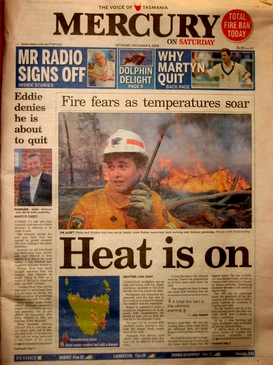
TheMercury is a daily newspaper, published in Hobart, Tasmania, Australia, by Davies Brothers Pty Ltd, a subsidiary of News Corp Australia, itself a subsidiary of News Corp. The weekend issues of the paper are called Mercury on Saturday and Sunday Tasmanian. The current editor of TheMercury is Craig Herbert.

George Bertrand Edwards was an Australian politician. He was a member of the Australian House of Representatives representing the Division of South Sydney for the Free Trade Party from 1901 to 1906 and the Division of North Sydney for the Liberal Party from 1910 until his death in 1911.

Lily Poulett-Harris was an Australian sportswoman and educationalist, notable for being the founder and captain of the first women's cricket team in Australia. Poulett-Harris continued to play until forced to retire due to ill health from tuberculosis that would eventually claim her life.

Franklin Square is a 1.6-acre (0.63-hectare) oak-lined public square located in the Hobart City Centre in Tasmania, Australia. It is named for Sir John Franklin, an Arctic explorer and former Lieutenant-Governor of Van Diemen's Land. The centrepiece of the park is a statue of Franklin, with an epitaph written by Alfred, Lord Tennyson. As the city's most central urban parkland and transportation hub, Franklin Square is frequently utilised for festive markets, public gatherings and as a place for public protest.
Ernest Frederick Burns Blyth was an Australian politician in Tasmania.
Herbert Clifford "Cliff" Taylor was an Australian rules footballer who played with Geelong in the Victorian Football League (VFL). He was also known as "Beau" Taylor.
This article outlines the history of Smooth Island, popularly known as Garden Island, in Norfolk Bay, Tasmania. The names come from the island's gently undulating topography and lush vegetation in comparison with the stony mainland. It has been privately owned since 1864.
Brisbane Street is a street in Hobart, Tasmania. The street was named for Sir Thomas Makdougall Brisbane, the sixth Governor of New South Wales.
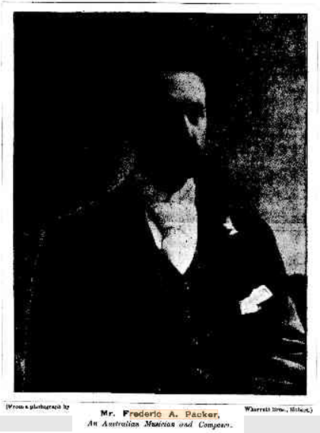
Frederick Augustus Packer (1839–1902) was an Australian composer of Anglican spiritual and romantic music. He was born in Reading, Berkshire, of a musical family. His parents, Frederick Alexander Packer and Augusta Packer, both members of the Royal Academy of Music in London, arrived with their family in Hobart in 1852 to take up the position of organist at St David's Cathedral in Davey Street. He worked as a postal telegraph operator, parliamentary civil servant, organist and music teacher, notably of Amy Sherwin. He died after some years in Sydney He was a nephew of composer Charles Sandys Packer and an uncle to media mogul R. C. Packer.
John Watchorn was an Australian politician. He was a member of the Tasmanian Legislative Council from 1882 until his death in 1905 and was Mayor of Hobart in 1890 and from 1894 to 1896.

Heinrich Wilhelm Ferdinand "Ferd" Kayser, was the mine manager of Mount Bischoff Tin Mining Company for thirty years.
Mary Elizabeth Livingston was a late-colonial Australian artist. She was best known as a botanical artist, specialising in Tasmanian native flora.
George Wishart Smith, sometimes written Wishart-Smith, was a railway executive in Western Australia and Railway Commissioner in Tasmania, from which service he was suspended after mounting costs and deteriorating patronage.
William Henry Simmonds was an English newspaperman whose varied career took him finally to Tasmania, Australia, where he was editor of the Hobart Mercury for 18 years.

The Avalon Theatre is a historic former Temperance Hall, theatre and cinema in Hobart, Tasmania, Australia.

