This page is based on this
Wikipedia article Text is available under the
CC BY-SA 4.0 license; additional terms may apply.
Images, videos and audio are available under their respective licenses.

A hatchback is a car with a hatch-type rear door that opens upwards and often a shared volume for the passenger and cargo areas.

Kei car is the Japanese vehicle category for the smallest highway-legal passenger cars. Similar Japanese categories existing for microvans, and Kei trucks.
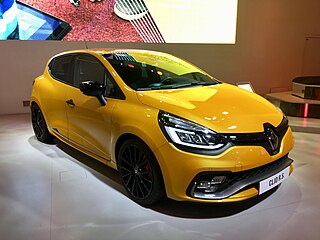
Hot hatch is a high-performance version of a mass-produced hatchback car.
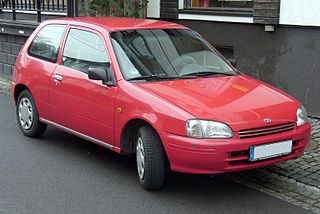
The Toyota Starlet is a small automobile manufactured by Toyota from 1973 to 1999, replacing the Publica, but retaining the Publica's "P" code and generation numbering. The first generation Starlet was sold as the Publica Starlet in some markets. In Japan, it was exclusive to Toyota Corolla Stores.
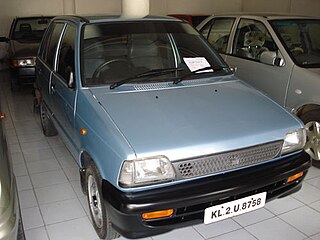
Maruti 800 is a small city car that was manufactured by Maruti Suzuki in India from 1983 to 18 January 2013. The first generation (SS80) was based on the 1979 Suzuki Fronte and had an 800 cc F8B engine, hence the moniker. Widely regarded as the most influential automobile in India, about 2.87 million 800s were produced during its course of which 2.66 million were sold in India itself.

The Daihatsu Fellow Max is a small Japanese automobile in the Kei car class. Originally introduced as the Daihatsu Fellow, the name was partially retained for the Max Cuore (1977) and then again for the 2000 Daihatsu Max.

The Suzuki Cultus is a supermini car produced by the Japanese manufacturer Suzuki from 1983 to 2003, and it is now a rebadged Suzuki Celerio in Pakistan since 2017. It was first presented at the 25th Tokyo Motor Show, formally introduced to Japan in 1983 and ultimately sold in seven countries across three generations and marketed worldwide as the Suzuki Swift. An alliance formed in 1981 between GM and Suzuki allowed GM to market the Cultus as a captive import internationally under more than a dozen nameplates including the Geo Metro, Chevrolet Sprint, Pontiac Firefly and Holden Barina. It was also known as the M-car within GM.
Changan Suzuki is an automobile manufacturing company headquartered in Chongqing, China and a joint-venture between Chang'an Automobile Group and Suzuki. Chang'an began assembling subcompact commercial trucks under license from Suzuki in 1990, and in 1993 the two companies formed Chang'an Suzuki to build licensed versions of the Suzuki Alto and Suzuki Cultus.
The Suzuki Cervo is a kei car manufactured by Suzuki Motor Corporation. Introduced in 1976 as the successor to the Suzuki Fronte Coupé, the Cervo name was originally affixed to a kei sports coupe, and then to models derived from the Suzuki Alto. The nameplate was retired between 1998 and 2006, and again in December 2009.

The Suzuki Carry is a kei truck produced by the Japanese automaker Suzuki. The microvan version was originally called the Carry van until 1982 when the van was renamed as the Suzuki Every. In Japan, the Carry and Every are Kei cars but the Suzuki Every Plus, the bigger version of Every, had a longer bonnet for safety purposes and a larger 1.3-liter 86 hp (63 kW) four-cylinder engine. They have been sold under a myriad of different names in several countries, and was the only car offered with Chevrolet and Ford badges.

Pak Suzuki Motor Company (PSMCL) is a Pakistani affiliate of Japanese automaker Suzuki. It is the Pakistani assembler and distributor of cars manufactured by Suzuki and its subsidiaries and foreign divisions. Currently Pak Suzuki is the largest car assembler in Pakistan.

Suzulight was the brand used for the kei cars built by the Suzuki Motor Corporation from 1955 to 1969. They were Suzuki's first entry into automotive manufacturing, having previously only produced motorcycles. The Suzulight sedans and light vans all had transversely mounted engines and front-wheel drive. The Suzulight Carry trucks and vans were the first to use the Carry label, still around today.
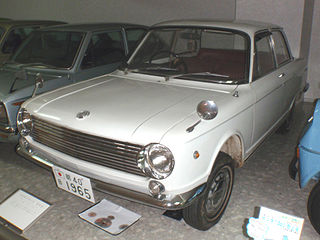
The Suzuki Fronte 800 was subcompact car with a two-stroke engine built by the Suzuki Motor Corporation in the latter half of the 1960s.
LC10 was the original name given to a series of very small three-cylinder, two-stroke engines built by Suzuki Motor Corporation in the 1960s and 1970s. They were used in a number of kei class automobiles and light trucks. The LC10 and its derivatives did not completely replace the FE and L50 two-cylinders, which continued to be used mainly for light commercials. The LC10 engine was developed together with the Suzuki B100 engine, a 8–11 PS (5.9–8.1 kW) 118.9 cc single-cylinder motorcycle engine which shared the same bore and stroke. For longevity and convenience, the LC10 received Suzuki's new "Posi-Force" auto-lubrication system, eliminating the need for pre-mixed fuel.
The Daihatsu A-series engine is a range of compact two-cylinder internal combustion piston engines, designed by Daihatsu with the aid of their owner Toyota. Petrol-driven, it has cast iron engine blocks and aluminum cylinder heads, which are of a single overhead cam lean burn design with belt-driven camshafts. The head design was called "TGP lean-burn", for "Turbulence Generating Pot". The engine also had twin balancing shafts, which provided smoothness equivalent to that of a traditional four-cylinder engine - although it also cost nearly as much to build.

The Suzuki FB engine is a series of two- and three-cylinder two-stroke engines that was produced by the Suzuki Motor Corporation from October 1961 until November 1987. They were used in a number of Kei-class automobiles and light trucks. From the original air-cooled 359 cc straight-twin version the FB series developed through a number of different models having different names, ending with the water-cooled, three-cylinder LJ50. The names used for various versions of this engine often refer to the chassis code of the cars in which they were introduced, until Suzuki changed their engine naming system sometime in the first half of the 1970s.


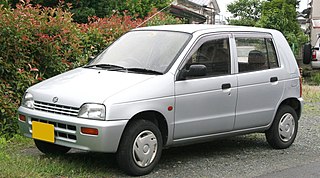

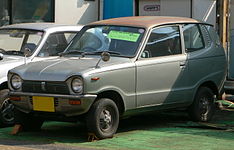 Suzuki Hatch (LS30/SH10; 1973–1979)
 Suzuki Hatch (SS40V; 1980–1984)

