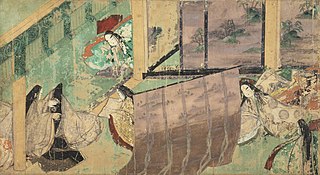
The Heian period is the last division of classical Japanese history, running from 794 to 1185. It followed the Nara period, beginning when the 50th emperor, Emperor Kammu, moved the capital of Japan to Heian-kyō. Heian (平安) means 'peace' in Japanese. It is a period in Japanese history when the Chinese influences were in decline and the national culture matured. The Heian period is also considered the peak of the Japanese imperial court, noted for its art, especially poetry and literature. Two syllabaries unique to Japan, katakana and hiragana, emerged during this time. This gave rise to Japan's famous vernacular literature, with many of its texts written by court ladies who were not as educated in Chinese as their male counterparts.

Minamoto no Yoritomo was the founder and the first shogun of the Kamakura shogunate, ruling from 1192 until 1199, also the first ruling shogun in the history of Japan. He was the husband of Hōjō Masako who acted as regent (shikken) after his death.

Taira no Kiyomori was a military leader and kugyō of the late Heian period of Japan. He established the first samurai-dominated administrative government in the history of Japan.

The Taira (平) was one of the four most important clans that dominated Japanese politics during the Heian period of Japanese history – the others being the Minamoto, the Fujiwara, and the Tachibana. The clan is divided into four major groups, named after the emperors they descended from: Kanmu Heishi, Ninmyō Heishi, Montoku Heishi, and Kōkō Heishi, the most influential of which was the Kanmu Heishi line.
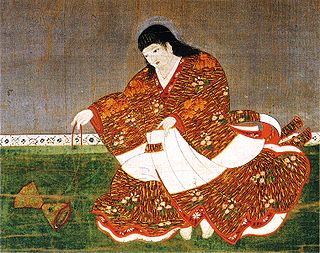
Emperor Antoku was the 81st emperor of Japan, according to the traditional order of succession. His reign spanned the years from 1180 through 1185. His death marked the end of the Heian period and the beginning of the Kamakura period.

The Genpei War was a national civil war between the Taira and Minamoto clans during the late Heian period of Japan. It resulted in the downfall of the Taira and the establishment of the Kamakura shogunate under Minamoto no Yoritomo, who appointed himself as Shōgun in 1192, governing Japan as a military dictator from the eastern city of Kamakura.

The Tale of the Heike is an epic account compiled prior to 1330 of the struggle between the Taira clan and Minamoto clan for control of Japan at the end of the 12th century in the Genpei War (1180–1185).
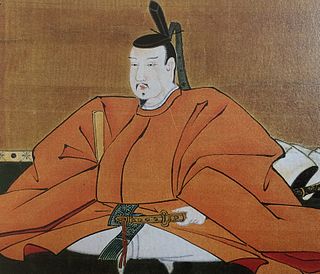
Minamoto no Noriyori was a Japanese samurai lord of the late Heian period and early Kamakura period, who fought alongside his brothers Minamoto no Yoritomo and Minamoto no Yoshitsune at a number of battles of the Genpei War. He was the sixth son of Minamoto no Yoshitomo.
Taira no Tomomori (1152–1185) was the son of Taira no Kiyomori, and one of the Taira Clan's chief commanders in the Genpei War at the end of the Heian period of Japanese history.

Taira no Shigehira (1158–1185) was one of the sons of Taira no Kiyomori, and one of the Taira Clan's chief commanders during the Heian period of the 12th century of Japan.

Taira no Koremori was one of the Taira clan's commanders and military lord during the Genpei War of the late Heian period of Japanese history. He was the only child of Taira no Shigemori, who was the eldest regent and heir of Taira no Kiyomori.

Taira no Munemori was heir to Taira no Kiyomori, and one of the Taira clan's chief commanders in the Genpei War.

Taira no Noritsune was a military leader of the late Heian period of Japan. He was the son of Taira no Norimori. He fought in the Genpei War against the Minamoto clan.

Taira no Tadanori (1144–1184) was a poet and military leader of the late Heian period of Japan. He was the brother of clan head Taira no Kiyomori, and one of his generals in the Genpei War against the Minamoto.

Taira no Tadamori was the head of the Taira clan. He was son of Taira no Masamori, and father of Taira no Kiyomori. Tadamori was also governor of the provinces of Harima, Ise, Bizen, and Tajima.

The Kobayakawa clan was a Japanese samurai clan that claimed descent from the Taira clan. Their holdings were in the Chūgoku region. They were a powerful clan during the Sengoku period but were disbanded during the Edo period after the Battle of Sekigahara. However, the Kobayakawa clan was restored by the Mōri clan during the Meiji period and granted a title of baronage in the new nobility. In addition, the Kusai clan of Takehara which is a branch of the Kobayakawa were granted a rank of nobility.
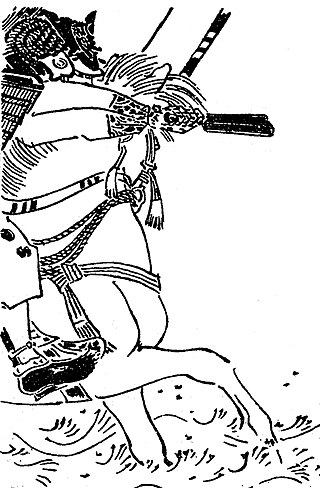
Ashikaga Yoshikane was a Japanese samurai military commander, feudal lord in the late Heian and early Kamakura period of Japan's history. He played an active part in the Jishō-Juei War and the later military campaign as a closely related person of the first Kamakura shōgun Minamoto no Yoritomo, and made Ashikaga clan influential position in gokenin vassal of the Kamakura shogunate.

Hasebe Nobutsura (year of birth unknown - Kempo-6 was a military commander between the end of Heian period and the beginning of Kamakura period. He was the son of Tametsura who was an officer for managing horses, Uma-no-jo

Taira no Norimori was a commander during the Genpei War and was the 3rd son of Taira no Tadamori. During the Hogen Rebellion, he and his brother supported Emperor Go-Shirakawa. At the Battle of Dan-no-ura, he committed suicide by jumping overboard. His older brother, Taira no Tsunemori, and his son, Taira no Noritsune, also committed suicide in the Battle of Dan-no-Ura.

Taira no Tsunemori (1124–1185) was the 3rd son of Taira no Tadamori and a younger half-brother of Taira no Kiyomori. He committed suicide with his younger brother, Taira no Norimori, at the Battle of Dan-no-ura, the last battle of the Genpei War.
