
A bascule bridge is a moveable bridge with a counterweight that continuously balances a span, or leaf, throughout its upward swing to provide clearance for boat traffic. It may be single- or double-leafed.

The BNSF Railway Bridge 5.1, also known as the St. Johns Railroad Bridge or the Willamette River Railroad Bridge, is a through truss railway bridge with a vertical lift that spans the Willamette River in Portland, Oregon, United States. Built by the Spokane, Portland and Seattle Railway (SP&S) and completed in 1908, it was originally a swing-span bridge, and its swing-span section was the longest in the world at the time. However, 81 years later the main span was converted from a swing-type to a vertical-lift type, in order to widen the navigation channel. The lift span is one of the highest and longest in the world. The bridge consists of five sections, with the two sections closest to the bank on each side fixed.

A moveable bridge, or movable bridge, is a bridge that moves to allow passage for boats or barges. In American English, the term is synonymous with drawbridge, and the latter is the common term, but drawbridge can be limited to the narrower, historical definition used in some other forms of English, in which drawbridge refers to only a specific type of moveable bridge often found in castles.

The River Cart is a tributary of the River Clyde, Scotland, which it joins from the west roughly midway between the towns of Erskine and Renfrew and opposite the town of Clydebank.

The Market Street Bridge, officially referred to as the John Ross Bridge, is a bascule bridge that spans the Tennessee River between downtown Chattanooga, Tennessee, and the Northshore District. It carries North Market Street, and was named in honor of Cherokee Chief John Ross. The bridge was completed in 1917 at a cost of $1.1 million. In the mid-1970s, the southern terminus of US 127 was moved several miles north to the intersection of Dayton Boulevard and Signal Mountain Boulevard in the nearby suburb of Red Bank.

The Newark Bay Bridge of the Central Railroad of New Jersey (CNJ) was a railroad bridge in New Jersey that connected Elizabethport and Bayonne at the southern end of Newark Bay. Its third and final incarnation was a four-track vertical-lift design that opened in 1926, replacing a bascule bridge from 1904 which superseded the original swing bridge from 1887. The bridge served the main line of the CNJ, carrying daily interstate trains as well as commuter trains.

The North Avenue Bridge can refer to one of three bridges that has carried North Avenue over the North Branch of the Chicago River on the north side of Chicago, Illinois. A center-pier swing bridge built in 1877 was replaced in 1907 by a bascule bridge, allowing river traffic more room for maneuvering in and out of the North Canal, just north of Goose Island.

The Cortland Street Drawbridge over the Chicago River is the original Chicago-style fixed-trunnion bascule bridge, designed by John Ericson and Edward Wilmann. When it opened in 1902, on Chicago's north side, it was the first such bridge built in the United States. The bridge was a major advance in American movable bridge engineering, and was the prototype for over 50 additional bridges in Chicago alone. The bridge was designated as an ASCE Civil Engineering Landmark in 1981, and a Chicago Landmark in 1991.
Belden G. Bly Bridge originally known as the Fox Hill Bridge was built in 1912 and renamed in 1985 in honor of former member of the Massachusetts House of Representatives Belden Bly. At the time of its demolition, the bridge was the oldest cantilever bridge in the United States still in use as well as the oldest Scherzer Rolling Lift under the supervision of the Massachusetts Department of Public Works. Streetcar tracks originally ran across the bridge.

The Corporation Bridge is a Scherzer rolling lift bascule bridge over the Old Dock in Grimsby, North East Lincolnshire, England. Built in 1925, it replaced an earlier swing bridge dating to 1872.

The Amtrak Old Saybrook–Old Lyme Bridge is a railroad bridge that carries the Northeast Corridor over the Connecticut River between Old Saybrook and Old Lyme, Connecticut. It is the southernmost crossing of the river before it reaches Long Island Sound. The bridge is a truss bridge with a bascule span, allowing boat traffic to pass through. The bridge is owned by Amtrak; it is used by Amtrak Northeast Regional and Acela intercity trains, Shore Line East local trains, and Providence and Worcester Railroad freight trains. A $1.3 billion replacement bridge began construction in 2024 with completion scheduled for 2031.

Keadby Bridge, more formally known as the King George V Bridge, crosses the River Trent near Althorpe and Keadby in Lincolnshire, England. It was designed by Alfred Charles Gardner FRSE MIME.
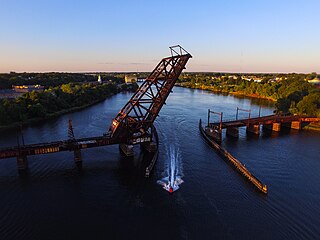
The Crook Point Bascule Bridge is a defunct Scherzer rolling lift railway bridge which spans the Seekonk River, connecting the city of Providence, Rhode Island, to the city of East Providence. Stuck in the open position since its abandonment in 1976, it is known to nearby residents as the "Stuck-Up Bridge" and has become somewhat of a local icon of urban decay. In 2022, the Providence Journal described the bridge as "a T-shirt-ready symbol of Providence's quirky evolution from industrial to creative hub."
The Congress Street Bridge was a movable deck-girder Scherzer rolling-lift bridge in Bridgeport, Connecticut, United States. In 1909, the City of Bridgeport tasked a special commission to oversee the construction of a bridge at Congress Street. The original construction was completed in 1911 for $300,000. The bridge served as a street car, vehicle and pedestrian bridge throughout its service life. In 1997, the bridge was closed after the Connecticut Department of Transportation found the substructure to be moving. The bridge was demolished in 2010 and $40 million funding for a new bridge has since been secured. The Congress Street bridge was on the Connecticut Historical Commission's list of bridges.

White Cart Bridge is a Scherzer rolling lift bascule bridge situated on the A8 road in Renfrew, Scotland. The bridge crosses White Cart Water at the confluence with the Black Cart River. It is one of only two remaining Scherzer type rolling lift bridges in the country, the other being 'the Queenie' at Peterhead Harbour, and became category A listed on 13 December 1994. The bridge is still capable of opening, as the Doosan Babcock factory in Renfrew requires the capability to move large loads by river.
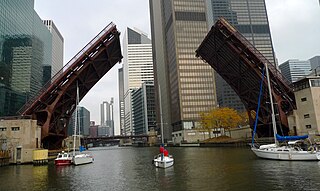
The Van Buren Street Bridge is a bascule bridge that spans the Chicago River in downtown Chicago, Illinois, United States. It is the sixth bridge at this location and carrying this name, and was completed in 1956. It replaced an 1895 Rolling Lift-type bascule bridge designed by William Scherzer.

William Donald Scherzer was an American engineer and inventor who invented the rolling lift bridge.

The Harrison Street Bridge is a fixed-trunnion bascule bridge in Chicago, Illinois, crossing the South Branch Chicago River.


