
Year 618 (DCXVIII) was a common year starting on Sunday of the Julian calendar. The denomination 618 for this year has been used since the early medieval period, when the Anno Domini calendar era became the prevalent method in Europe for naming years.

The Licchavi Princess Bhrikuti Devi, known to Tibetans as Bal-mo-bza' Khri-btsun, Bhelsa Tritsun or, simply, Khri bTsun, is traditionally considered to have been the first wife and queen of the earliest emperor of Tibet, Songtsen Gampo, and an incarnation of Tara. She was also known as "Besa", and was a princess of the Licchavi kingdom of Nepal and later the queen consort of Tibet.

Tibetan history, as it has been recorded, is particularly focused on the history of Buddhism in Tibet. This is partly due to the pivotal role this religion has played in the development of Tibetan and Mongol cultures and partly because almost all native historians of the country were Buddhist monks.

The Jokhang, also known as the Qoikang Monastery, Jokang, Jokhang Temple, Jokhang Monastery and Zuglagkang, is a Buddhist temple in Barkhor Square in Lhasa, the capital city of Tibet. Tibetans, in general, consider this temple as the most sacred and important temple in Tibet. The temple is currently maintained by the Gelug school, but they accept worshipers from all sects of Buddhism. The temple's architectural style is a mixture of Indian vihara design, Tibetan and Nepalese design.

Songtsen Gampo, also Songzan Ganbu, was the 33rd Tibetan king and founder of the Tibetan Empire, and is traditionally credited with the introduction of Buddhism to Tibet, influenced by his Nepali consort Bhrikuti, of Nepal's Licchavi dynasty, as well as with the unification of what had previously been several Tibetan kingdoms. He is also regarded as responsible for the creation of the Tibetan alphabet and therefore the establishment of Classical Tibetan, the language spoken in his region at the time, as the literary language of Tibet.
The Altan Tobchi, or Golden Summary, is a 17th-century Mongolian chronicle written by Guush Luvsandanzan. Its full title is Herein is contained the Golden Summary of the Principles of Statecraft as established by the Ancient Khans. Mongolian scholars typically call the work the "Lu Altan Tovch". It is generally considered second in dignity to the Secret History of the Mongols as a historical chronicle and piece of classical literature. In fact, the work is special in that it contains 233 of the 282 chapters of the Secret History not only verbatim but with additional detail in certain parts. It is also significant in that it is a major source of knowledge on the "Chingisiin Bilig" or Wisdom of Genghis, a code of ethical conduct specifically directed toward future generations of Mongolian ruling nobility. Duke Jamiyan discovered and brought the original pen copy of the Altan Tobchi to Ulaanbaatar in 1926 from a Taiji called Dari living in Dornod Province, Mongolia. It was studied in depth by Jamsrangiin Tseveen and Byambyn Rinchen, and was translated into English by Charles Bawden in 1955. It is one of the most frequently quoted sources in Mongolian publications.
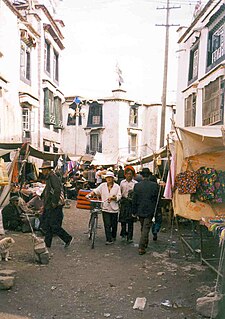
Muru Ningba or Meru Nyingba is a small Buddhist monastery located between the larger monasteries of Jokhang and Barkhor in the city of Lhasa, Tibet, China. It was the Lhasa seat of the former State Oracle who had his main residence at Nechung Monastery.

Reting Rinpoche was a title held by abbots of Reting Monastery, a Buddhist monastery in central Tibet.
The Japanese expedition to Tibet was an intelligence mission undertaken by Jinzō Nomoto in Tibet in 1939.
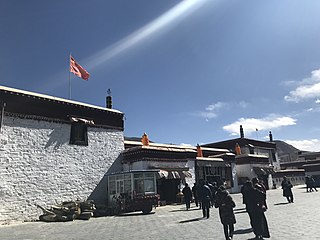
Tradruk Temple in the Yarlung Valley is the earliest great geomantic temple after the Jokhang and some sources say it predates that temple.
Ralpacan, born Tritsuk Detsen c. 806 CE according to traditional sources, was the 41st King of Tibet, ruling from the death of his father, Sadnalegs, in c. 815, until 838 CE. He is referred to as "son of God" in the Testament of Ba.
Gungsong Gungtsen was the only known son of Songtsen Gampo, the first Tibetan Emperor.
Namri Songtsen, also known as "Namri Löntsen" (570?–618?/629) was, according to tradition, the 32nd King of Tibet of the Yarlung Dynasty, which until his reign ruled only the Yarlung Valley. He expanded his kingdom to rule the central part of the Tibetan Plateau. His actions were decisive in the setting up of the Tibetan Empire, to which he can be named co-founder with his son, Songtsen Gampo.

The Tibetan Empire existed from the 7th to 9th centuries AD when Tibet was unified as a large and powerful empire, and ruled an area considerably larger than the Tibetan Plateau, stretching to parts of East Asia, Central Asia and South Asia.
The Sumpa were a tribe living in northeastern Tibet from ancient times. Chinese historical sources refer to them as "Qiang", a term for people living in what is now Southwest China, and their actual ethnic identity is not known. Their territory was absorbed by the Tibetan Empire in the late 7th century, after which point they gradually lost their independent identity.

(Thubten) Jamphel Yeshe Gyaltsen or Thupten Jampel Yishey Gyantsen, Tibetan: ཐུབ་བསྟན་འཇམ་དཔལ་ཡེ་ཤེས་རྒྱལ་མཚན་, Wylie: thub-bstan 'jam-dpal ye-shes rgyal-mtshan was a Tibetan tulku and the fifth Reting Rinpoche.

Tsangnyön Heruka, was an author and a master of the Kagyu school of Tibetan Buddhism. Born in Tsang, he is best known as a biographer and compiler of the Life of Milarepa and The Collections of Songs of Milarepa, both classics of Tibetan literature.
Hidden Tibet: History of Independence and Occupation is a book written by Sergius L. Kuzmin, a specialist of amphibians and history of Mongolia and Tibet, Dr.Sc.(Hist.) and Ph.D.(Biol.) of the Russian Academy of Sciences, Dr.Sc.(H.C.) of the Institute of History and Archeology of Mongolian Academy of Sciences and published in 2010 by A. Terentyev publishing house, with the support of the International Campaign for Tibet.
The Imperial Preceptor, or Dishi was a high title and powerful post created by Kublai Khan, founder of the Yuan dynasty. It was established as part of Mongol patronage of Tibetan Buddhism and Yuan administrative rule of Tibet.
The Tengri Tribe was founded by Tengri Khan in 600 c. and ruled circa The Tengri tribe was the predecessor of the Borjigin, founded by Bodonchar Munkhag after the death of his father, Dobun Mergen Khan, the last ruler of the Tengri, in 945 c.


