

Teofilo Bruni (Verona, 1569 - Vicenza, 1638 ) was an Italian mathematician and astronomer. [1]
Teofilo Bruni (Verona, 1569 - Vicenza, 1638 ) was an Italian mathematician and astronomer. [1]
Born in Verona, he was a capuchin friar known by the name of Raffaele. [2] He wrote mainly about mathematics and astronomy, but he published a book about clocks and other tools based on mathematical concepts. [3]

ManuelChrysoloras was a Byzantine Greek classical scholar, humanist, philosopher, professor, and translator of ancient Greek texts during the Renaissance. Serving as the ambassador for the Byzantine emperor Manuel II Palaiologos in medieval Italy, he became a renowned teacher of Greek literature and history in the republics of Florence and Venice, and today he's widely regarded as a pioneer in the introduction of ancient Greek literature to Western Europe during the Late Middle Ages.

Francesco Scipione Maffei was an Italian writer and art critic, author of many articles and plays. An antiquarian with a humanist education whose publications on Etruscan antiquities stand as incunables of Etruscology, he engaged in running skirmishes in print with his rival in the field of antiquities, Antonio Francesco Gori.
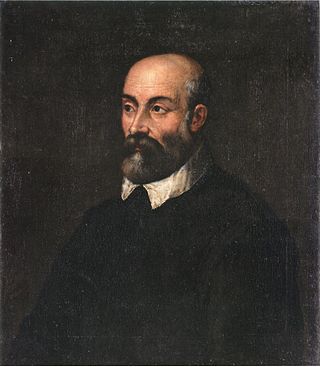
Andrea Palladio was an Italian Renaissance architect active in the Venetian Republic. Palladio, influenced by Roman and Greek architecture, primarily Vitruvius, is widely considered to be one of the most influential individuals in the history of architecture. While he designed churches and palaces, he was best known for country houses and villas. His teachings, summarized in the architectural treatise, The Four Books of Architecture, gained him wide recognition.
Carlo Ederle was an Italian military engineer.
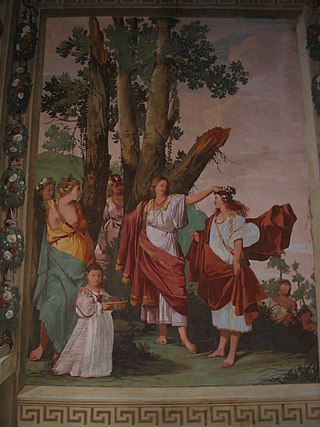
Giulio Carpioni was an Italian painter and etcher of the early Baroque era.

Francesco Maffei was an Italian painter, active in the Baroque style.
The decade of the 1670s in archaeology involved some significant events.
The decade of the 1750s in archaeology involved some significant events.

Alessandro Ferdinando Maffei was an Italian Lieutenant General of Infantry in the service of the Electorate of Bavaria. He was the brother of the Italian writer and archaeologist Francesco Scipione.
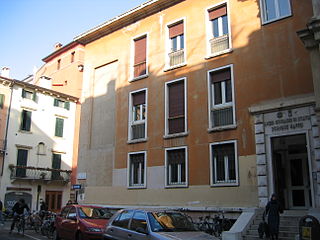
Istituto Maffei, officially called Liceo Ginnasio di Stato 'Scipione Maffei', is one of the oldest high schools in Italy. It is situated in the center of Verona in northern Italy.

The Veronese Easter was a rebellion during the Italian campaign of 1797, in which inhabitants of Verona and the surrounding areas revolted against the French occupying forces under Antoine Balland, while Napoleon Bonaparte was fighting in Austria. The uprising received its name through association with the anti-French uprising of the Sicilian Vespers of the 13th century. Incited by oppressive behaviour by the French, it began on the morning of 17 April 1797, the second day of Easter: the enraged population succeeded in defeating more than a thousand French soldiers in the first hour of fighting, forcing them to take refuge in the town's fortifications, which the mob then captured by force. The revolt ended on 25 April 1797 with the encirclement and capture of the town by 15,000 soldiers, who then forced it to pay a huge fine and hand over various assets, including artwork.
Maffei is a surname of Italian origin.
Francesco Portinaro was an Italian composer and humanist of the Renaissance, active both in northern Italy and in Rome. He was closely associated with the Ferrarese Este family, worked for several humanistic Renaissance academies, and was well known as a composer of madrigals and dialogues.
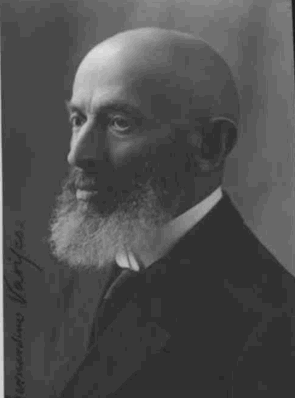
Bernardino Varisco, was an Italian philosopher and a professor of Theoretical Philosophy at the University of Rome La Sapienza from 1905 to 1925.

La fida ninfa is an opera by Antonio Vivaldi to a libretto by Scipione Maffei. The opera was first performed for the opening of the Teatro Filarmonico in Verona on 6 January 1732. Among the arias is "Alma oppressa de sorte crudele".
Bruni is an Italian surname. Notable people with the surname include:

Giovanni Rucellai, known as Giovanni di Bernardo Rucellai, was an Italian humanist, poet, dramatist and man of letters in Renaissance Florence, in Tuscany, Italy. A member of a wealthy family of wool merchants and one of the richest men in Florence, he was cousin to Pope Leo X and linked by marriage to the powerful Strozzi and de' Medici families. He was born in Florence, and died in Rome. He was the son of Bernardo Rucellai (1448–1514) and his wife Nannina de' Medici (1448–1493), and the grandson of Giovanni di Paolo Rucellai (1403–1481). He is now remembered mostly for his poem Le Api, one of the first poems composed in versi sciolti to achieve widespread acclaim.

The Jewel of Vicenza was a silver model of the city of Vicenza made as an ex-voto in the 16th century and attributed to the architect Andrea Palladio. The Jewel was stolen by the Napoleonic army during the Italian Campaign in the French Revolutionary Wars and subsequently destroyed. A copy was created between 2012 and 2013.

Scipione Agnelli was an Italian Catholic bishop, scholar and jurist.
Giovanni Camillo Glorioso was an Italian mathematician and astronomer. He was a friend of Marino Ghetaldi and successor of Galileo Galilei in Pisa, then in Padua.
| International | |
|---|---|
| National | |
