The Legend That Was Earth

Last updated

The Legend That Was Earth
TheLegendThatWasEarth.jpg
First edition
AuthorJames P. Hogan
Cover artistDru Blair
LanguageEnglish
PublisherBaen Publishing Enterprises
Publication date
2000

The Legend That Was Earth is a novel by science fiction author James P. Hogan; it was published in 2000 by Baen Publishing Enterprises. It includes several themes common to science fiction, such as dystopias, alien encounters, and the distinctions of personhood. It has been called a "political fantasy." [1]

Contents

Plot

At the onset of the story, aliens called Hyadeans have established contact and friendly business relations with Earth. They think Earth is fascinating because it so different from their own bleak, austere culture. Though they are highly interested in studying the planet and its cultures, Hyadeans are far more technologically advanced and have a more accurate knowledge of science. Many humans accept this alien presence, but there are many who do not trust the Hyadeans and believe they are plotting to take control of Earth. One group that espouses this belief is CounterAction, which the American government lists as a terrorist organization. When a flyer (advanced aircraft) carrying both Hyadean visitors and Terran politicians is shot down, CounterAction is blamed and the Internal Security Service (ISS) is intent on shutting down their organization by any methods necessary.

The action follows savvy Roland Cade who gives up his comfortable life when he is pulled into CounterAction. Because he was formerly married to Marie Cade, a political activist who plays a strong role in CounterAction, the ISS uses him to trace her. His mistress Julia is secretly an ISS agent, and convinces him to use his contacts with CounterAction to take in her friend, a supposed political dissident. He takes the friend to Chattanooga, where he unexpectedly runs into Marie. Julia's friend turns out to be an ISS plant and he is forced to flee with Marie; the government believes he is a part of CounterAction because of his wife’s association with the group. They both use their connections to get aid in dodging the government, and these connections form an unlikely bond. CounterAction has been strongly anti-Hyadean, but they find allies in Cade’s Hyadean friend Vrel and some of his comrades.

For much of the story, the action switches between Cade’s group of friends’ attempt to escape capture and the actions of the ISS as more information is revealed. While Cade and his friends learn that states and regions of the country are seceding, the Hyadean officials take over the increasingly impotent government and use military force to subdue resistance. However, a pro-Terran alien interviews Cade and Marie and films footage of Hyadean and government cruelty. This interview gets broadcast to both Earth and the aliens’ planet Chryse. As a result, many Hyadeans pledge their support and Terrans are given courage to fight for their freedom. The struggle stops being an Earth vs. alien skirmish, and becomes a fight for the rights of both Terran and Hyadean.

While Cade, Marie, and their posse travel from country to country to gain new allies and to find shelter, the Hyadean military steps ups its campaign and CounterAction comes under more attacks. They are attacked everywhere they flee, and their Hyadean allies suffer a massive defeat when a Hyadean mission is bombed. Finally, it appears the organization is done for entirely when a formation of giant airships appears. The ships are believed to be both Hyadean and capable of mass destruction. However, the ships belong to a friendly third party of a different alien civilization, the Querl; these aliens have come to help Terrans. CounterAction gets the news that the Hyadean government has just crumpled from popular indigenous support for Earth, and the war is over. New governments form and a stronger, benevolent union between Earth and Chryse begins.

Major characters

Science Fiction Themes

Dystopias

As the story begins, one can see the beginnings of a dystopia. Hyadeans are beginning to have more and more influence in Terran governmental and military affairs. Most Western countries have formed an alliance called the Global Economic Coalition, which the Hyadeans direct because of their stronger economic power. The secret mission of the Hyadean government is to use Earth as a colony, like they have done with other planets. The United States is a bit of a police state as well. Identification is required for simple things such as crossing a state border, and the government has enough technology to track people down easily. As CounterAction gains more influence, the dystopia worsens. Different cities and states begin to secede from the country, and the Hyadeans take over and start a massive military campaign against them. With smart drones and other impressive weapons, they destroy neighborhoods and areas indiscriminately. Hyadeans who sympathize with CounterAction are given no mercy; the Hyadean West Coast Trade and Cultural Mission, which is host to several Terran sympathizers, is flattened in a bombing raid. Order is restored only when the government in Chryse is dissolved from within.

Like all dystopias, this is both "political" and a "fantasy." [1]

Alien Encounters

The Legend That Was Earth appears to be a less drastic mix of Arthur C. Clarke's novel Childhood's End and the 2006 film Independence Day . The Hyadeans possess superior intelligence and technology, and their rulers wish to use Earth’s resources. However, their alien characteristics are not as foreign as the aliens’ in the aforementioned works. Hyadeans are basically discolored, chunky, pragmatic humans. Their skin colors range from dark-blue to pink and they are very tall and thickset. They also in general do not act upon emotion. Decisions are almost always based on self-interest; Hyadean visitors on Earth are amazed at Terran generosity and religions. Interaction, aside from the Hyadean government trying to colonize Earth, is fairly peaceful. Hyadeans wish to learn more about Terrans and socialize them. While there are some who do not trust the aliens, many Terrans accept and befriend them. This friendship only increases after the war ends.

Can Human Nature Be Learned?

The Hyadeans’ not-so-alien characteristics become even less distinct the more they remain in contact with Terran culture. While Hyadeans tend to be utilitarian, many admire Terran arts. Terran movies, music, and souvenirs are cherished in Chryse. The Hyadeans on earth often adopt human characteristics and traits. For example, one Hyadean starts wearing decorative clothing, whereas the standard garb in Chryse is a grey tunic ensemble. Many Hyadeans adopt Terran religions. Others, such as Vrel, are fascinated with human altruism and develop concern for others instead of pure self-interest. Hogan implies that the question of humanity is based on emotional depth and a sense of oneself as an individual; it is as if other life forms could actually learn to be humans. The protagonist Cade even wonders time from time if "Hyadeans could become even more Terran than Terrans themselves"(Hogan 187).

Reviews

The reviews have been mixed. The Historical Dictionary of Science Fiction reviewed the book simply as just a "political fantasy." [1] The Encyclopedia of Science Fiction called it "less than impressive" and "frequently lethargic," but the alien/human relationships "overcome the ponderous plot." [2]

Related Research Articles

<i>Starship Troopers</i> 1959 science fiction novel by Robert A. Heinlein

Starship Troopers is a military science fiction novel by American writer Robert A. Heinlein. Written in a few weeks in reaction to the US suspending nuclear tests, the story was first published as a two-part serial in The Magazine of Fantasy & Science Fiction as Starship Soldier, and published as a book by G. P. Putnam's Sons on November 5, 1959.

<span class="mw-page-title-main">Science fiction film</span> Film genre

Science fiction is a film genre that uses speculative, fictional science-based depictions of phenomena that are not fully accepted by mainstream science, such as extraterrestrial lifeforms, spacecraft, robots, cyborgs, mutants, interstellar travel, time travel, or other technologies. Science fiction films have often been used to focus on political or social issues, and to explore philosophical issues like the human condition.

<i>Camouflage</i> (novel) 2004 science fiction novel by Joe Haldeman

Camouflage is a 2004 science fiction novel by American writer Joe Haldeman. It won the James Tiptree, Jr. Award in 2004 and the Nebula Award for Best Novel in 2005.
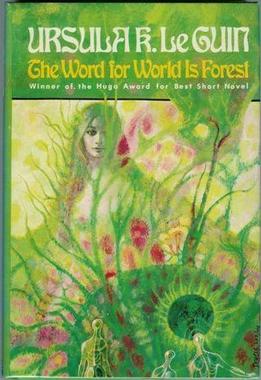
<i>The Word for World Is Forest</i> 1972 novel by Ursula K. Le Guin

The Word for World Is Forest is a science fiction novel by American writer Ursula K. Le Guin, first published in the United States in 1972 as a part of the anthology Again, Dangerous Visions, and published as a separate book in 1976 by Berkley Books. It is part of Le Guin's Hainish Cycle.

<i>The 27th Day</i> 1957 film by William Asher

The 27th Day is a 1957 American black-and-white science fiction film, distributed by Columbia Pictures. It was produced by Helen Ainsworth, directed by William Asher, and stars Gene Barry, Valerie French, George Voskovec, and Arnold Moss. The screenplay by John Mantley is based on his 1956 original science fiction novel of the same name.

<i>The War Against the Chtorr</i> Series of science fiction novels by David Gerrold

The War Against the Chtorr is a series of science fiction novels by American writer David Gerrold. The Chtorr series was originally planned as a trilogy, but as the story became more intricate, Gerrold realized that three books would not be enough for him to tell the entire story. For a time, he was uncertain how many books there would be in the end but plans on seven. As of 2022, four books have been completed. As of 2017, a fifth and sixth were in the works, 24 years after the publication of the fourth book.

<i>The Super Barbarians</i> 1962 novel by John Brunner

The Super Barbarians is a science fiction novel by British writer John Brunner, first published in the United States by Ace Books in 1962. Written in the first person, the story gives an account of an Earthman's struggle to regain lost memories and to uncover the horrifying secret of the feudal society whose people used remarkably advanced technology to conquer Earth and its solar system.

<i>Giants</i> (series) Group of five science fiction novels by James P. Hogan

The Giants series is a quintet of science fiction novels by James P. Hogan, published between 1977 and 2005.

<i>The Hostage of Zir</i> 1977 novel by Lyon Sprague de Camp

The Hostage of Zir is a science fiction novel by American writer L. Sprague de Camp, the seventh book of his Viagens Interplanetarias series and the fifth of its subseries of stories set on the fictional planet Krishna. Chronologically it is the third Krishna novel. It was first published in hardcover by Berkley/Putnam in 1977, and in paperback by Berkley Books in 1978. A new paperback edition was published by Ace Books in 1982 as part of the standard edition of the Krishna novels. An e-book edition was published by Gollancz's SF Gateway imprint on September 29, 2011 as part of a general release of de Camp's works in electronic form. The novel has also been translated into German and Czech.

Janissaries are an American series of military and political-based science fiction novels are set in an interstellar confederation of races, in which humans are a slave race entrusted with military affairs and law enforcement. They were written by Jerry Pournelle, with Roland J. Green co-authoring the second two books.

<i>Rogue Queen</i> 1951 science fiction novel by L. Sprague de Camp

Rogue Queen is a science fiction novel by American writer L. Sprague de Camp, the third book in his Viagens Interplanetarias series. It was first published in hardcover by Doubleday in 1951, and in paperback by Dell Books in 1952. A later hardcover edition was issued by The Easton Press in its The Masterpieces of Science Fiction series in 1996; later paperback editions were issued by Ace Books (1965) and Signet Books. A trade paperback edition was issued by Bluejay Books in June 1985. The first British edition was published in paperback by Pinnacle Books in 1954; a British hardcover reprint followed from Remploy in 1974. The novel has been translated into Portuguese, Italian, French and German. An E-book edition was published by Gollancz's SF Gateway imprint on September 29, 2011 as part of a general release of de Camp's works in electronic form.

<i>The Continent Makers</i> 1951 novella by Lyon Sprague de Camp

The Continent Makers is a science fiction novella by American writer L. Sprague de Camp, part of his Viagens Interplanetarias series. It was first published in the magazine Thrilling Wonder Stories in the issue for April, 1951. It first appeared in book form in the collection The Continent Makers and Other Tales of the Viagens, published in hardcover by Twayne Publishers in 1953, and in paperback by Signet Books in 1971. It has also been translated into Portuguese, Dutch, and Italian.

<i>Viagens Interplanetarias</i> Sequence of science fiction stories by L. Sprague de Camp

The Viagens Interplanetarias series is a sequence of science fiction stories by L. Sprague de Camp, begun in the late 1940s and written under the influence of contemporary space opera and sword and planet stories, particularly Edgar Rice Burroughs's Martian novels. Set in the future in the 21st and 22nd centuries, the series is named for the quasi-public Terran agency portrayed as monopolizing interstellar travel, the Brazilian-dominated Viagens Interplanetarias. It is also known as the Krishna series, as the majority of the stories belong to a sequence set on a fictional planet of that name. While de Camp started out as a science fiction writer and his early reputation was based on his short stories in the genre, the Viagens tales represent his only extended science fiction series.

<span class="mw-page-title-main">The Inspector's Teeth</span> Short story by L. Sprague de Camp

"The Inspector's Teeth" is a science fiction short story by American writer L. Sprague de Camp, part of his Viagens Interplanetarias series. It is the first (chronologically) set on Earth, and a linchpin tale in the sequence, showing how the interstellar political system forming the background of the rest of the series was established. It was first published in the magazine Astounding in the issue for April, 1950. It first appeared in book form in the collection The Continent Makers and Other Tales of the Viagens, published in hardcover by Twayne Publishers in 1953, and in paperback by Signet Books in 1971. It also appeared in The Best of L. Sprague de Camp, and Anthropomorphic Aliens: An Interstellar Anthology. The story has been translated into Portuguese, Dutch, Italian and German.

<span class="mw-page-title-main">The Colorful Character</span> Short story by Lyon Sprague de Camp

"The Colorful Character" is a science fiction short story by American writer L. Sprague de Camp, part of his Viagens Interplanetarias series. It was first published in the magazine Thrilling Wonder Stories in the issue for December, 1949. It first appeared in book form in the collection Sprague de Camp's New Anthology of Science Fiction, published simultaneously in hardcover by Hamilton and in paperback by Panther Books in 1953.

<i>Out of the Dark</i> (Weber novel) 2010 alien invasion science fiction novel by David Weber

Out of the Dark is an alien invasion science fiction novel by David Weber released by Tor Books on September 28, 2010. It is an extended version of the short story of the same name published in the 2010 anthology Warriors edited by Gardner Dozois and George R. R. Martin. A sequel, titled Into the Light, was published more than a decade later in January 2021. The third book in the series, To Challenge Heaven was released on January 16, 2024.
<i>Manhunter</i> (role-playing game) Tabletop role-playing game

Manhunter is a role-playing game originally published by Kingslayer Productions in 1988.
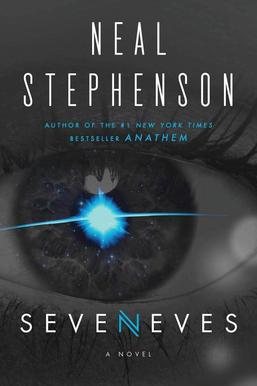
<i>Seveneves</i> 2015 novel by Neal Stephenson

Seveneves is a science fiction novel by Neal Stephenson published in 2015. The story tells of the desperate efforts to preserve Homo sapiens in the wake of apocalyptic events on Earth after the unexplained disintegration of the Moon and the remaking of human society as a space-based civilization after a severe genetic bottleneck.

<i>Invasion of the Air-eaters</i> Board game

Invasion of the Air-eaters is a science fiction near-future board wargame published by Metagaming Concepts in 1979 in which aliens invaders attempt to replace the oxygen in Earth's atmosphere with sulfur dioxide.

References

  1. 1 2 3 Stableford, Brian M. (2004). Historical dictionary of science fiction literature. scarecrow press. pp. 160–161. ISBN   9780810849389 . Retrieved December 13, 2024.
  2. D'Ammassa, Don (2015). Encyclopedia of Science Fiction. Facts on File. ISBN   9781438140629 . Retrieved December 13, 2024.