
Moriscos were former Muslims and their descendants whom the Catholic Church and Habsburg Spain commanded to forcibly convert to Christianity or face compulsory exile after Spain outlawed Islam. Spain had a sizeable Muslim population, the mudéjars, in the early 16th century.

Abu Marwan Abd al-Malik I, often simply Abd al-Malik or Mulay Abdelmalek, was the Saadian Sultan of Morocco from 1576 until his death right after the Battle of al-Kasr al-Kabir against Portugal in 1578.

The Saadi Sultanate, also known as the Sharifian Sultanate, was a state which ruled present-day Morocco and parts of Northwest Africa in the 16th and 17th centuries. It was led by the Saadi dynasty, an Arab Sharifian dynasty.

Ahmad al-Mansur (Arabic: أبو العباس أحمد المنصور, Ahmad Abu al-Abbas al-Mansur, also Ahmad al-Mansur al-Dahabbi, and Ahmed al-Mansour was the Saadi Sultan of Morocco from 1578 to his death in 1603, the sixth and most famous of all rulers of the Saadis. Ahmad al-Mansur was an important figure in both Europe and Africa in the sixteenth century. His powerful army and strategic location made him an important power player in the late Renaissance period. He has been described as "a man of profound Islamic learning, a lover of books, calligraphy and mathematics, as well as a connoisseur of mystical texts and a lover of scholarly discussions."
Judar Pasha was a Spanish-Moroccan military leader under the Saadian sultan Ahmad al-Mansur in the late 16th century. He led the Saadian army in the conquest of the Songhai Empire.

The Wattasid dynasty was a ruling dynasty of Morocco. Like the Marinid dynasty, its rulers were of Zenata Berber descent. The two families were related, and the Marinids recruited many viziers from the Wattasids. These viziers assumed the powers of the Sultans, seizing control of the Marinid dynasty's realm when the last Marinid, Abu Muhammad Abd al-Haqq, who had massacred many of the Wattasids in 1459, was murdered during a popular revolt in Fez in 1465.
Zidan Abu Maali was the embattled Saadi Sultan of Morocco from 1603 to 1627. He was the son and heir of Ahmad al-Mansur by his wife Lalla Aisha bint Abu Bakkar, a lady of the Chebanate tribe.

There was cultural contact between Europe and the Islamic world from the Renaissance to Early Modern period.
Ahmad ibn Qāsim Al-Hajarī also known as Al-Hajari, Afoukay, Chihab, Afokai or Afoqai, was a Muslim Morisco who worked as a translator in Morocco during the reigns of the Saadi sultans, Ahmad al-Mansur, Zidan Abu Maali, Abu Marwan Abd al-Malik II and Al Walid ibn Zidan. He was later sent as an envoy by Sultan Zidan Abu Maali of Morocco who sent him to France and Netherlands to negotiate the release of some Moriscos who were captured by privateers and thrown on the shores of the mentioned countries.

The Capture of Fez occurred in 1576 at the Moroccan city of Fez, when an Ottoman force from Algiers supported the prince Abd al-Malik in gaining the throne of the Saadi Sultanate against his nephew and rival claimant Mulay Muhammed al-Mutawakkil in exchange for making the Sultanate an Ottoman vassal.

Turkey–Morocco relations are the foreign relations between Morocco and Turkey, and spanned a period of several centuries, from the early 16th century when the Ottoman Empire neighbored Morocco and had an expedition there until modern times.
The Battle of Tadla occurred in September 1554 in Tadla, Morocco, between Ali Abu Hassun, last ruler of the Wattasid dynasty, and Mohammed ash-Sheikh, ruler of the Saadis.
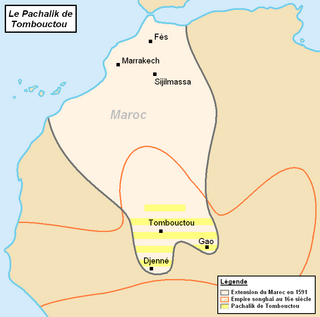
The Pashalik of Timbuktu, also known as the Pashalik of Sudan, was a West African political entity that existed between the 16th and the 19th century. It was formed after the Battle of Tondibi, when a military expedition sent by Saadian sultan Ahmad al-Mansur of Morocco defeated the Songhai Empire and established control over a territory centered on Timbuktu. Following the decline of the Saadi Sultanate in the early 17th century, Morocco retained only nominal control of the Pashalik.
Abul-Abbas Ahmad ibn Ali al-Mandjur al-Miknasi al-Fasi was a Moroccan scholar of theology and law and a prominent teacher at the Qarawiyyin University. He is known to have educated qadis for several Moroccan towns. Between 1579 and 1585 he spent much time in Marrakesh, where he taught the Moroccan sultan Ahmad al-Mansur. He is the author of theological commentaries, and especially his fahrasa is of great renown. He was the father of the well-known writer Ahmad Ibn al-Qadi.

The Zawiya Dila'iya, also known as the Zawiyaof Dila and the Dila'iya Sultanate, was a Sufi brotherhood, centred in the Middle Atlas range of Morocco.
The Khlout also written as Khlut, Khlot and sometimes Khult is an Arab tribe belonging to the Jacham of the Banu Hilal confederacy in Morocco. They today inhabit the Gharb region along with other Arab tribes.
Hassan Aourid is a Moroccan writer. He was born in Errachidia. He has a PhD in political science and lectures at the Mohammed V University. He has published widely in both Arabic and French. He has written half a dozen novels:
The Conquest of Fez or Capture of Fez took place in 1554 between the Algerian forces of Salah Rais and the ruler of the Saadi Sultanate, Mohammed ash-Sheikh. The battle took place on 7 January at Qudyat-al-Mahali, a suburb near Fez and occurred after Salah Reis’ two previous victories against the Saadians, one at Taza and another at the Sebou river. One of the objectives of the expedition is to restore Ali Abu Hassun, a Wattassid pretender, to the throne.
In the 16th century the Ottomans undertook several expeditions to Saadi Sultanate

