The Book of Exodus is the second book of the Bible. It is a narrative of the Exodus, the origin myth of the Israelites leaving slavery in Biblical Egypt through the strength of their deity named Yahweh, who according to the story chose them as his people. The Israelites then journey with the legendary prophet Moses to Mount Sinai, where Yahweh gives the Ten Commandments and they enter into a covenant with Yahweh, who promises to make them a "holy nation, and a kingdom of priests" on condition of their faithfulness. He gives them their laws and instructions to build the Tabernacle, the means by which he will come from heaven and dwell with them and lead them in a holy war to conquer Canaan, which has earlier, according to the myth of Genesis, been promised to the "seed" of Abraham, the legendary patriarch of the Israelites.
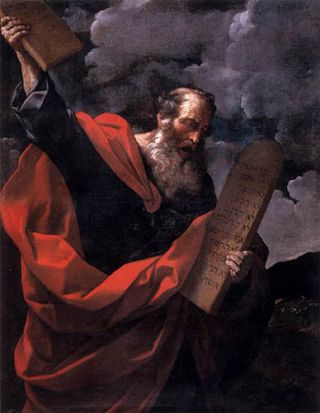
Moses was a Hebrew prophet, teacher and leader according to Abrahamic tradition. He is considered the most important prophet in Judaism and Samaritanism, and one of the most important prophets in Christianity, Islam, the Baháʼí Faith, and other Abrahamic religions. According to both the Bible and the Quran, Moses was the leader of the Israelites and lawgiver to whom the prophetic authorship of the Torah is attributed.

The land of Goshen is named in the Hebrew Bible as the place in Egypt given to the Hebrews by the pharaoh of Joseph, and the land from which they later left Egypt at the time of the Exodus. It is believed to have been located in the eastern Nile Delta, lower Egypt; perhaps at or near Avaris, the seat of power of the Hyksos kings.

The Crossing of the Red Sea or Parting of the Red Sea is an episode in The Exodus, a foundational story in the Hebrew Bible.
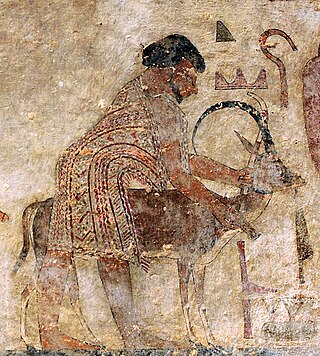
The Hyksos, in modern Egyptology, are the kings of the Fifteenth Dynasty of Egypt. Their seat of power was the city of Avaris in the Nile Delta, from where they ruled over Lower Egypt and Middle Egypt up to Cusae.
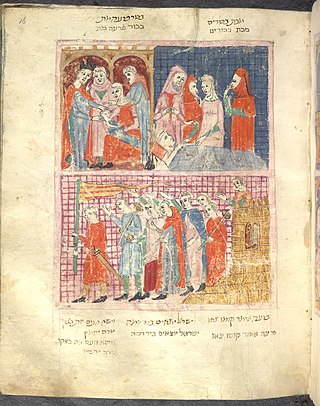
In the Book of Exodus, the Plagues of Egypt are ten disasters that Yahweh inflicts on the Egyptians to convince the Pharaoh to emancipate the enslaved Israelites, each of them confronting the Pharaoh and one of his Egyptian gods; they serve as "signs and marvels" given by Yahweh in response to the Pharaoh's taunt that he does not know Yahweh: "The Egyptians shall know that I am the LORD". These Plagues are recited by Jews during the Passover Seder.

The Shasu were Semitic-speaking pastoral nomads in the Southern Levant from the late Bronze Age to the Early Iron Age or the Third Intermediate Period of Egypt. They were tent dwellers, organized in clans ruled by a tribal chieftain and were described as brigands active from the Jezreel Valley to Ashkelon, in the Transjordan and in the Sinai. Some of them also worked as mercenaries for Asiatic and Egyptian armies.

The Exodus is the founding myth of the Israelites whose narrative is spread over four of the five books of the Pentateuch. The narrative of the Exodus describes a history of Egyptian bondage of the Israelites followed by their exodus from Egypt through a passage in the Red Sea, in pursuit of the Promised Land under the leadership of Moses.
John Van Seters is a Canadian scholar of the Hebrew Bible and the Ancient Near East. Currently University Distinguished Professor Emeritus at the University of North Carolina, he was formerly James A. Gray Professor of Biblical Literature at UNC. He took his Ph.D. at Yale University in Near Eastern Studies (1965) and a Th.D. h.c. from the University of Lausanne (1999). His honours and awards include a Guggenheim Fellowship, an NEH fellowship, an ACLS Fellowship, and research fellowships at Oxford, Cambridge, Katholieke Universiteit Leuven, and National Research Foundation of South Africa. His many publications include The Hyksos: A New Investigation (1966); Abraham in History and Tradition (1975); In Search of History ; The Edited Bible (2006); and The Biblical Saga of King David (2009).
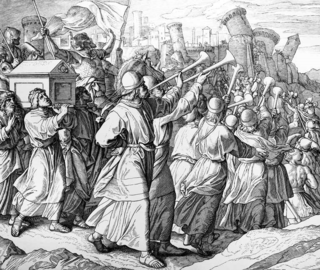
The Battle of Jericho, as described in the Biblical Book of Joshua, was the first battle fought by the Israelites in the course of the conquest of Canaan. According to Joshua 6:1–27, the walls of Jericho fell after the Israelites marched around the city walls once a day for six days, seven times on the seventh day, with the priests blowing their horns daily and the people shouting on the last day. Excavations at Tell es-Sultan, the biblical Jericho, have failed to find any traces of a city at the relevant time, which has led to a consensus among scholars that the story has its origins in the nationalist propaganda of much later kings of Judah and their claims to the territory of the Kingdom of Israel.

The Bible Unearthed: Archaeology's New Vision of Ancient Israel and the Origin of Its Sacred Texts, a book by Israel Finkelstein, Professor of Archaeology at Tel Aviv University, and Neil Asher Silberman, an archaeologist, historian and contributing editor to Archaeology Magazine published in January 2001 by Simon & Schuster using its Free Press imprint and reprinted in June 2002 using its Touchstone imprint, discusses the archaeology of Israel and its relationship to the origins and content of the Hebrew Bible.
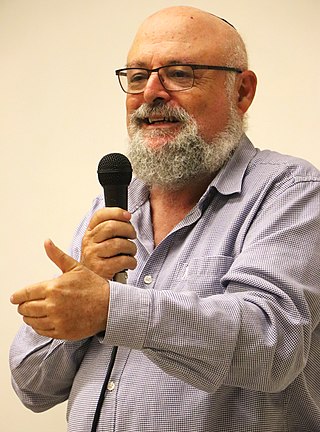
Israel Knohl is an Israeli Bible scholar and historian. He is the Yehezkel Kaufmann Professor of Biblical studies at the Hebrew University of Jerusalem and a Senior Fellow at Shalom Hartman Institute in Jerusalem. His books deal with the integration of scientific and archaeological discoveries with the biblical account, early Israelite beliefs, a survey of Israelite cult, and how and where the Israelites originated.

Mount Sinai is the mountain at which the Ten Commandments were given to Moses by God, according to the Book of Exodus in the Hebrew Bible. In the Book of Deuteronomy, these events are described as having transpired at Mount Horeb. "Sinai" and "Horeb" are generally considered by scholars to refer to the same place.

The Minoan eruption was a catastrophic volcanic eruption that devastated the Aegean island of Thera circa 1600 BCE. It destroyed the Minoan settlement at Akrotiri, as well as communities and agricultural areas on nearby islands and the coast of Crete with subsequent earthquakes and paleotsunamis. With a Volcanic Explosivity Index (VEI) of 6, it resulted in the ejection of approximately 28–41 km3 (6.7–9.8 cu mi) of dense-rock equivalent (DRE), the eruption was one of the largest volcanic events in human history. Since tephra from the Minoan eruption serves as a marker horizon in nearly all archaeological sites in the Eastern Mediterranean, its precise date is of high importance and has been fiercely debated among archaeologists and volcanologists for decades, without coming to a definite conclusion.

The Exodus Decoded is a 2006 documentary film by "investigative archaeologist" and filmmaker Simcha Jacobovici and producer/director James Cameron. It aired on April 16 on The History Channel. The documentary proposes naturalistic origins for the plagues of Egypt as described in the Book of Exodus.
The Tempest Stele was erected by pharaoh Ahmose I early in the 18th Dynasty of Egypt, c. 1550 BCE. The stele describes a great storm striking Egypt during this time, destroying tombs, temples and pyramids in the Theban region and the work of restoration ordered by the king.
"The Bible's Buried Secrets" is a Nova program that first aired on PBS, on November 18, 2008. According to the program's official website: "The film presents the latest archaeological scholarship from the Holy Land to explore the beginnings of modern religion and the origins of the Hebrew Bible, also known as the Old Testament. This archaeological detective story tackles some of the biggest questions in biblical studies: Where did the ancient Israelites come from? Who wrote the Bible, when, and why? How did the worship of one God—the foundation of modern Judaism, Christianity, and Islam—emerge?"
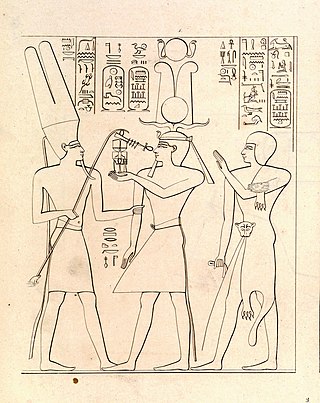
The Bible makes reference to various pharaohs of Egypt. These include unnamed pharaohs in events described in the Torah, as well as several later named pharaohs, some of whom were historical or can be identified with historical pharaohs.
The Exodus is the founding myth of the Israelites. The scholarly consensus is that the Exodus, as described in the Torah, is not historical.
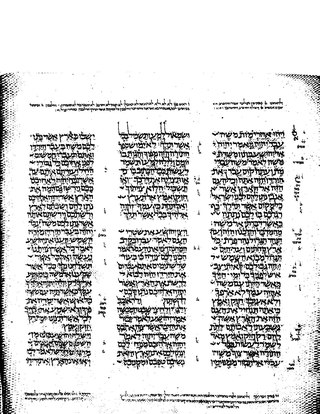
Joshua 3 is the third chapter of the Book of Joshua in the Hebrew Bible or in the Old Testament of the Christian Bible. According to Jewish tradition, the book was attributed to Joshua, with additions by the high priests Eleazar and Phinehas, but modern scholars view it as part of the Deuteronomistic History, which spans the books of Deuteronomy to 2 Kings, attributed to nationalistic and devotedly Yahwistic writers during the time of the reformer Judean king Josiah in 7th century BCE. This chapter focuses on the Israelites crossing the Jordan River westward into the land of Canaan under the leadership of Joshua, a part of a section comprising Joshua 1:1–5:12 about the entry to the land of Canaan.


 United States