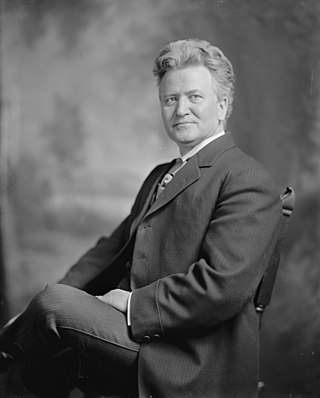
Robert MarionLa Follette Sr., nicknamed "Fighting Bob", was an American lawyer and politician. He represented Wisconsin in both chambers of Congress and served as the governor of Wisconsin from 1901 to 1906. A Republican for most of his life, he ran for president of the United States as the nominee of his own Progressive Party in the 1924 U.S. presidential election. Historian John D. Buenker describes La Follette as "the most celebrated figure in Wisconsin history".

The history of the United States from 1865 to 1917 was marked by the Reconstruction era, the Gilded Age, and the Progressive Era, and includes the rise of industrialization and the resulting surge of immigration in the United States.

In United States history, the Gilded Age is the period from about the late 1870s to the late 1890s, which occurred between the Reconstruction era and the Progressive Era. It was named by 1920s historians after Mark Twain's 1873 novel The Gilded Age: A Tale of Today. Historians saw late 19th-century economic expansion as a time of materialistic excesses marked by widespread political corruption.
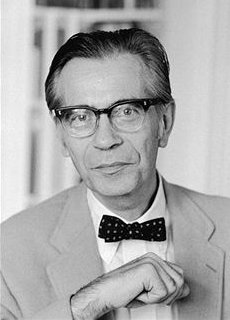
Richard Hofstadter was an American historian and public intellectual of the mid-20th century. Hofstadter was the DeWitt Clinton Professor of American History at Columbia University. Rejecting his earlier historical materialist approach to history, in the 1950s he came closer to the concept of "consensus history", and was epitomized by some of his admirers as the "iconic historian of postwar liberal consensus." Others see in his work an early critique of the one-dimensional society, as Hofstadter was equally critical of socialist and capitalist models of society, and bemoaned the "consensus" within the society as "bounded by the horizons of property and entrepreneurship", criticizing the "hegemonic liberal capitalist culture running throughout the course of American history".

The Progressive Era (1890s–1920s) was a period in the United States characterized by multiple social and political reform efforts. Reformers during this era, known as Progressives, sought to address issues they associated with rapid industrialization, urbanization, immigration, and political corruption, as well as the concentration of industrial ownership in monopolies. Reformers expressed concern about slums, poverty, and labor conditions. Multiple overlapping movements pursued social, political, and economic reforms by advocating changes in governance, scientific methods, and professionalism; regulating business; protecting the natural environment; and seeking to improve urban living and working conditions.
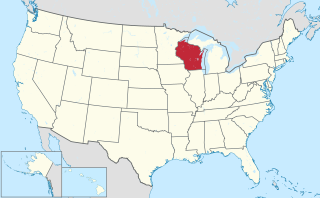
The Wisconsin Idea is a public philosophy that has influenced policy and ideals in the U.S. state of Wisconsin's education system and politics. In education, emphasis is often placed on how the Idea articulates education's role for Wisconsin's government and inhabitants. In politics, the Idea is most associated with the historic political upheaval and subsequent reformation during the Progressive Era in the United States.

The Age of Reform is a 1955 Pulitzer Prize-winning book by Richard Hofstadter. It is an American history, which traces events from the Populist Movement of the 1890s through the Progressive Era to the New Deal of the 1930s. The Age of Reform stands out from other historical material because Hofstadter's main purpose for writing is not to retell an extensive history of the three movements, but to analyze the common beliefs of the reform groups in our modern perspective to elucidate historical distortions, most notably between the New Deal and Progressivism.
Progressivism in the United States is a left-leaning political philosophy and reform movement. Into the 21st century, it advocates policies that are generally considered social democratic and part of the American Left. It has also expressed itself within center-right politics, such as New Nationalism and progressive conservatism. It reached its height early in the 20th century. Middle/working class and reformist in nature, it arose as a response to the vast changes brought by modernization, such as the growth of large corporations, pollution, and corruption in American politics. Historian Alonzo Hamby describes American progressivism as a "political movement that addresses ideas, impulses, and issues stemming from modernization of American society. Emerging at the end of the nineteenth century, it established much of the tone of American politics throughout the first half of the century."
These are the references for further information regarding the history of the Republican Party in the U.S. since 1854.

The Committee of Fifteen was a New York City citizens' group formed in November 1900 to combat prostitution and gambling. Established by influential members of New York's upper class, the Committee aimed to expose and reduce vice within the city, focusing particularly on areas where police corruption and political protection facilitated illegal activities. Through a combination of undercover investigations and public advocacy, the Committee gathered extensive evidence on urban vice, eventually presenting its findings to Governor Benjamin Barker Odell, Jr. in 1901. While the Committee disbanded later that year, its findings influenced the creation of the Committee of Fourteen, which took up the cause. The Committee of Fifteen's report, The Social Evil With Special Reference to Conditions Existing in the City of New York, published in 1902, became a cornerstone document for early 20th-century urban reform.

The Fourth Party System was the political party system in the United States from about 1896 to 1932 that was dominated by the Republican Party, except the 1912 split in which Democrats captured the White House and held it for eight years.
The Journal of the Gilded Age and Progressive Era is a peer-reviewed academic journal of American history. It is sometimes referred to by the acronym JGAPE.
Leon Fink is a Distinguished Professor in the Department of History at the University of Illinois at Chicago. A historian, his research and writing focuses on labor unions in the United States, immigration and the nature of work He is the founding editor of Labor: Studies in Working-Class History, the premier journal of labor history in the United States.
Richard Schneirov is a Professor Emeritus of history and noted labor historian at Indiana State University.
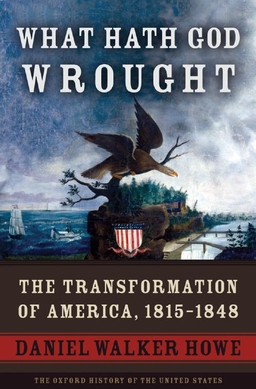
What Hath God Wrought: The Transformation of America, 1815–1848 is a nonfiction book about the history of the United States written by historian Daniel Walker Howe. Published in 2007 as part of the Oxford History of the United States series, the book offers a synthesis history of the early-nineteenth-century United States in a braided narrative that interweaves accounts of national politics, new communication technologies, emergent religions, and mass reform movements. The winner of multiple book prizes, including the 2008 Pulitzer Prize for History, reviewers widely praised What Hath God Wrought. Historian Richard Carwardine said it "lays powerful claim to being the best work ever written on this period of the American past."
George Edwin Mowry was an American historian focusing primarily on the Progressive Era. As a professor at UCLA and the University of North Carolina at Chapel Hill, he taught large classes and directed over 50 PhD dissertations. Mowry published five books, co-authored six others and edited three books. He published 10 book chapters, over 50 encyclopedia articles and over 100 book reviews in magazines and professional journals. He joined John Donald Hicks as coauthor of a highly successful university textbook. He was active in many organizations, especially the Organization of American Historians. His interpretation of the middle-class foundation of the Progressive Era remains influential.

Robert Huddleston Wiebe was an American historian and bestselling author. He specialized in American business history.
This bibliography of Theodore Roosevelt is a list of published works about Theodore Roosevelt, the 26th president of the United States. The titles are selected from tens of thousands of publications about him.
Cecelia Tichi is an American academic and author of mystery novels. She is the Gertrude Conaway Vanderbilt Professor of English and American Studies at Vanderbilt University. She is a former president of the American Studies Association, and the winner of the Jay B. Hubbell Medal for lifetime achievement in American literature.

The 1904 Wisconsin gubernatorial election was held on November 8, 1904.
