
Kamatari Fujiwara was a Japanese stage and film actor who appeared in over 200 films between 1933 and 1984. In addition to regular appearances in the films of Akira Kurosawa, he worked for directors such as Mikio Naruse, Yasujirō Ozu, Heinosuke Gosho and others.

Fumiko Hayashi was a Japanese writer of novels, short stories and poetry, who has repeatedly been included in the feminist literature canon. Among her best-known works are Diary of a Vagabond, Late Chrysanthemum and Floating Clouds.

Mikio Naruse was a Japanese filmmaker who directed 89 films spanning the period 1930 to 1967.

Hideko Takamine was a Japanese actress who began as a child actress and maintained her fame in a career that spanned 50 years. She is particularly known for her collaborations with directors Mikio Naruse and Keisuke Kinoshita, with Twenty-Four Eyes (1954) and Floating Clouds (1955) being among her most noted films.
Repast is a 1951 Japanese drama and shōshimin-eiga film directed by Mikio Naruse and starring Setsuko Hara. It is based on the final and unfinished novel by Fumiko Hayashi, and was the first in a series of adaptations of her work by the director.
Edward Selim Atiyah was an Anglo-Lebanese author and political activist. He is best known for his 1946 autobiography An Arab Tells His Story, and his 1955 book The Arabs.
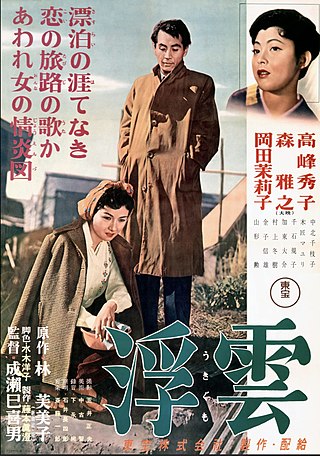
Floating Clouds is a 1955 Japanese drama film directed by Mikio Naruse. It is based on the novel Ukigumo by Japanese writer Fumiko Hayashi, published just before her death in 1951. The film received numerous national awards upon its release and remains one of director Naruse's most acclaimed works.

Lightning is a 1952 Japanese drama film directed by Mikio Naruse. It is based on the 1936 novel by Fumiko Hayashi and was the second in a series of adaptations of Hayashi's work by Naruse after the 1951 Repast.
A Wanderer's Notebook , also titled Her Lonely Lane, is a 1962 Japanese drama film directed by Mikio Naruse starring Hideko Takamine. It is based on the autobiographical book Diary of a Vagabond by Fumiko Hayashi and its stage adaptation by Kazuo Kikuta.

Just Before Nightfall is a 1971 French crime drama film written and directed by Claude Chabrol and starring Stéphane Audran and Michel Bouquet. Based on the 1951 novel The Thin Line by Edward Atiyah, it follows a married businessman who, after killing his mistress, tries to ease his conscience by confessing to his wife and the victim's husband.

Ranko Hanai was a Japanese actress who appeared in about 200 films between 1929 and 1961.
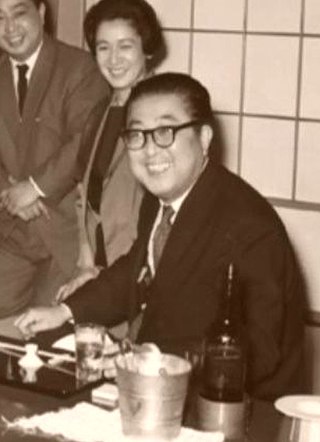
Sanezumi Fujimoto was a Japanese film producer. He served as the head of production for Toho Studios. He was co-producer of Akira Kurosawa's The Hidden Fortress. He also produced many other films, including Yasujirō Ozu's The End of Summer, Kihachi Okamoto's The Sword of Doom and Japan's Longest Day and several films directed by Mikio Naruse.
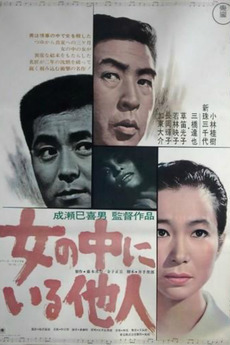
The Stranger Within a Womana.k.a.The Thin Line is a 1966 Japanese drama film directed by Mikio Naruse. It is based on the 1951 novel The Thin Line by Edward Atiyah.
Toshirō Ide was a Japanese screenwriter for both film and television.

Battle of Roses is a 1950 Japanese drama film directed by Mikio Naruse. It is based on the pre-war novel Bara kassen by Fumio Niwa.

Wife! Be Like a Rose!, also titled Kimiko, is a 1935 Japanese comedy drama film directed by Mikio Naruse. It is based on the shinpa play Futari tsuma by Minoru Nakano and one of Naruse's earliest sound films. Wife! Be Like a Rose! was one of the first Japanese films to see a theatrical release in the United States.

Three Sisters with Maiden Hearts is a 1935 Japanese drama film written and directed by Mikio Naruse. Based on the short story Sisters of Asakusa by Yasunari Kawabata, it was the director's first sound film.
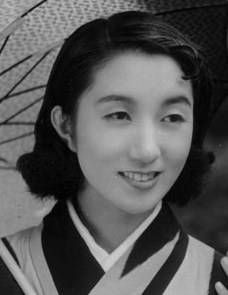
Mitsuko Miura was a Japanese actress active from 1938 to 1964. She appeared in over 150 films under the direction of filmmakers like Mikio Naruse, Kenji Mizoguchi and Hiroshi Shimizu.

Chieko Nakakita was a Japanese actress. She appeared in the early films of Akira Kurosawa and later starred in many films by Mikio Naruse.


