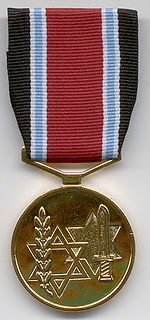
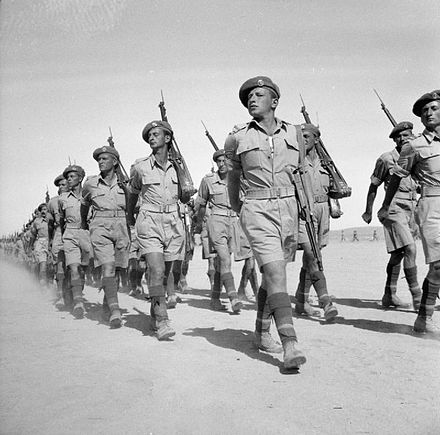
The Volunteer Ribbon is an Israeli decoration that is awarded to World War I and World War II veterans.
Israel, officially the State of Israel, is a country in Western Asia, located on the southeastern shore of the Mediterranean Sea and the northern shore of the Red Sea. It has land borders with Lebanon to the north, Syria to the northeast, Jordan on the east, the Palestinian territories of the West Bank and Gaza Strip to the east and west, respectively, and Egypt to the southwest. The country contains geographically diverse features within its relatively small area. Israel's economic and technological center is Tel Aviv, while its seat of government and proclaimed capital is Jerusalem, although the state's sovereignty over Jerusalem has only partial recognition.
World War I, also known as the First World War or the Great War, was a global war originating in Europe that lasted from 28 July 1914 to 11 November 1918. Contemporaneously described as "the war to end all wars", it led to the mobilisation of more than 70 million military personnel, including 60 million Europeans, making it one of the largest wars in history. It is also one of the deadliest conflicts in history, with an estimated nine million combatants and seven million civilian deaths as a direct result of the war, while resulting genocides and the 1918 influenza pandemic caused another 50 to 100 million deaths worldwide.
World War II, also known as the Second World War, was a global war that lasted from 1939 to 1945. The vast majority of the world's countries—including all the great powers—eventually formed two opposing military alliances: the Allies and the Axis. A state of total war emerged, directly involving more than 100 million people from over 30 countries. The major participants threw their entire economic, industrial, and scientific capabilities behind the war effort, blurring the distinction between civilian and military resources. World War II was the deadliest conflict in human history, marked by 50 to 85 million fatalities, most of whom were civilians in the Soviet Union and China. It included massacres, the genocide of the Holocaust, strategic bombing, premeditated death from starvation and disease, and the only use of nuclear weapons in war.
| The Volunteer Ribbon | |
|---|---|
The Volunteer Ribbon | |
| Awarded by The State of Israel | |
| Country | |
| Type | Award for military service towards the establishment of the State of Israel |
| Campaign(s) | First World War Second World War |
| Statistics | |
| Established | 1961 |
| Order of wear | |
| Next (higher) | Nili Ribbon |
| Next (lower) | Ribbon of The Haganah |
The ribbon is awarded to:
The Jewish Legion (1917–1921) is an unofficial name used to refer to five battalions of Jewish volunteers, the 38th to 42nd (Service) Battalions of the Royal Fusiliers, raised in the British Army to fight against the Ottoman Empire during the First World War.
Palestine is a geographic region in Western Asia usually considered to include Israel, the West Bank, the Gaza Strip, and in some definitions, some parts of western Jordan.
The Ottoman Army was reorganized along modern Western European lines during the Tanzimat modernization period and functioned during the decline and dissolution period that is roughly between 1861 and 1918, end of World War I for the Ottomans. The last reorganization occurred during the Second Constitutional Era.
The Yishuv or Ha-Yishuv or Ha-Yishuv Ha-Ivri is the body of Jewish residents in the land of Israel prior to the establishment of the State of Israel. The term came into use in the 1880s, when there were about 25,000 Jews living across the Land of Israel, then comprising the southern part of Ottoman Syria, and continued to be used until 1948, by which time there were some 630,000 Jews there. The term is used in Hebrew even nowadays to denote the Pre-State Jewish residents in the Land of Israel.
The British Army was, in 1939, a volunteer army, that introduced limited conscription in early 1939, and full conscription shortly after the declaration of war with Germany. During the early years of the Second World War, the British Army suffered defeat in almost every theatre of war in which it was deployed. With mass conscription, the expansion of the British Army was reflected in the formation of larger armies and army groups. From 1943, the larger and better-equipped British Army never suffered a strategic defeat.
Fort Edward is a National Historic Site of Canada in Windsor, Nova Scotia, and was built during Father Le Loutre's War (1749-1755). The British built the fort to help prevent the Acadian Exodus from the region. The Fort is most famous for the role it played both in the Expulsion of the Acadians (1755) and in protecting Halifax, Nova Scotia from a land assault in the American Revolution. While much of Fort Edward has been destroyed, including the officers quarters and barracks, the blockhouse that remains is the oldest extant in North America. A cairn was later added to the site.
Yom Kippur, also known as the Day of Atonement, is the holiest day of the year in Judaism. Its central themes are atonement and repentance. Jewish people traditionally observe this holy day with an approximate 25-hour period of fasting and intensive prayer, often spending most of the day in synagogue services.
Fighters against Nazis Medal is an Israeli decoration that is awarded to World War II veterans.
If the person eligible for this award has died, a family member (a spouse, a son, a daughter, a father, a mother, a brother, a sister, a grandson, a granddaughter) is entitled to submit an application requesting the ribbon, or an equivalent to the ribbon in event of loss or wear and tear. [1]
Ribbon
The ribbon's central stripe shows the flag of Israel with red, orange and green stripes on either side.
The Distinguished Service Cross (DSC) is a third level military decoration awarded to officers, and since 1993 ratings and other ranks, of the British Armed Forces, Royal Fleet Auxiliary and British Merchant Navy, and formerly also to officers of other Commonwealth countries.
The Distinguished Service Medal (DSM) was a military decoration awarded until 1993 to personnel of the Royal Navy and members of the other services, and formerly to personnel of other Commonwealth countries, up to and including the rank of Chief Petty Officer, for bravery and resourcefulness on active service at sea.
The Combat Action Ribbon, is a United States Navy, United States Marine Corps, and United States Coast Guard military decoration awarded to those U.S. sea service members "who have actively participated in ground or surface combat."
Awards and Decorations of Nazi Germany were military, political and civilian decorations that were bestowed between 1923 and 1945, first by the Nazi Party and later the state of Nazi Germany.
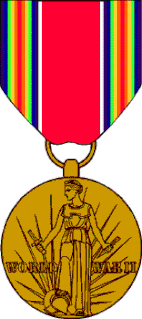
The World War II Victory Medal is a service medal of the United States military which was established by an Act of Congress on 6 July 1945 and promulgated by Section V, War Department Bulletin 12, 1945.
A member of the armed forces mentioned in dispatches is one whose name appears in an official report written by a superior officer and sent to the high command, in which his or her gallant or meritorious action in the face of the enemy is described.
The Luxembourg War Cross is a military decoration of Luxembourg. It was created on 17 April 1945 by the Grand Duchess Charlotte of Luxembourg. The War Cross recognizes military service and feats of bravery. The medal is often referred to as the Luxembourg Croix de Guerre as French is one of Luxembourg's three official languages.
The Military Medal (MM) was a military decoration awarded to personnel of the British Army and other arms of the armed forces, and to personnel of other Commonwealth countries, below commissioned rank, for bravery in battle on land. The award was established in 1916, with retrospective application to 1914, and was awarded to other ranks for "acts of gallantry and devotion to duty under fire". The award was discontinued in 1993 when it was replaced by the Military Cross, which was extended to all ranks, while other Commonwealth nations instituted their own award systems in the post war period.
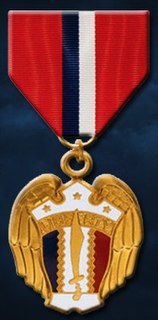
The Philippine Liberation Medal is a military award of the Republic of the Philippines which was created by an order of Commonwealth Army of the Philippines Headquarters on 20 December 1944, and was issued as the Philippine Liberation Ribbon. The decoration was presented to any service member, of both Philippine Commonwealth and allied militaries, who participated in the liberation of the Philippine Islands between the dates of 17 October 1944, and 2 September 1945. A full-sized medal was authorized and added on 22 July 1945.
Authorized foreign decorations of the United States military are those military decorations which have been approved for wear by members of the United States armed forces but whose awarding authority is the government of a country other than the United States.
Awards and decorations of the United States Army are those military awards including decorations which are issued to members of the United States Army under the authority of the Secretary of the Army. Together with military badges such awards provide an outward display of a service member's accomplishments.
Awards and decorations of the United States Air Force are military decorations which are issued by the Department of the Air Force to Air Force service members and members of other military branches serving under Air Force commands. Of all five branches of the United States Armed Forces, the United States Air Force currently maintains the highest number of active awards and decorations, including many without equivalent in any other service.
The Israeli military decorations are the decorations awarded to soldiers in the Israel Defense Forces who exhibit extraordinary bravery and courage.
The Military Merit Medal was a military decoration of the Empire of Austria-Hungary. It was founded by Emperor Franz Joseph I on March 12, 1890. The Military Merit Medal is often referred to as the "Signum Laudis" after the inscription on the reverse of the medal.
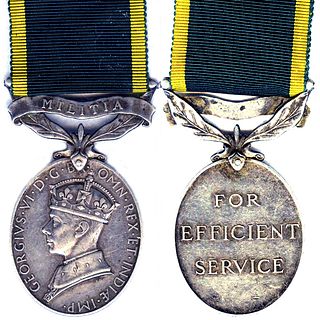
The Efficiency Medal was instituted in 1930 for award to part-time warrant officers, non-commissioned officers and men after twelve years of efficient service on the active list of the Militia or the Territorial Army of the United Kingdom, or of the other Auxiliary Military Forces throughout the British Empire. At the same time a clasp was instituted for award to holders of the medal upon completion of further periods of six years of efficient service.
The Cross of the resistance volunteer combatant is a French decoration that recognizes, as its name implies, those who fought in one of the resistance groups, or who were deported or interned for acts of resistance, or who were killed or injured while taking parts in acts of resistance against the German occupation forces during World War II. This award was created by a special law in 1954 and awarded to those who had been designated and issued cards certifying them as voluntary resistance fighters.
The Honour Roll Clasp of the Army was a decoration of Nazi Germany during World War II. A total number of 4,556 were awarded to members of the army and Waffen-SS.
The War of Independence Ribbon is an Israeli decoration and campaign ribbon awarded to Israelis that took part on the 1947–1949 Palestine war.
|title= (help)