
In art, chiaroscuro is the use of strong contrasts between light and dark, usually bold contrasts affecting a whole composition. It is also a technical term used by artists and art historians for the use of contrasts of light to achieve a sense of volume in modelling three-dimensional objects and figures. Similar effects in cinema, and black and white and low-key photography, are also called chiaroscuro.
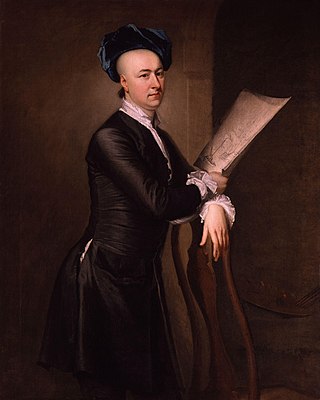
John James was a British architect particularly associated with Twickenham in west London, where he rebuilt St Mary's Church and also built a house for James Johnson, Secretary of State for Scotland, later Orleans House and since demolished. Howard Colvin's assessment of him was that of "a competent architect, but he lacked inventive fancy, and his buildings are for the most part plain and unadventurous in design".
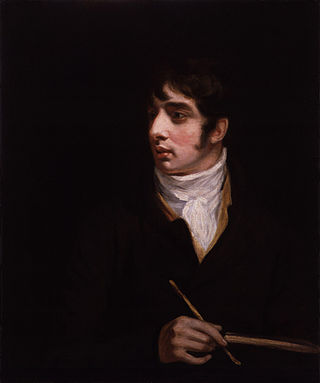
Thomas Girtin was an English watercolourist and etcher. A friend and rival of J. M. W. Turner, Girtin played a key role in establishing watercolour as a reputable art form.
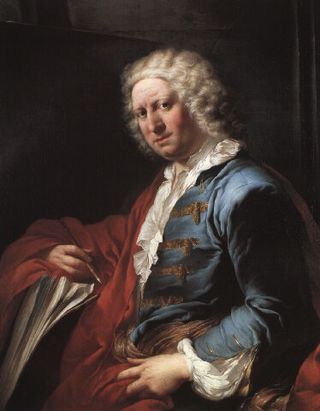
Giovanni Paolo, also known as Gian Paolo Panini or Pannini, was an Italian painter and architect who worked in Rome and is primarily known as one of the vedutisti. As a painter, Panini is best known for his vistas of Rome, in which he took a particular interest in the city's antiquities. Among his most famous works are his view of the interior of the Pantheon, and his vedute—paintings of picture galleries containing views of Rome. Most of his works, especially those of ruins, have a fanciful and unreal embellishment characteristic of capriccio themes. In this they resemble the capricci of Marco Ricci. Panini also painted portraits, including one of Pope Benedict XIV.
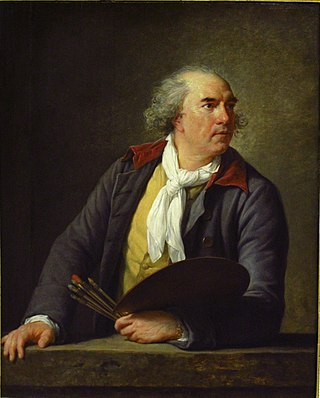
Hubert Robert was a French painter in the school of Romanticism, noted especially for his landscape paintings and capricci, or semi-fictitious picturesque depictions of ruins in Italy and of France.

Antoine Pesne was a French-born court painter of Prussia. Starting in the manner of baroque, he became one of the fathers of rococo in painting. His work represents a link between the French school and the Frederican rococo style.
Eric George Fraser was a British illustrator and graphic artist. He was famous in the public mind for contributions to the Radio Times, and as the creator in 1931 of 'Mr Therm' in adverts for the Gas Light and Coke Company.

Richard Cooper, he was the son of Richard Cooper senior (1701-1764) and his wife Anne Lind.

Samuel Hieronymus Grimm was an 18th-century Swiss landscape artist who worked in oils, watercolours, and pen and ink media.

Alexander Cozens (1717–1786) was a British landscape painter in watercolours, born in Russia, in Saint Petersburg. He taught drawing and wrote treatises on the subject, evolving a method in which imaginative drawings of landscapes could be worked up from abstract blots on paper. His son was the artist John Robert Cozens.

Hubert-François Bourguignon, commonly known as Gravelot, was a French engraver, a famous book illustrator, designer and drawing-master. Born in Paris, he emigrated to London in 1732, where he quickly became a central figure in the introduction of the Rococo style in British design, which was disseminated from London in this period, through the media of book illustrations and engraved designs as well as by the examples of luxury goods in the "French taste" brought down from London to provincial towns and country houses.
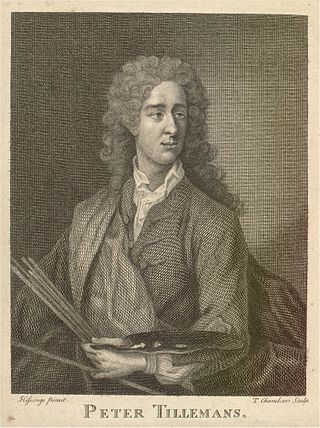
Peter Tillemans was a Flemish painter, best known for his works on sporting and topographical subjects. Alongside John Wootton and James Seymour, Tillemans was one of the founders of the English school of sporting painting.
Samuel Scott was a British landscape painter known for his riverside scenes and seascapes.

William Henry Pyne was an English writer, illustrator and painter, who also wrote under the name of Ephraim Hardcastle. He trained at the drawing academy of Henry Pars in London. He first exhibited at the Royal Academy in 1790. He specialized in picturesque settings including groups of people rendered in pen, ink and watercolour. Pyne was one of the founders of the Royal Watercolour Society in 1804.
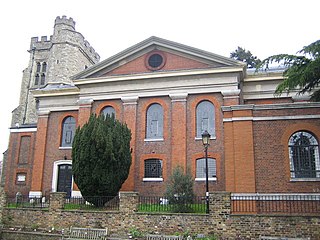
St Mary's Church, Twickenham, also known as St Mary the Virgin, Twickenham, is a Grade II* listed Church of England place of worship dedicated to Saint Mary the Virgin. It is on Church Street, Twickenham in the London Borough of Richmond upon Thames, England.

Pieter Stevensz. van Gunst, also known as Pieter Stevens van Gunst or Petrus Stephani, was a Dutch draughtsman, copperplate engraver and printmaker active in Amsterdam, London (1704), and the Dutch town of Nederhorst (1730-1731).

The Liber Veritatis, meaning Book of Truth in Latin, is a book of drawings recording his completed paintings made by Claude Lorrain, known in English as "Claude". Claude was a landscape painter in Rome, who began keeping this record in 1635/6, as he began to be highly successful, and maintained it until his death in 1682. The book is now in the British Museum, and was owned by the Dukes of Devonshire from the 1720s until 1957. It was reproduced in print form from 1774 to 1777 by Richard Earlom and had a considerable influence on British landscape art. The title Liber Veritatis was apparently invented for these reproductions, but is now also used for the original.

John Thirtle was an English watercolour artist and frame-maker. Born in Norwich, where he lived for most of his life, he was a leading member of the Norwich School of painters.

Study for the Madonna of the Cat is a set of two drawings by Leonardo da Vinci on both sides of a sheet of paper 13 centimeters high and 9.4 centimeters wide. The two drawings were made in pen and brown ink, on a preparatory drawing in stylus, with a brown wash on the back. This is one of the six works of Leonardo da Vinci showing the Virgin and Child playing with a cat or carrying it. A mirror symmetry between the drawings of the two faces is visible by transparency. The Study for the Madonna of the Cat is currently held at the British Museum in London under inventory number 1856,0621.1. The creative and scientific processes underlying the drawing Madonna of the Cat have been discussed by many art historians, including Kenneth Clark, Martin Kemp, Carmen Bambach and Larry Feinberg.

 Illustration to Homer's Iliad, circa 1713. Pen and grey ink, grey wash. Yale Center for British Art (B1977.14.5503).
 Battle Scene, circa 1713. Pen and grey ink, grey wash. Yale Center for British Art (B1975.4.1055).
 Scene from the Book of Tobit, circa 1713. Pen and grey ink, grey wash. Yale Center for British Art (B2009.9.128).
 Scene from Metamorphoses Book 5, circa 1713. Pen and grey ink, grey wash. Metropolitan Museum of Art, New York (2014.703.1)


