Related Research Articles

Clay County is a county in the southeastern portion of the U.S. state of Illinois. As of the 2020 United States Census, the population was 13,288. Since 1842, its county seat has been Louisville, in the center of the county's area. In 1950, the U.S. Census Bureau placed the mean center of U.S. population in Clay County.
Shiloh or Shilo may refer to:
Oak Grove may refer to:
This is a list of properties and districts in Mississippi that are listed on the National Register of Historic Places. There are more than 1,400 sites distributed among all of Mississippi's 82 counties.
Tibbee, also known as Tibbee Station, is an unincorporated community located in Clay County, Mississippi, United States. Tibbee is approximately 7 miles (11 km) east of Osborn and approximately 3 miles (4.8 km) north of Mayhew.

Watkins Mill in Lawson, Missouri, United States, is a preserved woolen mill dating to the mid-19th century. The mill is protected as Watkins Woolen Mill State Historic Site, which preserve its machinery and business records in addition to the building itself. It was designated a National Historic Landmark and added to the National Register of Historic Places in 1966 in recognition for its remarkable state of preservation. The historic site is the centerpiece of Watkins Mill State Park, which is managed by the Missouri Department of Natural Resources.

This is a list of the National Register of Historic Places listings in Clay County, Minnesota. It is intended to be a complete list of the properties and districts on the National Register of Historic Places in Clay County, Minnesota, United States. The locations of National Register properties and districts for which the latitude and longitude coordinates are included below, may be seen in an online map.

Drayden is an unincorporated community in St. Mary's County, Maryland, United States. West St. Mary's Manor was listed on the National Register of Historic Places in 1970. Porto Bello was listed in 1972.
Montpelier is an unincorporated community in Clay County, Mississippi, United States. It is located along Mississippi Highway 46 in the northwestern part of the county. The community contains West Clay Elementary School.

The Ned Ashton House in Iowa City, Iowa, also known as the Edward L. Ashton House or as Ashton House, was built in 1947-1948 and listed on the National Register of Historic Places in 2001.

Seven segments of the historic Natchez Trace are listed on the National Register of Historic Places (NRHP). Also there are additional NRHP-listed structures and other sites along the Natchez Trace, which served the travelers of the trace and survive from the era of its active use.

The Banfill Tavern, also known as the Locke House, is a historic building in Fridley, Minnesota, United States. It was built in 1847 on the east bank of the Mississippi River and has served variously as an inn, a logging camp office, a private home, a dairy farm, a post office, and a summer home. It is now owned by Anoka County and, until April 2022, housed the non-profit Banfill-Locke Center for the Arts. The building stands within Manomin County Park, and the art center is a partner site of the Mississippi National River and Recreation Area.

John W. Gaddis was a noted architect of Vincennes, Indiana. He designed numerous buildings that are preserved and listed on the National Register of Historic Places.
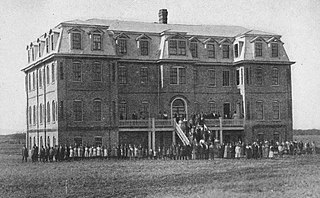
Okolona College, was a college for African Americans in Okolona, Mississippi, Chickasaw County, Mississippi. The school is located on Mississippi Highway 245 1.1 miles north of the junction with Mississippi Highway 32 and Mississippi Highway 41. It was also known as Okolona Industrial School, and Okolona Normal and Industrial School.

The Spikebuck Town Mound and Village Site is a prehistoric and historic archaeological site on Town Creek near its confluence with the Hiwassee River within the boundaries of present-day Hayesville, North Carolina. The site encompasses the former area of the Cherokee village of Quanassee and associated farmsteads. The village was centered on what is known as Spikebuck Mound, an earthwork platform mound, likely built about 1,000 CE by ancestral indigenous peoples during the South Appalachian Mississippian culture period.

The Clay County Courthouse is located on Main Street in Hayesville, Clay County, North Carolina. The T-shaped two-story brick building was built in 1888, and is a prominent local example of vernacular Italianate architecture. Its most visible feature is a three-story square tower, which projects for half its width from the main facade, and through which entry to the building is gained.

Farm No. 266—Johnny Cash Boyhood Home was the home of singer-songwriter Johnny Cash from 1935 to 1950. Cash moved with his family to a rural community in Mississippi County, Arkansas. The farm house was built in 1934 in a government project to help boost the economy. The Cash family joined the community in March 1935. Ray and Carrie Cash moved to Arkansas when they took an offer to farm government land for poor and impoverished farmers. The Cash family went through many hardships while living in the farm house by floods and losing one of their children, Jack Cash. Growing up picking cotton and working on the farm influenced some of Johnny Cash's songs in the future, one of them being "Pickin' Time." In 2018, the home was listed on the National Register of Historic Places.

The Austin–Whittemore House, sometimes referred to as the Austin–Whittemore Museum, is a historic building in Vermillion, South Dakota. Originally a private residence built in 1884, it is now a historic house museum and the headquarters of the Clay County Historical Society. It was listed on the National Register of Historic Places in 1972.

Brumfield High School, formerly G. W.Brumfield School, was a segregated public high school for African American students built in 1925 and closed in 1990; located in Natchez, Mississippi.

Clay County Agricultural High School, also known as Pheba High School and West Clay County Agricultural School, was an agricultural high school in Pheba, Mississippi. Its main building survives. A two-story dormitory building was demolished in 2009. The buildings are listed on the National Register of Historic Places and are Mississippi Landmarks.
References
- ↑ Swoope, Jan (August 6, 2016). "Back to school: One family preserves a piece of America's one-room school history". The Dispatch.
- 1 2 Elkins, Ashley (November 3, 1996). "HED: Woman preserves 135-year-old, one-room school". Northeast Mississippi Daily Journal.
  | This Mississippi school-related article is a stub. You can help Wikipedia by expanding it. |