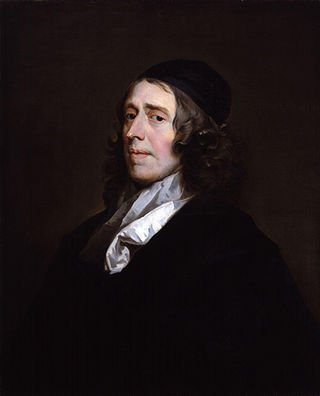
John Owen was an English Nonconformist church leader, theologian, and academic administrator at the University of Oxford.
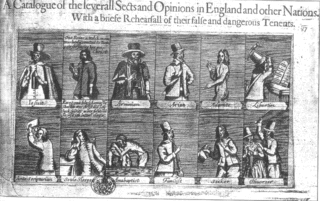
English Dissenters or English Separatists were Protestants who separated from the Church of England in the 17th and 18th centuries.
John Mayo was a Puritan minister in pre-revolutionary Boston, Massachusetts. He was the first minister of Old North Church, also known as Second Church or Paul Revere's Church. This is the Old North Church that was in North Square until the church was dismantled and used by the British for firewood during the occupation of Boston during the Revolutionary War.
Rev. John Wesley (1636–78) was an English nonconformist minister. He was the grandfather of John Wesley.
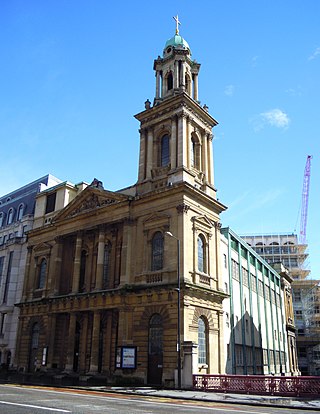
The City Temple is a Nonconformist church on Holborn Viaduct in London. The current minister is Rodney Woods. The church is part of the Thames North Synod of the United Reformed Church and is a member of the Evangelical Alliance.
Timothy Jollie,, was a nonconformist minister and notable educator in the north of England.

Richard Frankland (1630–1698) was an English nonconformist, notable for founding the Rathmell Academy, a dissenting academy in the north of England.
John Tillinghast (1604–1655) was an English clergyman and Fifth-monarchy man. He is known for his confrontation with Oliver Cromwell, and millenarian writings.
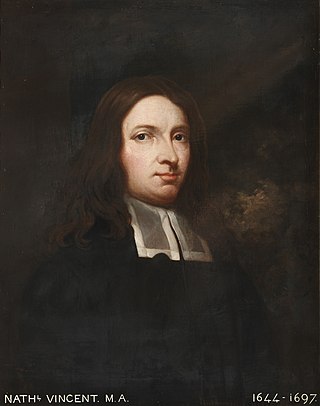
Nathaniel Vincent was an English nonconformist minister, ejected in 1662 and several times imprisoned.

Richard Gilpin (1625–1700) was an English nonconformist minister and physician, prominent in the northern region.
Rev. Thomas Tregosse of Cornwall was a Puritan minister and vicar of the Rebellion period who was silenced for being a Nonconformist.
John Angier (1605–1677) was an English nonconformist minister.
William Aspinwall, was a nonconformist English minister.
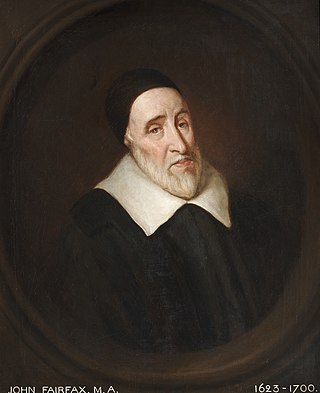
John Fairfax (1623–1700) was an English ejected minister.
Rev. Joseph Hull (1596-1665) led a congregation of 104 from England to Massachusetts in 1635. He founded the Cape Cod town of Barnstable in 1639 and served as one of Maine’s earliest ministers. Hull's willingness to preach without approval from church officials and his efforts to chart a middle course between Anglicans and Puritans resulted in repeated conflicts with religious and colonial authorities.
Nathaniel Wanley was an English clergyman and writer, known for The Wonders of the Little World.
Thomas Grantham (1634–1692) was an English General Baptist minister, and theologian. He had access to Charles II of England, and made petitions on behalf of Baptist beliefs.

St Mary's Church is a Roman Catholic Parish church in Great Yarmouth, Norfolk. It is situated on Regent Road in the centre of the town. It was originally built by the Society of Jesus in the late 1840s and it is now administered by the Diocese of East Anglia. The architect was Joseph John Scoles who also designed the Anglican St Mary's church in the Southtown area of Great Yarmouth and it is a Grade II* listed building.

Meadrow Unitarian Chapel is a Unitarian chapel in the Farncombe area of Godalming, Surrey, England. It is part of the London District and South Eastern Provincial Assembly of Unitarian and Free Christian Churches, one of 16 districts within the General Assembly of Unitarian and Free Christian Churches, the umbrella organisation for British Unitarians.
Timothy Armitage may refer to:


