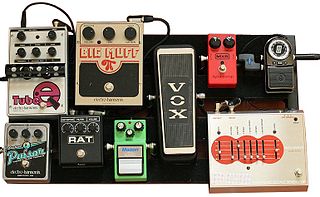
An effects unit, effects processor, or effects pedal is an electronic device that alters the sound of a musical instrument or other audio source through audio signal processing.
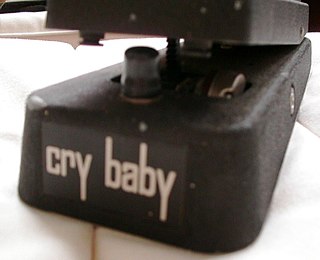
A wah-wah pedal, or simply wah pedal, is a type of effects pedal designed for electric guitar that alters the timbre of the input signal to create a distinctive sound, mimicking the human voice saying the onomatopoeic name "wah-wah". The pedal sweeps a band-pass filter up and down in frequency to create a spectral glide. The wah-wah effect originated in the 1920s, with trumpet or trombone players finding they could produce an expressive crying tone by moving a mute in, and out of the instrument's bell. This was later simulated with electronic circuitry for the electric guitar when the wah-wah pedal was invented. It is controlled by movement of the player's foot on a rocking pedal connected to a potentiometer. Wah-wah effects may be used without moving the treadle as a fixed filter to alter an instrument’s timbre, or to create a "wacka-wacka" funk-styled rhythm for rhythm guitar playing.
Danelectro is a brand of musical instruments and accessories that was founded in Red Bank, New Jersey, in 1947. The company is known primarily for its string instruments that employed unique designs and manufacturing processes. The Danelectro company was sold to the Music Corporation of America (MCA) in 1966, moved to a much larger plant in Neptune City, New Jersey, and employed more than 500 people. Nevertheless, three years later Danelectro closed its plant.

The pedal steel guitar is a console-type of steel guitar with pedals and knee levers that change the pitch of certain strings to enable playing more varied and complex music than other steel guitar designs. Like all steel guitars, it can play unlimited glissandi and deep vibrati—characteristics it shares with the human voice. Pedal steel is most commonly associated with Country music and Hawaiian music.

Boss is a manufacturer of effects pedals for electric guitar and bass guitar. It is a division of the Roland Corporation, a Japanese manufacturer that specializes in musical equipment and accessories. For many years Boss has manufactured a wide range of products related to effects processing for guitars, including "compact" and "twin" effects pedals, multi-effect pedals, electronic tuners and pedal boards. In more recent times, Boss expanded their product range by including digital studios, rhythm machines, samplers and other electronic music equipment. They also are now manufacturing solid-state amplifiers and speaker heads such as the Waza and the Katana. Both feature multi-effects units meant to emulate Boss' classic effects pedals.
Ernie Ball was an American entrepreneur and musician who developed guitar-related products. Ball began as a club and local television musician and entrepreneur, building an international business in guitars and accessories. Ernie Ball Inc. is the eponymous corporation Ball started to market guitar accessories.

Dunlop Manufacturing, Inc. is a manufacturer of musical accessories, especially effects units, based in Benicia, California, United States. Founded in 1965 by Jim Dunlop Sr., the company grew from a small home operation to a large manufacturer of music gear. Dunlop has acquired several well-known effects pedal brands, including Cry Baby, MXR and Way Huge.
Morley Pedals is the name of a guitar effects pedal company, famous for manufacturing wah-wah pedals and other treadle type effects for guitar. Morley pedals use electro-optical circuitry rather than a potentiometer to control the effect. The foot treadle controls a shutter inside the pedal that in turn controls the amount of light reaching a photoresistor. The advantage to this system is that there are no potentiometers in the signal path to wear out and become "scratchy sounding" over time. Electro-optical circuitry is used throughout the classic Morley pedal line, which includes or has included volume pedals, delay pedals, chorus and phaser pedals, and many others.
A phaser is an electronic sound processor used to filter a signal by creating a series of peaks and troughs in the frequency spectrum. The position of the peaks and troughs of the waveform being affected is typically modulated by an internal low-frequency oscillator so that they vary over time, creating a sweeping effect.

Electro-Harmonix is a New York City-based company that makes electronic audio processors and sells rebranded vacuum tubes. The company was founded by Mike Matthews in 1968. It is best known for a series of guitar effects pedals introduced in the 1970s and 1990s. EHX also made a line of guitars in the 1970s.

The Ibanez Tube Screamer is an overdrive pedal made by Ibanez. First developed by Maxon as a competitor to the Boss OD-1, it was sold outside of Japan under the Ibanez brand and became popular among guitarists for its characteristic mid-boosted tone and amp-like distortion. The Tube Screamer has gone through multiple iterations since its debut in 1979, notably the original TS808 model and its successor, the TS9. Many guitarists have used it to create their signature sound, and it is considered one of the most successful, widely copied, and modified overdrive pedals in the history of the electric guitar.

AWA Technology Services, formerly named Amalgamated Wireless (Australasia) Ltd, is an Australian communications technology company. Throughout most of the twentieth century, AWA was Australia's largest and most prominent electronics organisation, undertaking development, manufacture and distribution of radio, telecommunications, television and audio equipment as well as broadcasting services.

Eko is an Italian manufacturer of electric guitars, acoustic guitars and similar instruments, catering to professional level and manufacturing largely for export. It is located in Recanati, Marche.

Musitronics, often shortened to Mu-tron, was a manufacturer of electronic musical effects active in the 1970s. Founded by Mike Beigel and Aaron Newman, the company's products provided filtering and processing effects and were derived from synthesizer components. The company was known for producing high-quality products with many user-adjustable parameters, but high production costs and a failed product line, the Gizmotron, caused its downfall.
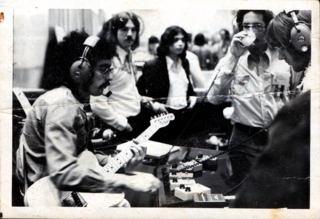
MXR is a New York–based manufacturer of effects pedals from Rochester. The company was co-founded in 1972 by Keith Barr and Terry Sherwood and incorporated as MXR Innovations, Inc. in 1974. The MXR trademark is now owned by Jim Dunlop.

RainSong is a musical instrument manufacturer company based in Woodinville, Washington. RainSong makes carbon fiber (graphite) bodied steel-string acoustic guitars.

Maxon is the brand name used by the Nisshin Onpa company of Japan for its line of effects pedals designed for guitar and bass.

Howard M. Leese is an American guitarist, record producer, and musical director who played with Heart as guitarist and keyboardist for 23 years. He continues to record and tour as a solo artist, and as guitarist with The Paul Rodgers Band and Bad Company. In 2013, he was inducted into the Rock and Roll Hall of Fame as a member of Heart.
Fryette Amplification of North Hollywood, California is a manufacturer of hand-built electric guitar amplifiers, speaker cabinets, power amplifiers, sound effects pedals and pedalboard accessories. The company was founded as VHT Amplification in Studio City, Los Angeles, California by Steven Fryette in January 1989 and was the first to produce a true three-channel vacuum tube amplifier.

Chase Bliss is a Minnesota-based company that makes high-end electronic audio processors, known as effects pedals, used for the electric guitar, synthesizer, or for manipulating audio in a recording studio.

