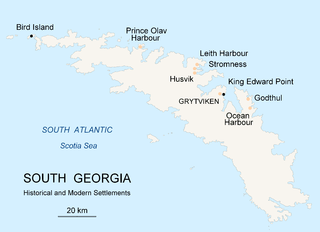
Prince Olav Harbour is small harbour in the south west portion of Cook Bay, entered between Point Abrahamsen and Sheep Point, along the north coast of South Georgia.

Possession Bay is a bay 2 miles (3.2 km) wide on the north coast of South Georgia, an island in the southern Atlantic Ocean. It recedes southwest for 5 miles (8 km), and is separated from Cook Bay to the north by Black Head promontory. It is connected to King Haakon Bay by Shackleton Gap, a mountain pass.

King Edward Cove is a sheltered cove immediately southwest of Mount Duse, in the west side of Cumberland East Bay, South Georgia. This cove, frequented by early sealers at South Georgia, was charted by the Swedish Antarctic Expedition, 1901–04, under Otto Nordenskiöld. It was named in about 1906 for King Edward VII of the United Kingdom.
Jason Peak is a peak, 675 metres (2,215 ft) high, lying 1 mile (1.6 km) west of Jason Harbour on the north coast of South Georgia. The name appears to be first used on a 1929 British Admiralty chart.
Fortuna Bay is a bay 3 miles (5 km) long and 1 mile (1.6 km) wide. Its entrance is defined by Cape Best on the west and Robertson Point to the east, near Atherton Peak on the north coast of South Georgia. It was named after the Fortuna, one of the ships of the Norwegian–Argentine whaling expedition under C.A. Larsen which participated in establishing the first permanent whaling station at Grytviken, South Georgia, in 1904–05. The Second German Antarctic Expedition (SGAE) under Wilhelm Filchner explored Fortuna Bay in 1911–12. Discovery Investigations (DI) personnel charted the area during their 1929–30 expedition.
You may be looking for Undine South Harbour near Ducloz Head, South Georgia
Not to be confused with Cook Ice Cap in the Kerguelen Islands.
Inverleith Harbour is a small bay between Andrews Point and Briggs Peninsula along the northeast coast of Anvers Island, in the Palmer Archipelago, Antarctica. It was presumably discovered by whalers working in this area who gave the name "Inverleith" or "Leith Harbour". "Inverleith Harbour" is recommended because the name "Leith Harbour" is used elsewhere in the Antarctic. Leith, Scotland, is the home of Salvesen and Company, a whaling firm which has operated extensively in Antarctic waters.
Ems Rock is a rock midway between Harrison Point and Busen Point in the south part of Stromness Bay, South Georgia. It was charted by Discovery Investigations personnel under Lieutenant Commander J.M. Chaplin in 1927 and 1929, and was named in 1957 by the UK Antarctic Place-Names Committee for the sailing vessel Ems, owned by the Tonsberg Hvalfangeri, Husvik, located at the head of Husvik Harbour in Stromness Bay.
Alert Cove is a small cove lying south of Kanin Point in Husvik Harbor, Stromness Bay, on the north coast of South Georgia. It was charted by Discovery Investigations (DI) personnel in 1928 and is named after Alert, the motorboat used by the DI survey party.
Allen Bay is a semi-circular bay 0.5 nautical miles (1 km) wide, lying 1 nautical mile (2 km) west-northwest of Larsen Point in the northern part of Cumberland West Bay, South Georgia. It was charted in 1926 by Discovery Investigations personnel on the Discovery, and was named by them, probably for H.T. Allen, a member of the Discovery Committee at that time.
Boat Harbor is a small circular harbour lying south of Little Jason Lagoon in Jason Harbour, South Georgia. The name appears to be first used on a 1930 British Admiralty chart.
Breakwater Rocks are a group of rocks extending across the south part of the entrance to Boat Harbour in Jason Harbour, South Georgia. The name The Breakwater was probably given by Lieutenant Commander J.M. Chaplin, Royal Navy, during his survey of Jason Harbour in 1929. The South Georgia Survey, 1956–57, reported that the name is misleading; the rocks are not in a continuous straight line forming a natural breakwater, but are in a group. The name was therefore altered to "Breakwater Rocks" by the UK Antarctic Place-Names Committee in 1957.
Jason Island is an island 1 nautical mile (2 km) north of Larsen Point at the west side of the entrance to Cumberland Bay, off the north coast of South Georgia. It was named after the Jason, the vessel used by Captain C.A. Larsen in 1893–94 in exploring Cumberland Bay.

Mikkelsen Harbor is a small bay indenting the south side of Trinity Island between Skottsberg Point and Borge Point, in the Palmer Archipelago, Antarctica. It was discovered by the Swedish Antarctic Expedition, 1901–04. The origin of the name comes from Peder Michelsen, whaling manager who was lost in the whaling grounds in December 1910. The harbour was charted by Captain Hans Borge, and apparently the name was in common usage by 1913, at the time of the geologic reconnaissance by Scottish geologist David Ferguson in the whale-catcher Hanka..
Little Jason Lagoon is an almost circular lagoon, 0.4 nautical miles (0.7 km) in diameter, lying at the head of Jason Harbour to which it is connected by a narrow cut, in Cumberland West Bay, South Georgia. The name "Little Jason" was in use at South Georgia prior to 1920. The feature was surveyed in 1929 by Discovery Investigations personnel, who named it "Nogood Lagoon" because a motor boat could not get through the entrance. The South Georgia Survey, 1951–52, reported that the feature is known locally as Little Jason or "Lille Jason". The name Little Jason Lagoon was approved in order to indicate the nature of the feature, and at the same time to conform with local usage.
Husdal is a short valley running west-southwest from the head of Husvik Harbour, South Georgia. It was named by the UK Antarctic Place-Names Committee in the Norwegian form "Husdal" in association with the disused Husvik whaling station at the head of Husvik Harbour.
Mai Point is a point marking the east side of the entrance to Maiviken, a small bay in Cumberland West Bay, South Georgia. It was charted by the Swedish Antarctic Expedition, 1901–04, under Otto Nordenskjöld. The name derives from association with Maiviken.
Kanin Point is a rocky point lying 2 nautical miles (4 km) west-southwest of Kelp Point on the south side of Husvik Harbor, in Stromness Bay, South Georgia. The descriptive name "Rocky Point" was given for this feature, probably by Discovery Investigations personnel who surveyed Husvik Harbor in 1928, but this name is used elsewhere in the Antarctic. The South Georgia Survey, 1951–52, reported that this feature is known at the Husvik whaling station as Kanin Point. The name presumably arose from one of several attempts made since 1872 to introduce rabbits into the island. Kanin Point is approved on the basis of local usage.

New Harbour is a bay about 10 miles (16 km) wide between Cape Bernacchi and Butter Point along the coast of Victoria Land, due west of Ross Island. It was discovered by the British National Antarctic Expedition (1901–04) and so named because this new harbor was found while the Discovery was seeking the farthest possible southern anchorage along the coast of Victoria Land. The Ferrar Glacier flows into the bay, which overlooked by Mount Barnes, which sits at the eastern end of the Kukri Hills range.