This article is being considered for deletion in accordance with Wikipedia's deletion policy. Please share your thoughts on the matter at this article's deletion discussion page. |
This article contains content that is written like an advertisement .(September 2023) |
The Toyota Legendary Moments series is a series of television advertisements produced over several years for the Australian Football League by its major sponsor, Toyota.
The advertisements feature comedians Stephen Curry and Dave Lawson and a footballer re-enacting one or more famous incidents from that player's career. Curry plays the straight man to Lawson, while the demeanour of the player varies depending upon that player's personality.
The re-enactments take place on a suburban field, and humorous props and set-ups are used to allow the footballer, who is usually long retired, to emulate incidents which he is no longer athletic enough to carry out. It has been reported that the advertisements are largely unscripted; Curry and Lawson arrive with various props and gags in mind, but the players themselves are not told in advance what these props or the script will be. [1]
The series began with two advertisements, those of Wayne Harmes and James Hird, and proved to be extremely popular with television viewers. In the years that followed, new instalments were produced and released one at a time, at a rate of one or two new advertisements in each football season. The 2012 version, starring Leigh Matthews won a Bronze medal in the DDB Award for Best 60+ Second TV/Cinema Commercial at the 2012 Melbourne Advertising and Design Awards. [2]
In 2010, a new advertisement featured Wally Lewis, a popular National Rugby League identity. This was the first time the campaign sought and featured a different sports code. [3]
Re-enacts the game-winning goal from the 1979 Grand Final, when Carlton's Wayne Harmes dived to tap the ball from the boundary line into the goal square for Ken Sheldon. Harmes recreated the dive using a Slip 'n' Slide.
Re-enacts the game-winning goal from Essendon's Round 3, 2004 win against the West Coast Eagles, where Hird scored the goal, then hugged a random teenage fan in the crowd. The fan is replaced with a confused-looking groundskeeper.
Re-enacts Daicos' tight-angle goal in the 1990 qualifying final. Curry, Lawson and Daicos all don mullet wigs reminiscent of Daicos' hair from the era.
Re-enacts Brereton's heroics in the 1989 Grand Final. Brereton was knocked unconscious by a heavy shirtfront Geelong's Mark Yeates at the opening bounce. Severely winded and concussed, he was attended to by trainers then began to vomit before jogging back into the play. Only minutes later in the game, he marked and kicked an inspirational goal. He would finish with three goals in a game that Hawthorn would win by six points.
In the advertisement, Lawson plays the role of Yeates, and is implied to have hit Brereton with a large plank of wood. Brereton then regathers himself and spits out a mouthful of canned food to simulate the vomiting. They run in slow motion to simulate concussion, and Brereton kicks a goal to finish the advertisement.
Primarily re-enacts Blight's 70m after-the-siren game-winning goal in Round 10, 1976 at Princes Park. Miniature posts are used to make the distance seem longer, and Lawson blows an airhorn at an unsuspecting Blight to represent the siren. Lawson also pokes fun at Blight for a separate incident where, running into an open goal, he confused the goal posts with the behind posts and kicked the wrong score.
Re-enacts Jesaulenko's famous specky from the 1970 Grand Final. Various methods, including a trampoline, piggy-back and eventually a crane, are used to provide Jesaulenko with the elevation, while Lawson says almost nothing throughout the advertisement except for variations on commentator Mike Williamson's famous call of "oh, Jesaulenko, you beauty!"
Re-enacts various incidents from Lockett's career, including the pig at full forward incident which raised Lockett's ire, the after-the-siren behind in the 1996 preliminary final which put Sydney into its first Grand Final in more than fifty years (prompting Lawson to comment "what a huge behind!" to the heavily built Lockett, also displeasing him), and his 1300th goal, with a large crowd of people emerging from nowhere to recreate the pitch invasion.
Re-enacts Bourke's famous courageous display at Arden Street in Round 21, 1980. Bourke, after an accidental collision with a team-mate, was bleeding profusely, then moved to the forward line to score a goal to help Richmond to a narrow victory. The collision is represented as Lawson running Bourke over with a golf cart decorated in Richmond colours, the blood is replaced with tomato sauce, and the whole thing eventually degenerates into a big tomato sauce fight.
Re-enacts two incidents from Doull's career. Firstly, it focuses upon the time that Essendon's Cameron Clayton stole his headband and his team-mate Tony Buhagiar ended up with it and threw it into the Waverley Park crowd, and combined this with the time in a match against Hawthorn, he was tackled around the neck by Kevin Ablett. Bruce chased after Ablett, with the commentator say "Bruce Doull has gone berserk". Contrary to stories told, he did not have his headband stolen in the Hawthorn game however it was almost the only time the usually docile Doull lost his temper during a game. Lawson plays the part of Clayton, and while Doull blocks his first attempt at stealing the headband, Lawson eventually prevails. He charges around shouting "Bruce Doull has gone berserk!" while Doull stands motionless.
The advertisement then focuses upon the 1982 Grand Final, when he was accosted by streaker Helen d'Amico. d'Amico is also played by Lawson (in a pixellated female nude-suit), while d'Amico herself makes a Hitchcock-esque cameo as an onlooking dog-walker.
Re-enacts Bartlett's seven-goal performance in the 1980 Grand Final, won by Richmond by a then-record margin. Curry and Lawson try to teach Bartlett how to handpass, poking fun at his tendency to always kick for goal instead of setting up team-mates, but this only results in Bartlett stealing the ball and kicking more goals. The advertisement also features Lawson shaving his head into Bartlett's familiar combover.
Primarily re-enacts Hudson's three-goal performance in the 1971 Grand Final, and more specifically his failure to score a fourth which would have broken Bob Pratt's record of 150 goals in a VFL season. It features Hudson being knocked out by Kevin "Cowboy" Neale (represented by Lawson on a docile pony), simulates his concussion by fitting Hudson with thick glasses and spinning him in circles, and Hudson kicking his final attempt into man-on-the-mark Barry Lawrence (represented by Lawson being hit in the groin with the ball). The advertisement also re-enacts Hudson's famous arrival by helicopter to VFL Park in his only VFL game of 1973. [4]
Re-enacts the famous occasion when Matthews collided with and broke a behind post in a match at Windy Hill. After running into the post fails to break it, Lawson cuts a notch in the post with an axe; Matthews, Curry and Lawson then tie a rope to the top of the post and pull it down. Curry also tries to inspire Matthews to break the post by telling him that "if it bleeds, we can kill it", a quote from Predator that Matthews famously used as a coach to inspire the Brisbane Lions to an upset win against Essendon.
Re-enacts Long's goal in the 1993 Grand Final when he ran from the wing into the forward 50 before kicking the goal. Lawson firstly attaches rockets to Long's shoes to help him gain speed; however, this fails, so Lawson attempts to tow Long on the back of a bicycle; however, he is too heavy, and Lawson is barely able to pedal. Lawson then emerges from behind the trees in an aeroplane, which he lands on the oval. Long stands on the wing of the plane, bouncing the ball, as Lawson drives the plane down the ground. The advertisement then cuts to Long kicking a goal from thirty metres out, which Lawson, playing the role of Stephen Silvagni, touches on the line; however, Curry declares it a goal, and he celebrates with Long, while Lawson continues to protest.
The 2016 moment, revealed during the 2016 EJ Whitten Legends Game recreates Leo Barry's pack mark in the dying seconds of the 2005 Grand Final. To recreate the mark, Barry is launched off a catapult into a collection of tackling bags with players faces attached.
Re-enacts Lewis' Game 2 and Series winning try of the 1989 State of Origin series, where, with the injuries of Allan Langer, Mal Meninga and Paul Vautin, the Queensland rugby league team had only 12 men in their team. However, Wally scored a 40-meter try - a moment which has been described as Queensland's greatest performance.
Leigh Raymond Matthews is a former Australian rules footballer and coach. He played for Hawthorn in the Victorian Football League (VFL) and coached Collingwood and the Brisbane Lions in the VFL and renamed Australian Football League (AFL).
Anthony Howard Lockett is a former Australian rules footballer who played for the St Kilda Football Club and Sydney Swans in the Australian Football League (AFL). Nicknamed "Plugger", he is considered one of the greatest full forwards and players in the game's history.
John Robert Nicholls is a former Australian rules footballer who played for the Carlton Football Club in the Victorian Football League (VFL).
Peter John HudsonAM is a former Australian rules footballer who played for the Hawthorn Football Club in the Victorian Football League (VFL) and for the New Norfolk Football Club and Glenorchy Football Club in the Tasmanian Australian National Football League (TANFL).
Dermott Hugh Brereton is a former Australian rules footballer who played for the Hawthorn Football Club, Sydney Swans and Collingwood Football Club in the Australian Football League (AFL).
Born of Irish migrants, Brereton is regarded as one of key members of Hawthorn's era of dominance in the 1980s. A centre half-forward with strong marking skills and a reliable kick for goal, Brereton was renowned for his flamboyant style and rugged on-field conduct, which resulted in frequent visits to the Tribunal. For all his physicality, Brereton was as courageous as he was aggressive and his ability to play through debilitating injuries was remarkable, although inevitably this would impact him severely in later years. He also represented Victoria in State of Origin matches, and both played for and coached Australia in the International Rules Series.
Brereton was recognized for his on-field achievements when he was inducted into the Australian Football Hall of Fame in 1999. He has since become a respected member of the football media, working for various TV and radio stations in Melbourne covering the AFL as a commentator and analyst.
Stephen Curry is an Australian comedian and actor who has appeared in many television drama and comedy series, and feature films.
Oleksandr Vasiliovych "Alex" Jesaulenko is a former Australian rules footballer and who played for the Carlton Football Club and the St Kilda Football Club in the Victorian Football League (VFL). He also served as a coach at both clubs.
Francis William Bourke is a former Australian rules footballer and coach who represented Richmond in the Victorian Football League (VFL) between 1967 and 1981, and coached the club in 1982 and 1983.
Alexander Bruce Doull is a former Australian rules footballer who played for the Carlton Football Club in the Victorian Football League (VFL).
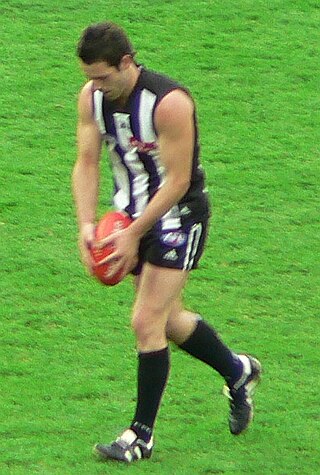
Alan Didak is a former professional Australian rules footballer of Croatian descent who played for the Collingwood Football Club in the Australian Football League.

This page is a collection of VFL/AFL goalkicking records. The Australian Football League (AFL), known as the Victorian Football League (VFL) until 1990, is the elite national competition in men's Australian rules football. This list only includes home-and-away matches and finals; representative games, pre-season and Night Series games are excluded from the totals.
Wayne Harmes is a retired Australian rules footballer in the Victorian Football League.

Peter Daicos is a former professional Australian rules footballer who played his entire 250-game career with the Collingwood Football Club in the VFL/AFL.
The 1996 AFL season was the 100th season of the Australian Football League (AFL), the highest level senior Australian rules football competition in Australia, which was known as the Victorian Football League until 1989. The season featured sixteen clubs and ran from 29 March until 28 September. It comprised a 22-game home-and-away season followed by a finals series featuring the top eight clubs, as well as several celebrations of the league's centenary.
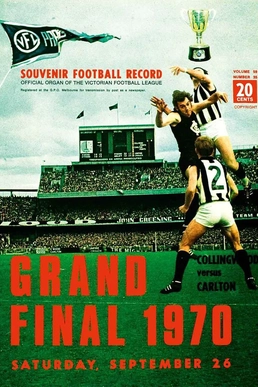
The 1970 VFL Grand Final was an Australian rules football game contested between the Carlton Football Club and Collingwood Football Club, held at the Melbourne Cricket Ground (MCG) on 26 September 1970. It was the 73rd annual Grand Final of the Victorian Football League, staged to determine the premiers for the 1970 VFL season. The match was won by Carlton by a margin of 10 points, marking that club's 10th premiership victory.
The 1991 AFL Grand Final was an Australian rules football game contested between the Hawthorn Football Club and West Coast Eagles, held at Waverley Park in Melbourne on 28 September 1991. It was the 94th annual grand final of the Australian Football League, staged to determine the premiers for the 1991 AFL season. The match, attended 75,230 spectators, was won by Hawthorn by a margin of 53 points, marking that club's ninth premiership victory.
The 1979 VFL Grand Final was an Australian rules football game contested between the Carlton Football Club and Collingwood Football Club, held at the Melbourne Cricket Ground in Melbourne on 29 September 1979. It was the 83rd annual Grand Final of the Victorian Football League, staged to determine the premiers for the 1979 VFL season. The match, attended by 113,545 spectators, was won by Carlton by a margin of 5 points, marking that club's 12th premiership victory.
The 1982 VFL Grand Final was an Australian rules football game contested between the Carlton Football Club and Richmond Football Club, held at the Melbourne Cricket Ground in Melbourne on 25 September 1982. It was the 86th annual Grand Final of the Victorian Football League, staged to determine the premiers for the 1982 VFL season. The match, attended by 107,536 spectators, was won by Carlton.
The 1973 VFL Grand Final was an Australian rules football game contested between Carlton and Richmond at the Melbourne Cricket Ground on 29 September 1973. It was the 76th annual Grand Final of the Victorian Football League (VFL), staged to determine the premiers for the 1973 VFL season. Although Carlton were the favourites to win, it was Richmond who would take the flag by 30 points, marking that club's eighth VFL/AFL premiership victory.
The 1991 Australian Football League finals series was the 95th annual edition of the VFL/AFL final series, the Australian rules football play-off tournament staged to determine the winner of the 1991 AFL Premiership season. The series ran over four weekends in September 1991, culminating with the 1991 AFL Grand Final at AFL Park on 28 September 1991.