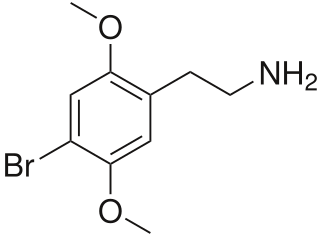
2C-B (4-bromo-2,5-dimethoxyphenethylamine), also known as "Nexus", is a synthetic psychedelic drug of the 2C family, mainly used as a recreational drug. The substance was first synthesized by Alexander Shulgin in 1974, and gained an initial reputation for potential psychotherapeutic use, but its use has been limited to mainly recreational use. To date, there is limited scientific information regarding the drug's pharmacokinetics and pharmacological effects in humans. The existing studies primarily classify 2C-B as a stimulant, and hallucinogen, and less commonly as an entactogen, and empathogen.
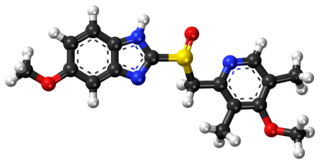
Esomeprazole, sold under the brand name Nexium [or Neksium] among others, is a medication which reduces stomach acid. It is used to treat gastroesophageal reflux disease, peptic ulcer disease, and Zollinger–Ellison syndrome. Its effectiveness is similar to that of other proton pump inhibitors (PPIs). It is taken by mouth or injection into a vein.

Rizatriptan, sold under the brand name Maxalt among others, is a medication used for the treatment of migraine headaches. It is taken by mouth. It can also be applied on the tongue. It is a serotonin (5-HT) 1B/1D receptor agonist (triptan).

Dihydrocodeine is a semi-synthetic opioid analgesic prescribed for pain or severe dyspnea, or as an antitussive, either alone or compounded with paracetamol (acetaminophen) or aspirin. It was developed in Germany in 1908 and first marketed in 1911.

Nicotine replacement therapy (NRT) is a medically approved way to treat people with tobacco use disorder by taking nicotine through means other than tobacco. It is used to help with quitting smoking or stopping chewing tobacco. It increases the chance of quitting tobacco smoking by about 55%. Often it is used along with other behavioral techniques. NRT has also been used to treat ulcerative colitis. Types of NRT include the adhesive patch, chewing gum, lozenges, nose spray, and inhaler. The use of multiple types of NRT at a time may increase effectiveness.

Dextropropoxyphene is an analgesic in the opioid category, patented in 1955 and manufactured by Eli Lilly and Company. It is an optical isomer of levopropoxyphene. It is intended to treat mild pain and also has antitussive and local anaesthetic effects. The drug has been taken off the market in Europe and the US due to concerns of fatal overdoses and heart arrhythmias. It is still available in Australia, albeit with restrictions after an application by its manufacturer to review its proposed banning. Its onset of analgesia is said to be 20–30 minutes and peak effects are seen about 1.5–2.0 hours after oral administration.
Nicotine gum is a chewing gum containing the active ingredient nicotine polacrilex. It is a type of nicotine replacement therapy (NRT) used alone or in combination with other pharmacotherapy for smoking cessation and for quitting smokeless tobacco.
Nicorette is the brand name of a number of products for nicotine replacement therapy (NRT) that contain nicotine polacrilex. Developed in the late 1970s in Sweden by AB Leo in the form of a chewing gum, Nicorette was the first nicotine replacement product on the market.

Norethisterone acetate (NETA), also known as norethindrone acetate and sold under the brand name Primolut-Nor among others, is a progestin medication which is used in birth control pills, menopausal hormone therapy, and for the treatment of gynecological disorders. The medication available in low-dose and high-dose formulations and is used alone or in combination with an estrogen. It is ingested orally.

Nikethamide is a stimulant which mainly affects the respiratory cycle. Widely known by its former trade name of Coramine, it was used in the mid-twentieth century as a medical countermeasure against tranquilizer overdoses, before the advent of endotracheal intubation and positive-pressure lung expansion. It is no longer commonly considered to be of value for such purposes.

Zinc gluconate is the zinc salt of gluconic acid. It is an ionic compound consisting of two anions of gluconate for each zinc(II) cation. Zinc gluconate is a popular form for the delivery of zinc as a dietary supplement providing 14.35% elemental zinc by weight.

Strepsils is a brand of throat lozenges manufactured by British-Dutch company Reckitt Benckiser. Strepsils throat lozenges are used to relieve discomfort caused by mouth and throat infections.
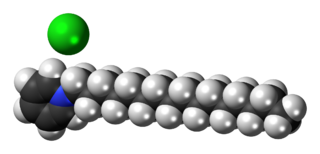
Cetylpyridinium chloride (CPC) is a cationic quaternary ammonium compound used in some types of mouthwashes, toothpastes, lozenges, throat sprays, breath sprays, and nasal sprays. It is an antiseptic that kills bacteria and other microorganisms. It has been shown to be effective in preventing dental plaque and reducing gingivitis. It has also been used as an ingredient in certain pesticides. Though one study seems to indicate cetylpyridinium chloride does not cause brown tooth stains, at least one mouthwash containing CPC as an active ingredient bears the warning label "In some cases, antimicrobial rinses may cause surface staining to teeth," following a failed class-action lawsuit brought by customers whose teeth were stained.

Desvenlafaxine, sold under the brand name Pristiq among others, is a medication used to treat depression. It is an antidepressant of the serotonin-norepinephrine reuptake inhibitor (SNRI) class and is taken by mouth. It is recommended that the need for further treatment be occasionally reassessed. It may be less effective than its parent compound venlafaxine, although some studies have found comparable efficacy.

2,4-Dichlorobenzyl alcohol is a mild antiseptic, able to kill bacteria and viruses associated with mouth and throat infections. It is a common ingredient in throat lozenges such as Cofsils, Strepsils, Lorsept, and Gorpils. It is also an ingredient in the European product Neo Borocillina. A low-pH throat lozenge containing dichlorobenzyl alcohol (1.2 mg) and amylmetacresol (0.6 mg) has been found to deactivate respiratory syncytial virus and SARS-Cov, but not adenovirus or rhinovirus. A dentifrice containing 10% sodium benzoate and 0.3% dichlorobenzyl alcohol maintains antimicrobial activity for 5 to 10 minutes after brushing.
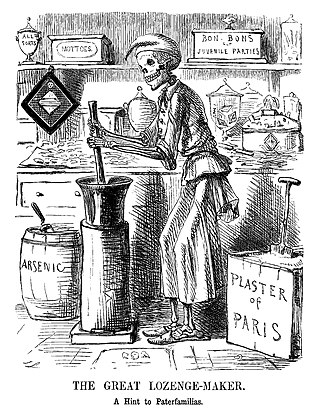
In 1858 a batch of sweets in Bradford, England, was accidentally adulterated with highly poisonous arsenic trioxide. About five pounds of sweets were sold to the public, leading to around 20 deaths and over 200 people suffering the effects of arsenic poisoning.
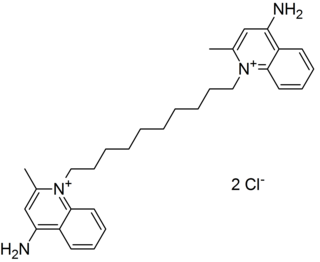
Dequalinium is a quaternary ammonium cation and bolaamphiphile commonly available as the dichloride salt. It is useful as an antiseptic and disinfectant. The bromide, iodide, acetate, and undecenoate salts are known as well. Dequalinium chloride is the active ingredient of several medications.
A nicotine lozenge is a modified-release dosage tablet that contains a dose of nicotine polacrilex, which dissolves slowly in the mouth to release nicotine over the course of 20 to 30 minutes. Nicotine lozenges are intended to help individuals quit smoking and are generally an over-the-counter medication. Nicotine lozenges are commonly found in 2 mg and 4 mg strengths, although other strengths may be found. The nicotine is absorbed through the lining of the mouth and enters the blood vessels. It is used as an aid in nicotine replacement therapy (NRT), a process for smoking cessation.
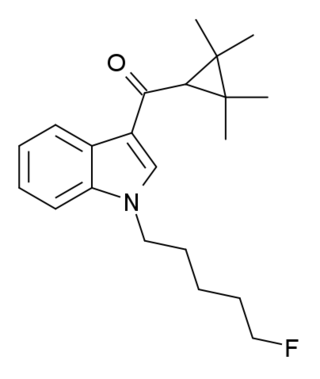
XLR-11 (5"-fluoro-UR-144 or 5F-UR-144) is a drug that acts as a potent agonist for the cannabinoid receptors CB1 and CB2 with EC50 values of 98 nM and 83 nM, respectively. It is a 3-(tetramethylcyclopropylmethanoyl)indole derivative related to compounds such as UR-144, A-796,260 and A-834,735, but it is not specifically listed in the patent or scientific literature alongside these other similar compounds, and appears to have not previously been made by Abbott Laboratories, despite falling within the claims of patent WO 2006/069196. XLR-11 was found to produce rapid, short-lived hypothermic effects in rats at doses of 3 mg/kg and 10 mg/kg, suggesting that it is of comparable potency to APICA and STS-135.

AB-PINACA is a compound that was first identified as a component of synthetic cannabis products in Japan in 2012.


