
The Kellogg–Briand Pact or Pact of Paris – officially the General Treaty for Renunciation of War as an Instrument of National Policy – is a 1928 international agreement on peace in which signatory states promised not to use war to resolve "disputes or conflicts of whatever nature or of whatever origin they may be, which may arise among them". The pact was signed by Germany, France, and the United States on 27 August 1928, and by most other states soon after. Sponsored by France and the U.S., the Pact is named after its authors, United States Secretary of State Frank B. Kellogg and French foreign minister Aristide Briand. The pact was concluded outside the League of Nations and remains in effect.
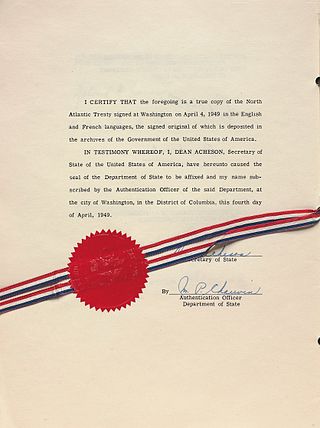
The North Atlantic Treaty, also known as the Washington Treaty, forms the legal basis of, and is implemented by, the North Atlantic Treaty Organization (NATO). The treaty was signed in Washington, D.C., on 4 April 1949.
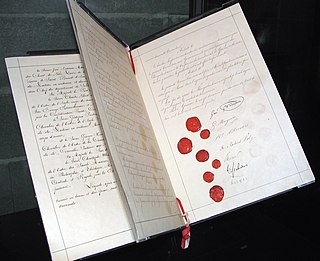
The law of war is a component of international law that regulates the conditions for initiating war and the conduct of hostilities. Laws of war define sovereignty and nationhood, states and territories, occupation, and other critical terms of law.
A casus belli is an act or an event that either provokes or is used to justify a war. A casus belli involves direct offenses or threats against the nation declaring the war, whereas a casus foederis involves offenses or threats against its ally—usually one bound by a mutual defense pact. Either may be considered an act of war. A declaration of war usually contains a description of the casus belli that has led the party in question to declare war on another party.

The Locarno Treaties were seven post-World War I agreements negotiated amongst Germany, France, Great Britain, Belgium, Italy, Poland and Czechoslovakia in late 1925. In the main treaty, the five western European nations pledged to guarantee the inviolability of the borders between Germany and France and Germany and Belgium as defined in the Treaty of Versailles. They also promised to observe the demilitarized zone of the German Rhineland and to resolve differences peacefully under the auspices of the League of Nations. In the additional arbitration treaties with Poland and Czechoslovakia, Germany agreed to the peaceful settlement of disputes, but there was notably no guarantee of its eastern border, leaving the path open for Germany to attempt to revise the Versailles Treaty and regain territory it had lost in the east under its terms.

The Japanese Instrument of Surrender was the written agreement that formalized the surrender of the Empire of Japan, marking the end of hostilities in World War II. It was signed by representatives from the Empire of Japan and from the Allied nations: the United States of America, the Republic of China, the United Kingdom of Great Britain and Northern Ireland, the Union of Soviet Socialist Republics, the Commonwealth of Australia, the Dominion of Canada, the Provisional Government of the French Republic, the Kingdom of the Netherlands, and the Dominion of New Zealand. The signing took place on the deck of USS Missouri in Tokyo Bay on 2 September 1945.

The Hague Conventions of 1899 and 1907 are a series of international treaties and declarations negotiated at two international peace conferences at The Hague in the Netherlands. Along with the Geneva Conventions, the Hague Conventions were among the first formal statements of the laws of war and war crimes in the body of secular international law. A third conference was planned for 1914 and later rescheduled for 1915, but it did not take place because of the start of World War I.

The Treaty of Sèvres was a 1920 treaty signed between some of the Allies of World War I and the Ottoman Empire, but not ratified. The treaty would have required the cession of large parts of Ottoman territory to France, the United Kingdom, Greece and Italy, as well as creating large occupation zones within the Ottoman Empire. It was one of a series of treaties that the Central Powers signed with the Allied Powers after their defeat in World War I. Hostilities had already ended with the Armistice of Mudros.

The Great Peace of Montreal was a peace treaty between New France and 39 First Nations of North America that ended the Beaver Wars. It was signed on August 4, 1701, by Louis-Hector de Callière, governor of New France, and 1300 representatives of 39 Indigenous nations.
A non-aggression pact or neutrality pact is a treaty between two or more states/countries that includes a promise by the signatories not to engage in military action against each other. Such treaties may be described by other names, such as a treaty of friendship or non-belligerency, etc. Leeds, Ritter, Mitchell, & Long (2002) distinguish between a non-aggression pact and a neutrality pact. They posit that a non-aggression pact includes the promise not to attack the other pact signatories, whereas a neutrality pact includes a promise to avoid support of any entity that acts against the interests of any of the pact signatories. The most readily recognized example of the aforementioned entity is another country, nation-state, or sovereign organization that represents a negative consequence towards the advantages held by one or more of the signatory parties.

The Balkan Pact, or Balkan Entente, was a treaty signed by Greece, Romania, Turkey and Yugoslavia on 9 February 1934 in Athens, aimed at maintaining the geopolitical status quo in the region after the end of World War I. To present a united front against Bulgarian designs on their territories, the signatories agreed to suspend all disputed territorial claims against one another and their immediate neighbours following the aftermath of the war and a rise in various regional irredentist tensions.

The Treaty of Bucharest of 1916 was signed between Romania and the Entente Powers on 4 /17 August 1916 in Bucharest. The treaty stipulated the conditions under which Romania agreed to join the war on the side of the Entente, particularly territorial promises in Austria-Hungary. The signatories bound themselves to keep secret the contents of the treaty until a general peace was concluded.

The Treaty of London in 1518 was a non-aggression pact between the major European states. The signatories were Burgundy, France, England, the Holy Roman Empire, the Netherlands, the Papal States and Spain, all of whom agreed not to attack one another and to come to the aid of any that were under attack.
The Agreement on Sub-Regional Arms Control is an arms limitation agreement signed on June 14, 1996, in Florence, Italy. In accordance with article IV, Annex 1-B to the Dayton Accord, the agreement draws from the provisions of the Treaty on Conventional Armed Forces in Europe and limits the number of tanks, armored combat vehicles, artillery, combat aircraft and attack helicopters that the parties to the agreement can possess. As part of the agreement, the parties of FR Yugoslavia, the two entities of Bosnia and Herzegovina and Croatia annually exchange information on and allow inspections of their military holdings. It was signed under the supervision of the OSCE.
The Cilicia Peace Treaty was signed in London between France and the Turkish National Movement based in Angora to end the fighting in the Franco-Turkish War.
The Southern Africa Non-aggression Pact required signatory states to ensure that no individual or organization attacked a signatory state from signatory soil. Presidents Jose Eduardo dos Santos of Angola, Mobutu Sese Seko of Zaire, and Kenneth Kaunda of Zambia signed the agreement on October 14, 1979. The signatories also signed a treaty on transportation and communication cooperation the same day.

Russia–Tajikistan relations are the bilateral relations between the Russian Federation and Tajikistan.
The Confederate privateers were privately owned ships that were authorized by the government of the Confederate States of America to attack the shipping of the United States. Although the appeal was to profit by capturing merchant vessels and seizing their cargoes, the government was most interested in diverting the efforts of the Union Navy away from the blockade of Southern ports, and perhaps to encourage European intervention in the conflict.

The Greek–Serbian Alliance of 1913 was signed at Thessaloniki on 1 June 1913, in the aftermath of the First Balkan War, when both countries wanted to preserve their gains in Macedonia from Bulgarian expansionism. The treaty formed the cornerstone of Greek–Serbian relations for a decade, remaining in force through World War I until 1924.
An Ottoman–Bulgarianalliance was signed in Sofia on 19 August (6 August O.S.) 1914 during the opening month of the First World War, although at the time both the signatories were neutral. The Minister of the Interior, Talaat Pasha, and President Halil Bey of the Chamber of Deputies signed the treaty on behalf of the Ottoman Empire (Turkey) and Prime Minister Vasil Radoslavov on behalf of the Kingdom of Bulgaria. The Ottoman–Bulgarian alliance was probably a prerequisite for Bulgaria's joining the Central Powers after Turkey entered the war in November.


