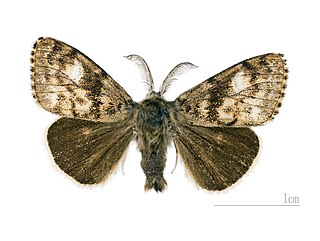
The flannel moths or crinkled flannel moths are a family of insects. They occur in North America and the New World tropics. The larvae are called puss caterpillars, and with their long hairs, resemble cotton balls. They have venomous spines that can cause a painful sting and inflammation lasting for several days. In some cases, the sting may cause headache, nausea, and shock-like symptoms. Perhaps the most notorious for stinging is the caterpillar of Megalopyge opercularis.
Mantala is a genus of moths in the subfamily Arctiinae. It contains the single species Mantala tineoides, which is found on Borneo. The habitat consists of lowland and lower montane forests.
Trichaetoides is a genus of moths in the family Erebidae.
Casuariclystis is a genus of moths in the family Geometridae. It contains only one species, Casuariclystis latifascia, which is widespread. The range includes Borneo, the Andamans, Fiji, Rotuma Island, Vanuatu, New Caledonia, Hong Kong, the Ogasawara Islands, Kenya, Mauritius, Aldabra, and the Seychelles. The habitat consists of coastal areas, dry heath forests, limestone forests, oceanic islands, and dry secondary forests.
Abaciscus paucisignata is a species of moth belonging to the family Geometridae. It was described by Warren in 1899. It is known from Peninsular Malaysia and Borneo.
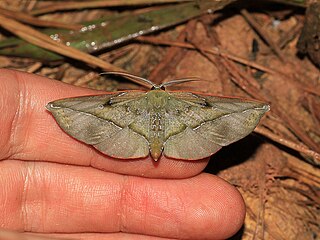
Omiza lycoraria is a geometer moth in the Ennominae subfamily. The It is found in Peninsular Malaysia, Borneo and Sumatra. The species is the most common in lowland forests but may be found in lower and upper montane forests up to about 1800m.

Scopula butleri is a moth of the family Geometridae. It was described by Prout in 1913. It is found in the north-eastern Himalaya, Sumatra, China, Japan and Borneo. The habitat consists of lowland forests and lower montane forests.
Scopula hyphenophora is a moth of the family Geometridae. It is found in India, Peninsular Malaysia and on Borneo and Bali. The habitat consists of lowland primary and secondary forests, alluvial forests and forests on limestone.
Ctenane labuana is a moth of the family Nolidae. It was described by Swinhoe in 1904. It is found on Borneo. The habitat consists of riverine forests, dipterocarp forests and alluvial forests.

Didiguides semifervens is a species of moth of the family Nolidae. It is found on Borneo, Sumatra and Sulawesi, as well as in New Guinea and on the Bismarck Islands. The habitat consists of dipterocarp forests, including alluvial forests.
Eilema fasciculosa is a moth of the subfamily Arctiinae. It is found on Borneo, Peninsular Malaysia and Bali. The habitat consists of lowland forests, particularly alluvial forests.
Trichaetoides divisura is a moth in the family Erebidae. It is found on Borneo and Sumatra.
Teulisna chiloides is a moth in the family Erebidae. It was described by Francis Walker in 1862. It is found on Peninsular Malaysia, Sumatra, Borneo, Sulawesi and Sumbawa. It has also been recorded from Queensland. The habitat consists of lowland dipterocarp forests, alluvial forests and lower montane forests.
Trichaetoides albifrontalis is a moth in the family Erebidae. It was described by Pagenstecher in 1885. It is found on Nias.
Trichaetoides albiplaga is a moth in the family Erebidae. It was described by Francis Walker in 1862. It is found on Borneo, Peninsular Malaysia and in Thailand. The habitat consists of both lowland and mountainous areas.
Trichaetoides apicalis is a moth in the family Erebidae. It was described by Francis Walker in 1856. It is found on Sumatra and Borneo.
Trichaetoides chloroleuca is a moth in the family Erebidae. It was described by Francis Walker in 1859. It is found on Borneo, Sumatra, Peninsular Malaysia and in Singapore. It is mostly found in lowland localities.
Trichaetoides separabilis is a moth in the family Erebidae. It was described by Francis Walker in 1862. It is found on Borneo. The habitat consists of lowland alluvial forests and dipterocarp forests.
The Syntomini are a tribe of moths in the family Erebidae.
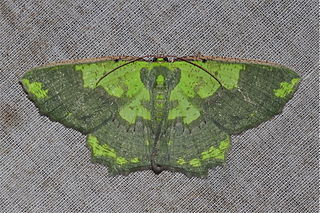
Agathia obsoleta is a species of moth in the family Geometridae. It is found in Java, Sumatra, Borneo and the Philippines. A. obsoleta is a rare species of lowland forests, including heath forest.