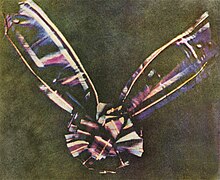
The Lumière brothers, Auguste Marie Louis Nicolas Lumière and Louis Jean Lumière, were French manufacturers of photography equipment, best known for their Cinématographe motion picture system and the short films they produced between 1895 and 1905, which places them among the earliest filmmakers.

Photography is the art, application, and practice of creating images by recording light, either electronically by means of an image sensor, or chemically by means of a light-sensitive material such as photographic film. It is employed in many fields of science, manufacturing, and business, as well as its more direct uses for art, film and video production, recreational purposes, hobby, and mass communication. A person who makes photographs is called a photographer.

A set of primary colors or primary colours consists of colorants or colored lights that can be mixed in varying amounts to produce a gamut of colors. This is the essential method used to create the perception of a broad range of colors in, e.g., electronic displays, color printing, and paintings. Perceptions associated with a given combination of primary colors can be predicted by an appropriate mixing model that reflects the physics of how light interacts with physical media, and ultimately the retina. The most common color mixing models are the additive primary colors and the subtractive primary colors. Red, yellow and blue are also commonly taught as primary colours, despite some criticism due to its lack of scientific basis.
The following list comprises significant milestones in the development of photography technology.

Charles Cros or Émile-Hortensius-Charles Cros was a French poet and inventor. He was born in Fabrezan, Aude.
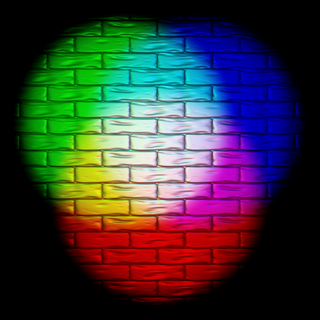
Additive color or additive mixing is a property of a color model that predicts the appearance of colors made by coincident component lights, i.e. the perceived color can be predicted by summing the numeric representations of the component colors. Modern formulations of Grassmann's laws describe the additivity in the color perception of light mixtures in terms of algebraic equations. Additive color predicts perception and not any sort of change in the photons of light themselves. These predictions are only applicable in the limited scope of color matching experiments where viewers match small patches of uniform color isolated against a gray or black background.

Sergey Mikhaylovich Prokudin-Gorsky was a Russian chemist and photographer. He is best known for his pioneering work in colour photography and his effort to document early 20th-century Russia.

Color photography is photography that uses media capable of capturing and reproducing colors. By contrast, black-and-white or gray-monochrome photography records only a single channel of luminance (brightness) and uses media capable only of showing shades of gray.
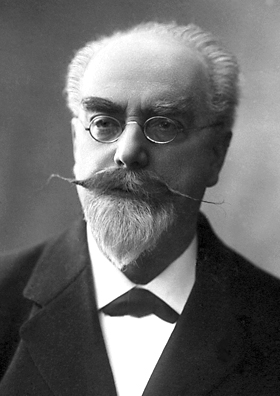
Jonas Ferdinand Gabriel Lippmann was a Luxembourgish-born French physicist and inventor who won the Nobel Prize in Physics in 1908 "for his method of reproducing colours photographically based on the phenomenon of interference".

The history of photography began with the discovery of two critical principles: The first is camera obscura image projection; the second is the discovery that some substances are visibly altered by exposure to light. There are no artifacts or descriptions that indicate any attempt to capture images with light sensitive materials prior to the 18th century.

Richard Leach Maddox was an English photographer and physician who invented lightweight gelatin negative dry plates for photography in 1871.
Photozincography, sometimes referred to as heliozincography but essentially the same process, known commercially as zinco, is the photographic process developed by Sir Henry James FRS (1803–1877) in the mid-nineteenth century.

Louis Désiré Blanquart-Evrard was a French inventor, photographer and photo publisher. Being a cloth merchant by trade, in the 1840s he developed interest in photography and focused on technical and economical issues of mass production of photo prints.

A color triangle is an arrangement of colors within a triangle, based on the additive or subtractive combination of three primary colors at its corners.
Thomas Sutton was an English photographer, author, and inventor.
The Finlay colour process was an early additive colour photography process devised by an Irish woman named Clare Elizabeth Finlay which could produce a picture in natural colour with a single exposure.
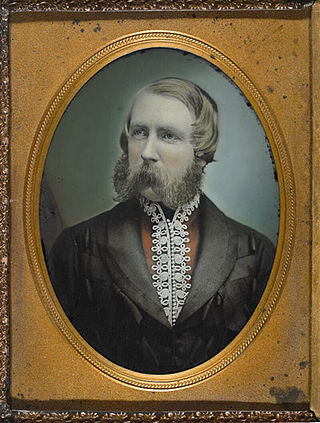
Farnham Maxwell-Lyte FRSC was an English chemist and the pioneer of a number of techniques in photographic processing. As a photographer he is known for his views of the French Pyrenees.
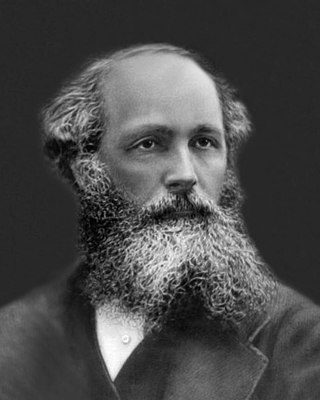
James Clerk Maxwell was a Scottish physicist and mathematician who was responsible for the classical theory of electromagnetic radiation, which was the first theory to describe electricity, magnetism and light as different manifestations of the same phenomenon. Maxwell's equations for electromagnetism achieved the "second great unification in physics", where the first one had been realised by Isaac Newton.
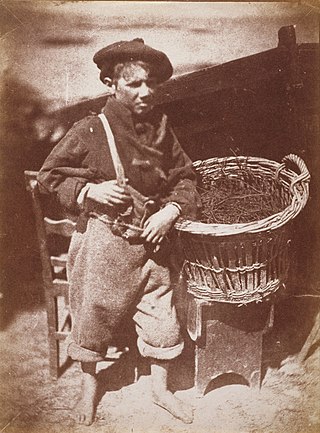
Scotland played a major role in the technical development of photography in the nineteenth century through the efforts of figures including James Clerk Maxwell and David Brewster. Its artistic development was pioneered by Robert Adamson and artist David Octavius Hill, whose work is considered to be some of the first and finest artistic uses of photography. Thomas Roger was one of the first commercial photographers. Thomas Keith was one of the first architectural photographers. George Washington Wilson pioneered instant photography and landscape photography. Clementina Hawarden and Mary Jane Matherson were amongst the first female photographers. War photography was pioneered by James MacCosh, James Robertson, Alexander Graham and Mairi Chisholm.
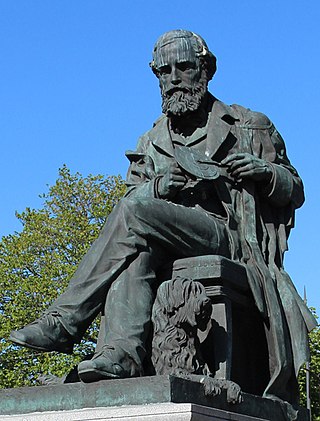
The James Clerk Maxwell Foundation is a registered Scottish charity set up in 1977. By supporting physics and mathematics, it honors one of the greatest physicists, James Clerk Maxwell (1831–1879), and while attempting to increase the public awareness and trust of science. It maintains a small museum in Maxwell's birthplace. This museum is owned by the Foundation.