Notes
- ↑ Roy McLeavy (ed.). "URBA, France". Jane's Surface Skimmers Hovercraft and Hydrofoils. Jane's Yearbooks, London. pp. 148–150.
 | This French railway-related article is a stub. You can help Wikipedia by expanding it. |
The URBA mass transport system in France was a suspended monorail design that used suction to lift the train off its rail. It was designed by the Compagnie d'Energetique Lineaire mb. At least two prototypes were built in Lyon in 1968 and tested on a 79-metre track. The URBA 4 and URBA 8 prototypes carried 4 and 8 passengers respectively. Propulsion was provided by Merin Gerin linear motors. [1]
| | This French railway-related article is a stub. You can help Wikipedia by expanding it. |

The Heinkel He 274 was a German heavy bomber design developed during World War II, purpose-designed for high-altitude bombing with pressurized crew accommodation.

The MOWAG Piranha is a family of armoured fighting vehicles designed by the Swiss company MOWAG.
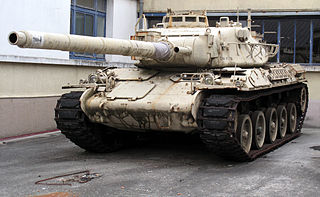
The AMX-30 is a main battle tank designed by Ateliers de construction d'Issy-les-Moulineaux and first delivered to the French Army in August 1965. The first five tanks were issued to the 501st Régiment de Chars de Combat in August of that year. The production version of the AMX-30B weighed 36 metric tons, and sacrificed protection for increased mobility. The French believed that it would have required too much armour to protect against the latest anti-tank threats, thereby reducing the tank's maneuverability. Protection, instead, was provided by the speed and the compact dimensions of the vehicle, including a height of 2.28 metres. It had a 105 mm gun, firing a then advanced high explosive anti-tank warhead known as the Obus G. The Obus G used an outer shell, separated from the main charge by ball bearings, to allow the round to be spin stabilized by the gun without affecting the warhead inside. Mobility was provided by the 720 horsepower (540 kW) HS-110 diesel engine, although the troublesome transmission adversely affected the tank's performance.
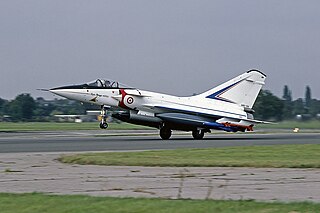
The Dassault Mirage 4000 was a French prototype twinjet fighter aircraft developed by Dassault-Breguet from their Mirage 2000.

The Dassault MD 315 Flamant is a French light twin-engined transport airplane built shortly after World War II by Dassault Aviation for the French Air Force.

The Véhicule Blindé de Combat d'Infanterie is a French Infantry fighting vehicle designed to replace the AMX-10P. They entered active service with the French Army in 2008, with 630 vehicles ordered up to 2010. Spain and the UK have shown interest in the vehicle.

The Aérospatiale N 262 is a French twin-turboprop high-wing airliner built first by Nord Aviation. The aircraft was also known as the Nord 262.
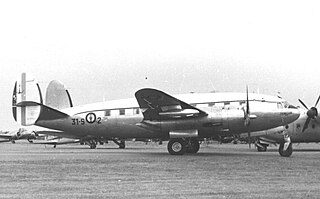
The Sud-Ouest S.O.30 Bretagne was a 1940s French airliner built by Sud-Ouest.

The Nord Aviation 3202 was a 1950s French military trainer aircraft designed and built by Nord Aviation to meet a French Army requirement for a two-seat basic trainer, as a replacement for the biplane Stampe SV.4. Altogether, 101 examples were built, with the first flying on 17 April 1957.

The Bleriot-SPAD S.51 was a French fighter aircraft developed in 1924 in response to a French Air Force requirement for an aircraft to replace their obsolete Nieuport-Delage NiD.29s.
The Blériot-SPAD S.81 was a French fighter aircraft developed in 1923 to a requirement by the French Air Force. It was flown competitively against the Dewoitine D.1 and was selected over that aircraft due to the Dewoitine's more radical design, leading to an order for 80 aircraft. The S.81 was a single-bay biplane of conventional configuration with I-shaped interplane struts and lacking Herbemont's usual swept upper wing. It featured a wooden fuselage of monocoque construction and metal wings skinned in fabric. Production versions differed from the prototypes in having a lengthened fuselage and larger tail fin.

The Klemm Kl 107 was a two-seat light aircraft developed in Germany in 1940. It was a conventional low-wing cantilever monoplane of wooden construction with fixed tailwheel undercarriage. Wartime production totalled only five prototypes and some 20 production machines before the Klemm factory was destroyed by Allied bombing. Following World War II and the lifting of aviation restrictions on Germany, production recommenced in 1955 with a modernised version, the Kl 107B, of which Klemm built a small series before selling all rights to the design to Bölkow. This firm further revised the design and built it as the Kl 107C before using it as the basis for their own Bo 207.

The Piel CP-30 Emeraude is an aircraft designed in France in the mid-1950s and widely built both by factories and homebuilders.

The Fairchild 91,, was a single-engine eight-passenger flying boat airliner developed in the United States in the mid-1930s.
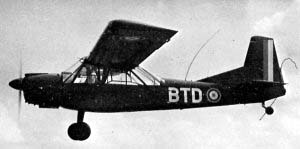
The Nord 3400 Norbarbe was a French two-seat observation and casualty-evacuation aircraft built by Nord Aviation for the French Army Light Aviation.
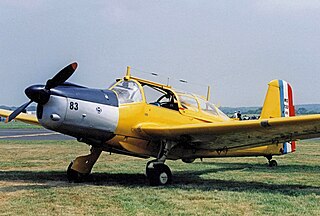
The Morane-Saulnier Alcyon is a two or three-seat basic training monoplane designed and built in France by Morane-Saulnier.
The SZD-8 Jaskółka was a single-seat glider aircraft that was designed and built in Poland at Szybowcowy Zakład Doświadczalny in Bielsko-Biała from 1951.
The Morane-Saulnier MS.755 Fleuret was a prototype French two-seat jet trainer designed and built by Morane-Saulnier. It failed to gain any orders but was developed into the larger four-seat MS.760 Paris.
The Nord 2100 Norazur was a 1940s French civil transport monoplane designed and built at Courbevoie near Paris by SNCAN.

The Blériot-SPAD S.91 was a French light-weight fighter aircraft. It would be later developed into the Blériot-SPAD S.510, the last biplane produced by the French aeronautic industries.