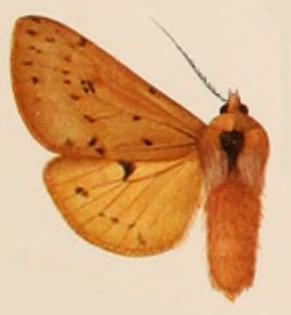
Udea ochropera

Last updated

Udea ochropera
Scientific classification
Kingdom:
Phylum:
Class:
Order:
Family:
Genus:
Species:
U. ochropera
Binomial name
Udea ochropera
(Hampson, 1913)
Synonyms
  • Pionea ochroperaHampson, 1913

Udea ochropera is a moth in the family Crambidae. It was described by George Hampson in 1913. It is found in Colombia [1] and Mexico. [2]

Moth Group of mostly-nocturnal insects in the order Lepidoptera

Moths are a polyphyletic group of insects that includes all members of the order Lepidoptera that are not butterflies, with moths making up the vast majority of the order. There are thought to be approximately 160,000 species of moth, many of which have yet to be described. Most species of moth are nocturnal, but there are also crepuscular and diurnal species.

Crambidae Family of insects

The Crambidae are the grass moth family of lepidopterans. They are variable in appearance, the nominal subfamily Crambinae taking up closely folded postures on grass stems where they are inconspicuous, while other subfamilies include brightly coloured and patterned insects which rest in wing-spread attitudes.

Sir George Francis Hampson, 10th Baronet was a British entomologist.

The wingspan is about 26 mm. The forewings are ochreous, irrorated with dark brown and suffused with purplish fuscous except on the costal area and the inner margin. The apical area is ochreous, with a dark streak below vein 8 and the antemedial line is blackish, angled outwards below the costa and bent outwards to the inner margin. There is a black annulus in the middle of the cell and a narrow elliptical discoidal annulus defined by black. The postmedial line is blackish, slightly defined on the outer side by ochreous, obliquely downcurved to vein 6, excurved and slightly waved to vein 2, then bent inwards to below the end of the cell and again excurved. There are some small black spots on the costa towards the apex, as well as a blackish terminal line with ochreous points at the veins. The hindwings are semihyaline white with black points at the angles of the cell. The apical area and the termen to vein 2 are suffused with brown, the termen with blackish points to the submedian fold. [3]

Wingspan distance from the tip of one limb such as an arm or wing to the tip of the paired limb, or analogically the same measure for airplane wings

The wingspan of a bird or an airplane is the distance from one wingtip to the other wingtip. For example, the Boeing 777-200 has a wingspan of 60.93 metres, and a wandering albatross caught in 1965 had a wingspan of 3.63 metres, the official record for a living bird. The term wingspan, more technically extent, is also used for other winged animals such as pterosaurs, bats, insects, etc., and other aircraft such as ornithopters. In humans, the term wingspan also refers to the arm span, which is distance between the length from one end of an individual's arms to the other when raised parallel to the ground at shoulder height at a 90º angle. Former professional basketball player Manute Bol stands at 7 ft 7 in (2.31 m) and owns one of the largest wingspans at 8 ft 6 in (2.59 m).

Related Research Articles

<i>Deuterocopus atrapex</i> species of insect

Deuterocopus atrapex is a moth of the family Pterophoridae described by Thomas Bainbrigge Fletcher in 1909. It has been recorded from Sri Lanka, Assam, Selangor, the Tenasserim Hills, south-eastern Borneo, Ternate, Ambon Island, Batian, southern Sulawesi, the Sangihe Islands, Halmahera, Neu Pommern, northern New Guinea, the Kei Islands, the D'Entrecasteaux Islands and Queensland.

<i>Spilosoma fraterna</i> species of insect

Spilosoma fraterna is a moth of the family Erebidae first described by Walter Rothschild in 1910. It is found on Papua New Guinea.

Bocchoris rufiflavalis is a moth of the family Crambidae. It can be found in Madagascar.

Haritalodes polycymalis is a moth in the family Crambidae. It was described by George Hampson in 1912. It is found in the Democratic Republic of the Congo, Guinea, Ivory Coast, Kenya, Madagascar, Malawi, Mozambique, Sierra Leone, South Africa (KwaZulu-Natal), Tanzania and Uganda.

Syllepte tumidipes is a moth in the family Crambidae. It was described by George Hampson in 1912. It is found in Cameroon, the Democratic Republic of the Congo, Gabon, Ghana, Nigeria and Sierra Leone.

Catephia pyramidalis is a species of moth of the family Erebidae. It is found in Kenya.

Sufetula cyanolepis is a moth in the family Crambidae. It was described by George Hampson in 1912. It is found in Indonesia (Sulawesi).

Syllepte leucographalis is a moth in the family Crambidae. It was described by George Hampson in 1912. It is found in Indonesia (Bali).

Syllepte methyalinalis is a moth in the family Crambidae. It was described by George Hampson in 1912. It is found in Guyana.

Syllepte microspilalis is a moth in the family Crambidae. It was described by George Hampson in 1912. It is found in Singapore.

Syllepte ochrifusalis is a moth in the family Crambidae. It was described by George Hampson in 1899. It is found in Papua New Guinea, where it has been recorded from the D'Entrecasteaux Islands.

Udea melanephra is a moth in the family Crambidae. It was described by George Hampson in 1913. It is found in Colombia and Bolivia.

Udea phaealis is a moth in the family Crambidae. It was described by George Hampson in 1899. It is found in Orizaba, Mexico.

Udea umbriferalis is a moth in the family Crambidae. It was described by George Hampson in 1918. It is found in Peru and Bolivia.

Udeoides nigribasalis is a moth in the family Crambidae. It was described by George Hampson in 1913. It is found in Kenya.

Ulopeza junctilinealis is a moth in the family Crambidae. It was described by George Hampson in 1912. It is found in Indonesia (Bali).

Ulopeza sterictodes is a moth in the family Crambidae. It was described by George Hampson in 1912. It is found in Papua New Guinea.

Nordstromia humerata is a moth in the family Drepanidae. It was described by Warren in 1896. It is found in north-eastern India.

Habrona marmorata is a moth in the family Drepanidae. It is widely distributed in Papua and Papua New Guinea.

Podalia lanocrispa is a moth of the family Megalopygidae. It was described by E. Dukinfield Jones in 1912. It is found in Brazil.

References

  1. Nuss, M.; et al. (2003–2014). "GlobIZ search". Global Information System on Pyraloidea. Retrieved 2014-07-15.
  2. BOLD Systems
  3. The Annals and Magazine of Natural History: Including Zoology, Botany, and Geology