| Udea umbriferalis | |
|---|---|
| Scientific classification | |
| Kingdom: | Animalia |
| Phylum: | Arthropoda |
| Class: | Insecta |
| Order: | Lepidoptera |
| Family: | Crambidae |
| Genus: | Udea |
| Species: | U. umbriferalis |
| Binomial name | |
| Udea umbriferalis (Hampson, 1918) | |
| Synonyms | |
| |
Udea umbriferalis is a moth in the family Crambidae. It was described by George Hampson in 1918. It is found in Peru [1] and Bolivia. [2]

Moths comprise a group of insects related to butterflies, belonging to the order Lepidoptera. Most lepidopterans are moths, and there are thought to be approximately 160,000 species of moth, many of which have yet to be described. Most species of moth are nocturnal, but there are also crepuscular and diurnal species.

The Crambidae are the grass moth family of lepidopterans. They are variable in appearance, the nominal subfamily Crambinae taking up closely folded postures on grass stems where they are inconspicuous, while other subfamilies include brightly coloured and patterned insects which rest in wing-spread attitudes.
Sir George Francis Hampson, 10th Baronet was a British entomologist.
The wingspan is about 22 mm. The forewings are rufous suffused with dark brown, the costal area bright rufous except towards the base, with three small black spots on the costa towards the apex. The antemedial line is black-brown, angled outwards below the costa, excurved below the cell and angled inwards above the inner margin, defined on inner side by whitish below the cell. There is a small black annulus in the upper part of the middle of the cell and a discoidal figure-of-eight shaped mark, its upper and lower parts filled in with rufous, the rufous from the costa extending into the cell before it. The postmedial line is black-brown defined on the outer side by whitish, strong and obliquely downcurved to vein 6, then excurved and minutely dentate to vein 2 where it is retracted to below the angle of the cell and bent outwards below the submedian fold. There is a terminal series of minute black spots with whitish striae between them. The hindwings are red-brown, rather darker at the termen on which there is a series of minute blackish points. [3]
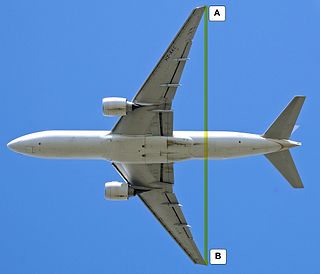
The wingspan of a bird or an airplane is the distance from one wingtip to the other wingtip. For example, the Boeing 777-200 has a wingspan of 60.93 metres, and a wandering albatross caught in 1965 had a wingspan of 3.63 metres, the official record for a living bird. The term wingspan, more technically extent, is also used for other winged animals such as pterosaurs, bats, insects, etc., and other fixed-wing aircraft such as ornithopters. In humans, the term wingspan also refers to the arm span, which is distance between the length from one end of an individual's arms to the other when raised parallel to the ground at shoulder height at a 90º angle. Former professional basketball player Manute Bol stands at 7 ft 7 in (2.31 m) and owns one of the largest wingspans at 8 ft 6 in (2.59 m).