
A design is the concept of or proposal for an object, process, or system. The word, design, refers to something that is or has been intentionally created by a thinking agent, although it is sometimes used to refer to the inherent nature of something – its design. The verb to design expresses the process of developing a design. In some cases, the direct construction of an object without an explicit prior plan may also be considered to be a design. A design is expected to have a purpose within a certain context, usually having to satisfy certain goals and constraints and to take into account aesthetic, functional, economic, environmental, or socio-political considerations. Traditional examples of designs include architectural and engineering drawings, circuit diagrams, sewing patterns, and less tangible artefacts such as business process models.
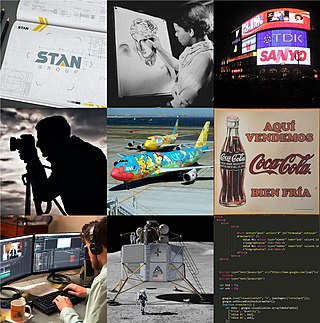
Graphic design is a profession, academic discipline and applied art whose activity consists in projecting visual communications intended to transmit specific messages to social groups, with specific objectives. Graphic design is an interdisciplinary branch of design and of the fine arts. Its practice involves creativity, innovation and lateral thinking using manual or digital tools, where it is usual to use text and graphics to communicate visually.

Paul Rand was an American art director and graphic designer. He was best known for his corporate logo designs, including the logos for IBM, UPS, Enron, Morningstar, Inc., Westinghouse, ABC, and NeXT. He was one of the first American commercial artists to embrace and practice the Swiss Style of graphic design.

Susan Kare is an American artist and graphic designer, who contributed interface elements and typefaces for the first Apple Macintosh personal computer from 1983 to 1986. She was employee #10 and creative director at NeXT, the company formed by Steve Jobs after he left Apple in 1985. She was a design consultant for Microsoft, IBM, Sony Pictures, Facebook, and Pinterest. As of 2023 Kare was an employee of Niantic Labs. As a pioneer of pixel art and of the graphical computer interface, she has been celebrated as one of the most significant designers of modern technology.
In film and television, production designer is the individual responsible for the overall aesthetic of the story. The production design gives the viewers a sense of the time period, the plot location, and character actions and feelings. Working directly with the director, cinematographer, and producer, production designers have a key creative role in the creation of motion pictures and television. The term production designer was coined by William Cameron Menzies while he was working on the film Gone with the Wind. Production designers are commonly confused with art directors as the roles have similar responsibilities. Production designers decide the visual concept and deal with the many and varied logistics of filmmaking including, schedules, budgets, and staffing. Art directors manage the process of making the visuals, which is done by concept artists, graphic designers, set designers, costume designers, lighting designers, etc. The production designer and the art director lead a team of individuals to assist with the visual component of the film. Depending on the size of the production the rest of the team can include runners, graphic designers, drafts people, props makers, and set builders. Productions Designers create a framework for the visual aesthetic of a project and work in partnership and collaboration with the Set Decorator & Set Decorating department to execute the desired look.

Emigre was a (mostly) quarterly magazine published from 1984 until 2005 in Berkeley, California, dedicated to visual communication, graphic design, typography, and design criticism. Produced by Rudy VanderLans and Zuzana Licko, Emigre was known for creating some of the first digital layouts and typeface designs. Exposure to Licko's typefaces through the magazine lead to the creation of Emigre Fonts in 1985.

Rebeca Méndez is a Mexican-American artist and graphic designer. She is professor at UCLA Design Media Arts in Los Angeles, California, and since July 2020 is chair of the department, as well as founder and director of the Counterforce Lab. Her Vice-chair Peter Lunenfeld wrote about her: "Rebeca has won the three most significant awards in the field of design: The Cooper-Hewitt National Design Award in Communication Design, 2012, the AIGA Medal in 2017, and induction to the One Club Hall of Fame in 2017. This triple crown would be worthy enough on its own, more than worthy, absolutely exceptional, but when you add in that Rebeca is the first and only Latina to win each one of these, much less all three, the achievement is towering." In fact, she is the only woman ever to have received all these three awards, while Bob Greenberg from R/GA is the only man to have received all of them.

Peter Biľak is a Slovak graphics and typeface designer based in The Hague, Netherlands. He works in the editorial, graphic, and type design fields.

Herbert Matter was a Swiss-born American photographer and graphic designer known for his pioneering use of photomontage in commercial art. Matter's innovative and experimental work helped shape the vocabulary of 20th-century graphic design.

Ellen Lupton is a graphic designer, curator, writer, critic, and educator. Known for her love of typography, Lupton is the Betty Cooke and William O. Steinmetz Design Chair at Maryland Institute College of Art. Previously she was the Senior Curator of Contemporary Design at Cooper Hewitt, Smithsonian Design Museum in New York City and was named Curator Emerita after 30 years of service. She is the founding director of the Graphic Design M.F.A. degree program at Maryland Institute College of Art (MICA), where she also serves as director of the Center for Design Thinking. She has written numerous books on graphic design for a variety of audiences. She has contributed to several publications, including Print, Eye, I.D., Metropolis, and The New York Times.
Jessica Helfand is a designer, author, and educator. She is a former contributing editor and columnist for Print, Eye and Communications Arts magazine, and founding editor of the website Design Observer. She is Senior Critic at Yale School of Art since 1994, a lecturer in Yale College, and Artist-in-Residence at Yale’s Institute for Network Science. Named the first Henry Wolf Resident in design at the American Academy in Rome in 2010, she is a member of the Alliance Graphique Internationale and the Art Director’s Hall of Fame. In 2013, she won the AIGA medal.
Astrid Stavro is an Italian graphic designer based in London.
Grafik was a specialist London-based magazine on graphic design and visual culture.
Roxanne Starr is an American graphic designer and comic book letterer.
Studio Dumbar is a Dutch graphic design agency.

Gail Anderson is an American graphic designer, writer, and educator known for her typographic skill, hand-lettering and poster design.

Kit Hinrichs is an American graphic designer, author, collector, and design educator.
Designer and artist Jessie Stanley is based in Melbourne, Australia. She had an internship at Fabrica in Italy after earning her Bachelor of Visual Communication degree with First Class Honors from Monash University in 2001. In 2003, she founded her own studio, "Foundry." Although her work has been recognised and honoured, I still think of her as a forgotten design super hero. Her name deserves to be associated with excellent Australian design.
Demian Conrad is a Swiss designer whose work ranges from graphic design to visual arts. Conrad is an author of books on design, and also the creative director of cultural institutions and firms, such as the Center for Future Publishing and DADADUM. He is also known for having invented a process named Water Random Offset Printer (WROP).
Laurie Haycock Makela is an American graphic designer and educator. She co-chaired the design program at Cranbrook Academy of Art in the 1990s along with her husband, P. Scott Makela. Both were honored with the AIGA medal in 2000.


